
Review · BERLIN
Berlin: Berlin Charité Guided History Tour
The most unusual part of this Berlin walk is its final stop: the Animal Anatomical Theatre, an old teaching building tucked behind a courtyard. It gives the tour a sense of discovery without turning the subject into a simple sightseeing stroll. You follow medicine from an 18th-century plague house to one of Europe’s major university hospitals.
I like the clear human focus, from Rudolf Virchow and Robert Koch to Emil von Behring and Ferdinand Sauerbruch. I also like that the tour faces the Charité’s Nazi-era cooperation instead of polishing away the institution’s darker chapters. The main drawback is simple: you see the Charité Bed House and hospital grounds only from outside, and the tour is conducted in German.
Key points to know
- Three centuries of medicine: Follow the Charité from an 18th-century plague house to a leading university hospital.
- Famous names explained: Learn how doctors and scientists including Virchow, Koch, Behring, and Sauerbruch shaped Berlin medicine.
- A rare interior visit: Enter the Animal Anatomical Theatre, Berlin’s oldest surviving teaching building.
- The hospital is viewed from outside: Group tours cannot enter the Charité Bed House or Campus Mitte grounds.
- A serious look at Nazi history: The tour includes the institution’s cooperation with the Nazi regime.
- German-language storytelling: The guide leads the tour in German, so language ability matters.
Why Charité makes an unusual Berlin tour

Berlin has plenty of tours about kings, walls, war, and grand architecture. This one follows a different thread: the way doctors, hospitals, laboratories, and teaching institutions changed the city and the wider world.
The Charité began in the 18th century as a plague house. That starting point matters. It reminds you that the hospital was not born as a polished center of research. It grew from a practical response to disease, then became a place where medicine was taught, tested, and sometimes misused.
I find that framework useful because it connects Berlin’s medical past to places you may otherwise pass without a second thought. A hospital façade, a university building, or an old courtyard can look ordinary until you know what happened there.
The two-hour length is well judged for this subject. You get enough time for names and context, but the walk should not consume an entire day. At $28 per person, the price is fair if you care about Berlin’s intellectual and social history, especially because the tour includes entry to the Animal Anatomical Theatre.
More Guided Tours in Berlin:
- Berlin: Third Reich & Cold War Guided Walking Tour
★ 4.9 · 8,378 reviews - Berlin: History of the Third Reich Guided Walking Tour
★ 4.7 · 791 reviews - Berlin: Cold War & Berlin Wall History Guided Bike Tour
★ 4.8 · 422 reviews
Starting at the Charité Tower

You meet in front of the Charité Tower at the crossroads of Schumannstraße, Charitéplatz, and Charitéstraße. Arrive early enough to find the exact meeting point, since the tour begins on time.
The opening stop is the Charité Bed House. You look at it from the outside rather than entering. This is not a minor technical detail. The building is an active hospital, with hygiene and protection rules that prevent ordinary sightseeing groups from walking through it.
That limitation may disappoint anyone expecting a behind-the-scenes hospital visit. I would treat the exterior stop as an orientation point instead. Your guide can place the hospital in its urban setting and explain how the institution developed, while you avoid confusing a working medical facility with a museum.
The Charité is one of Europe’s important university hospitals, and the opening view gives the rest of the walk a clear subject. You are not touring a reconstructed set. You are looking at a functioning medical institution with centuries of stories attached to it.
Walking Luisenstraße through medical Berlin
From the Bed House, the group continues along Luisenstraße and across the university campus. This part of the tour links buildings, people, and ideas rather than presenting one isolated monument.
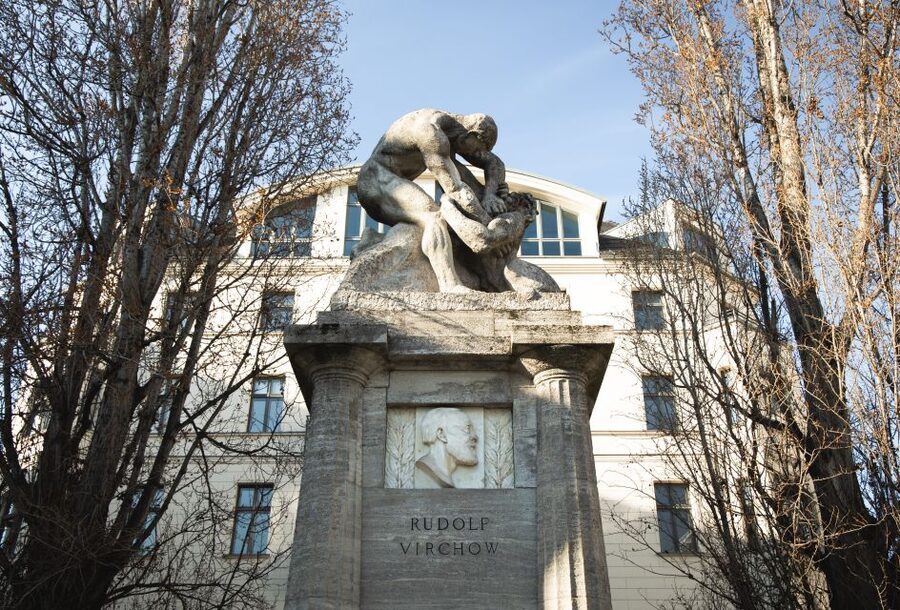
The route is especially useful if you want more than a list of famous names. Berlin medicine was shaped by doctors who worked in hospitals, taught students, carried out research, and competed over new ideas. Your guide explains that world through figures such as Rudolf Virchow, Emil von Behring, Robert Koch, and Ferdinand Sauerbruch.
Virchow is a key name in the story. He is closely associated with modern pathology and with the idea that disease should be studied through careful scientific investigation. Koch is tied to the study of infectious disease, while Behring is remembered as a Nobel Prize-winning pioneer in immunology. Sauerbruch represents another period of surgery and medical innovation.
The value here is not simply hearing a roll call of scientists. You get a sense of how medical progress was built by people working in a particular city, at particular hospitals and schools. If you already know some of these names, the walk helps connect them to place. If you do not, the guide provides a useful introduction without requiring a medical background.
Because this is a walking tour, you should expect the story to unfold outdoors for much of the time. Wear comfortable shoes and prepare for ordinary Berlin conditions. The route is not presented as a visit through hospital wards, operating rooms, or laboratories.
Famous scientists and the human cost of progress

The strongest part of the tour is likely to be its balance between achievement and consequence. Berlin’s medical history includes Nobel Prize winners and major scientific advances, but it also includes error, ambition, institutional power, and suffering.
The guide discusses the lives and work of important doctors while also addressing the darker years when Charité doctors cooperated with the Nazi regime. That subject can be uncomfortable, but it belongs in any honest account of the institution.
I appreciate that the tour does not treat science as automatically noble. Medical knowledge can save lives, yet doctors and hospitals still operate within political systems. The Nazi period shows how professional status and scientific authority can be placed in the service of a criminal state.
You should know this before booking if you want a light sightseeing activity. The tour includes moving stories about life and death, and its serious sections may stay with you longer than the architectural details. That is also what gives the experience more weight than a standard city walk.
More History Tours in Berlin:
- Berlin’s Best: 2 Hour Walking Tour Third Reich and the Cold War
★ 5.0 · 5,486 reviews - Third Reich Berlin: Hitler and WWII Walking Tour
★ 5.0 · 3,301 reviews - Berlin: Third Reich, Hitler, and WWII Walking Tour
★ 4.9 · 1,757 reviews - Berlin: 3-Hour World Heritage Cruise to Potsdam
★ 4.5 · 1,569 reviews
Entering the Animal Anatomical Theatre
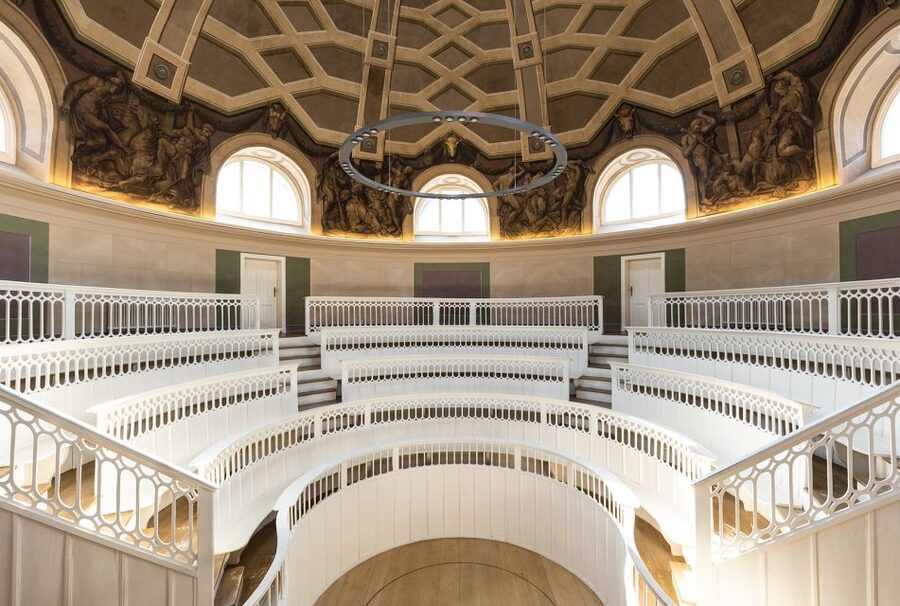
The final indoor stop is the Animal Anatomical Theatre, often referred to as the TAT. It is described as Berlin’s oldest surviving teaching building, and its location in a backyard adds a sense of surprise to the route.
This is the one place where the tour moves beyond exterior viewing. The building gives you a physical link to the teaching of medicine and anatomy in earlier centuries. Its purpose was educational, but the setting also reveals how medical training once took place before modern hospitals and classrooms took their current form.
I would consider this the tour’s main visual reward. Much of the walk deals with names, events, and institutions. The theatre gives those ideas a room of their own, allowing you to see the kind of setting in which medical knowledge was passed from teachers to students.
Opening hours can change at short notice because of closed events, and the building is closed on public holidays. Check the date before you book, particularly if the theatre is the main reason you want to go. If it is unavailable, the rest of the walk still covers substantial material, but the experience will lose its most distinctive interior stop.
What you will not see inside
The tour’s boundaries are important enough to repeat. You do not enter the Charité Bed House, and group tours cannot access the Charité Campus Mitte hospital grounds.
This makes the activity a history walk around the institution, not a hospital tour. You will not see patient areas or working clinical departments. That restriction protects the normal operation of the hospital and respects medical privacy.
Some people will see this as a drawback. If you want rare access to the present-day Charité, this is not the right booking. If you want a guided account of how the institution came to matter, the exterior route is enough to provide a strong setting.
The contrast between the active hospital and the old teaching theatre is also useful. One is a current medical facility with strict rules. The other is a preserved historical space that can receive visitors. Together, they show how much medical education and hospital life have changed.
How the German-language format affects the experience
The live guide conducts the tour in German. That makes the activity a natural fit for German speakers, including Berlin residents who want to learn more about familiar buildings and streets.
The available feedback describes the guide as engaging, clear, and strong in delivery. One German participant specifically found the tour worthwhile even as a Berliner, while another praised the amount learned and the guide’s rhetoric. Those details suggest that the tour is not aimed only at first-time visitors. A local can gain a new way to read the older Charité buildings.
If your German is limited, the language may be the decisive issue. The subject depends on names, dates, medical terms, and the careful explanation of difficult history. You might still enjoy the walk visually, but you would miss much of its value without enough German to follow a sustained spoken presentation.
No guide name is provided for this activity, so I would not book expecting a particular individual. The quality depends on the guide assigned that day, but the consistently positive comments about clarity and information make the presentation a central strength.
Is $28 a fair price?
At $28, the tour sits in a reasonable range for a two-hour specialist walk. You are paying for a live guide, a focused subject, and access to the Animal Anatomical Theatre when it is open.
The value is strongest if you enjoy medical history, university culture, science, or the less familiar side of Berlin. You get more than a view of a famous hospital. The walk explains why the institution matters and introduces several figures whose work changed medicine.
The value is weaker if you want a broad overview of Berlin or a tour packed with major postcard sights. This is a narrow subject, and the hospital itself is mostly seen from the outside. You are paying for interpretation rather than a long list of entrances and monuments.
The two-hour format also makes it easy to fit into a wider Berlin plan. Free cancellation up to 24 hours before the start gives you some flexibility, and the reserve-now, pay-later option means you do not have to pay at once. The tour starts on time, so do not cut the journey to the meeting point too close.
Who should book this Charité walk?
I would recommend it to you if you enjoy the stories behind institutions. It suits visitors who want to understand Berlin’s scientific life, as well as residents who have seen Charité buildings without knowing their background.
It is a good choice for anyone interested in:
- Medical history and famous scientists
- Nobel Prize winners and university research
- The history of hospitals and medical teaching
- Berlin’s Nazi-era past
- Unusual historic buildings
- Serious, guide-led walking tours in German
Families with older children may also find the subject worthwhile, though the life-and-death themes and Nazi history call for mature interest. I would not choose it for very young children who need a fast-moving sightseeing route.
You should also book with realistic expectations about pace and access. This is not a theatrical reenactment, a museum-only visit, or a modern hospital tour. It is a thoughtful walk that spends much of its time outdoors and ends in a historic teaching building.
Should you book it?
Book this tour if you want a focused, serious look at Berlin through medicine. The combination of Charité history, major scientists, Nazi-era responsibility, and the Animal Anatomical Theatre gives the two hours a clear purpose.
Skip it if you need an English-language tour, want to enter the hospital, or prefer Berlin’s grand sights and light entertainment. For German speakers with curiosity about science and the city’s less obvious past, $28 is a sensible price for a well-structured introduction.
FAQ
How long is the Berlin Charité Guided History Tour?
The tour lasts two hours.
What language is the tour conducted in?
The live tour guide conducts the experience in German.
Where does the tour meet?
You meet in front of the Charité Tower at the crossroads of Schumannstraße, Charitéplatz, and Charitéstraße.
Can the tour enter the Charité Bed House?
No. The Bed House is viewed from outside because it is a working hospital with protection and hygiene regulations.
Can group tours enter the Charité Campus Mitte grounds?
No. The hospital grounds are not accessible for group tours.
Does the tour visit the Animal Anatomical Theatre?
Yes. The tour visits the Animal Anatomical Theatre, Berlin’s oldest surviving teaching building, from the inside when it is open.
Is the Animal Anatomical Theatre open on public holidays?
No. The TAT is closed on public holidays, and its opening hours may also change at short notice for closed events.
Can I cancel for a full refund?
Yes. You can cancel up to 24 hours in advance for a full refund. You can also reserve now and pay later.
Just added around Berlin
- Berlin Food & Cultural Tour: Must-Try German & Berliner Classics★ 5.0 · 51 reviews
- Berlin Half-Day World War II Walking Tour★ 4.5 · 48 reviews
- Small-Group Historical Bike Tour in Berlin★ 4.5 · 103 reviews
- Historic center of Berlin – Tour in Italian★ 5.0 · 143 reviews
- Berlin Cold War & World War II Third Reich Walking Tour★ 4.5 · 30 reviews
- Berlin Wall and Cold War Bike Tour in Small Groups★ 5.0 · 114 reviews
- Private Tour: Jewish Heritage Walking Tour of Berlin★ 5.0 · 29 reviews
- Private Taxi Tour City East & West History and Architecture 3-4h★ 5.0 · 42 reviews
Berlin History Tours, compared.

Berlin: Third Reich & Cold War Guided Walking Tour
Read our review →
Berlin’s Best: 2 Hour Walking Tour Third Reich and the Cold War
Read our review →
Third Reich Berlin: Hitler and WWII Walking Tour
Read our review →
Berlin: Third Reich, Hitler, and WWII Walking Tour
Read our review →
Berlin: 3-Hour World Heritage Cruise to Potsdam
Read our review →
Cold War, Berlin Wall, Spies and the East Side Gallery
Read our review →
Berlin: History of the Third Reich Guided Walking Tour
Read our review →
Browse the lists this tour appears in