Review · NAPLES
Herculaneum Private Tour with an Archaeologist
Herculaneum gives you something Pompeii often cannot: a close look at Roman domestic life, with wooden details, painted rooms, courtyards, and household spaces still visible. A private guide helps you read the town as more than a collection of old walls, explaining how people lived, worked, bathed, and worshiped before Mount Vesuvius buried the city.
I like the private format, which lets you ask questions and set the pace with your own guide. I also like the clear two-hour route through major houses, the baths, and the waterfront terrace, with guides such as Mena, Sara, Luciano, Daniela, and Antonella earning especially warm praise for their storytelling and subject knowledge.
The main consideration is price. At $178.38 per person, this is a serious spend, and the €16 adult entry ticket is not included. There is also some uncertainty over the advertised archaeologist qualification, since at least one guide was described as a historian or teacher rather than a practicing archaeologist.
Key points to know before booking
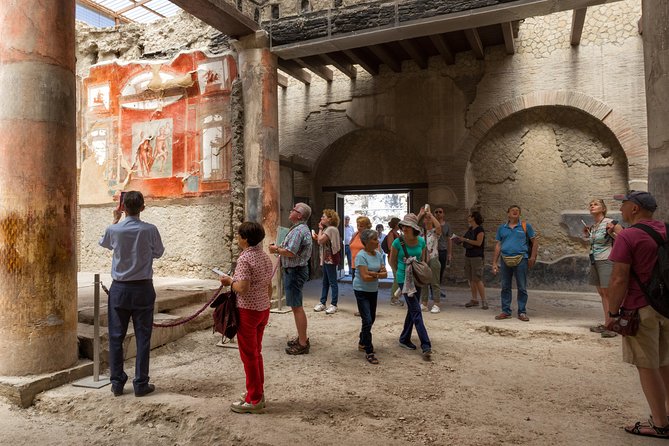
- Herculaneum is smaller than Pompeii but unusually well preserved, making two hours enough for a focused introduction.
- You visit eleven important locations, including the House of the Wooden Partition, the Central Thermae, and the House of the Deer.
- The private guide is the real value, especially if you want Roman daily life explained rather than simply pointed out.
- Entrance tickets cost extra, at €16 for adults and €2 for EU citizens aged 18 to 25.
- Early visits are wise in summer, since the site can become very hot by noon.
- A free luggage store is available at the meeting point, a useful perk if you are moving between Naples and another destination.
Why Herculaneum rewards a guided visit
Herculaneum was a seaside Roman town destroyed by the eruption of Mount Vesuvius in the first century. Unlike a museum visit, you walk through its streets and enter the homes, baths, and public buildings themselves.
I find the site especially rewarding because its small scale makes it easier to picture ordinary life. The houses are not just foundations. You can see courtyards, wall decoration, doorways, and in some cases preserved wood. A guide can point out what each space was for and explain how the parts fit together.
That help matters here. Without context, a painted room is simply a painted room. With a good guide, you begin to see status, family life, commerce, religion, and social habits in the arrangement of the building.
The private setup also changes the tone. You are not sharing the guide with a large group, so you can ask about a particular decoration, compare Herculaneum with Pompeii, or request a slower pace. Several highly praised guides, including Sara, Luciano, Mena, and Daniela, are described as clear, lively, and able to answer questions at both a basic and advanced level.
More Ancient History Tours in Italy
- Herculaneum: Skip-the-Line Guided Tour with Archaeologist
★ 4.8 · 3,439 reviews - Herculaneum Small Group Tour and Ticket With an Archaeologist
★ 5.0 · 994 reviews - From Naples: Pompeii & Herculaneum with Archaeologist Guide
★ 4.8 · 665 reviews
Meeting at the red ticket-office building
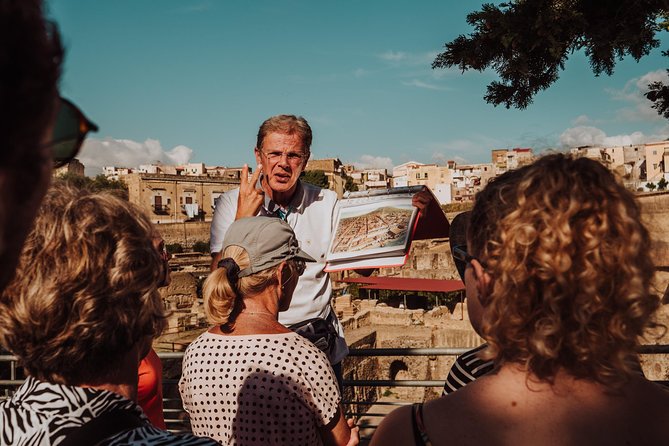
The tour begins outside the archaeological site’s ticket office, a red building on Via dei Papiri Ercolanesi in Ercolano. This is also where the tour ends.
You must arrange your own transportation and buy your own entrance ticket. The adult price is €16, while EU citizens aged 18 to 25 pay €2. Since the guide fee does not cover admission, add that cost when comparing this experience with a standard entry ticket or a larger group tour.
The meeting area has a free luggage store, which can make this tour practical on a travel day. You can leave bags before heading into the ruins, though you should confirm the exact storage arrangements when booking.
The site is near public transportation, so the location is reasonably practical if you are coming from Naples or another nearby base. Transportation is not provided, and food and drinks are also your responsibility.
The College of the Augustales
The first stop is the College of the Augustales, a religious building linked to the worship of the emperor. Your guide uses it to explain how public religion and civic identity worked in Roman towns.
The value of this stop is not just the building itself. It gives you an early look at the connection between politics, religion, and local status. In a guided visit, details that might seem decorative or obscure can be tied to the larger social system.
The planned time is about ten minutes. That is enough for an introduction, though not enough for a long archaeological lecture. If this is an area that interests you, use the private format to ask your guide for more context.
The House of the Skeleton and the Relief of Telephus
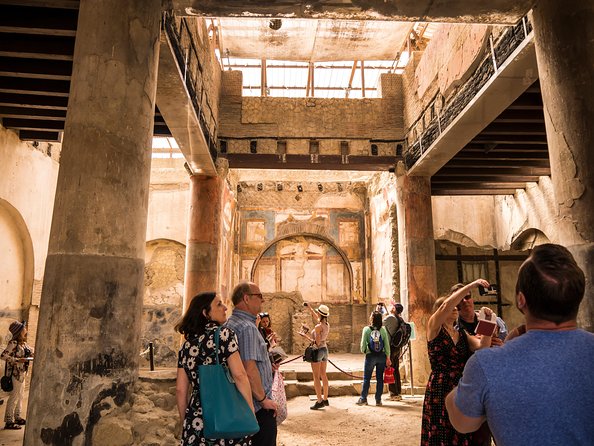
The House of the Skeleton follows, with about ten minutes set aside. Its name alone makes it memorable, but the larger value is the chance to see how a private residence was arranged and how archaeologists interpret clues left inside it.
Next comes the House of the Relief of Telephus, also known as Casa del Rilievo di Telefo. This home is important for its decorative detail and its connection to Roman taste. The relief of Telephus gives your guide a useful opening to discuss mythology, art, and the way wealthy households displayed culture.
These two stops show why a guide is useful at Herculaneum. You are not simply moving from one doorway to the next. You are comparing different homes and noticing how decoration, layout, and status may have varied from one household to another.
More Ancient History Tours in Naples
- From Naples: Ruins of Pompeii
★ 4.3 · 204 reviews - Naples: Pompeii Archaeology Park Tour & Skip-the-Line Entry
★ 4.8 · 190 reviews - Pompeii: Private Tour with an Archaeologist
★ 4.9 · 168 reviews - Pompeii and Herculaneum led by an Archaeologist with private transport
★ 5.0 · 78 reviews
The House of the Wooden Partition
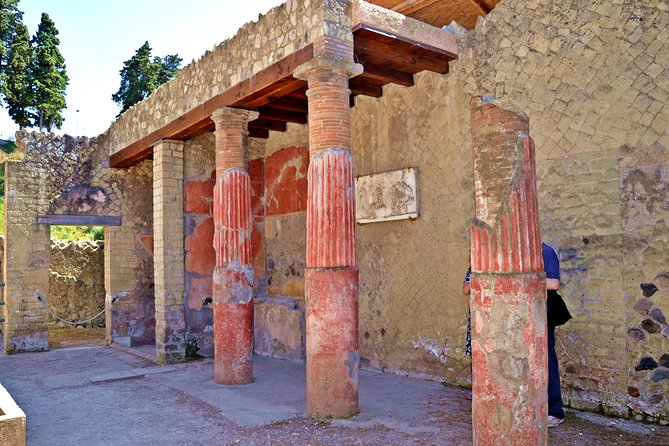
The House of the Wooden Partition is one of the most appealing stops on the route. Its name points to an unusually preserved wooden feature, a reminder that Roman buildings were not made only of stone and brick.
That surviving wood helps correct the common picture of the ancient world as entirely hard and bare. Roman homes included timber doors, partitions, furniture, and fittings, but those materials rarely survive at archaeological sites.
I would pay close attention here and ask your guide to explain how the partition worked within the house. This is the sort of detail that can turn a short stop into one of the most memorable parts of the visit.
The Terrace of M. Nonio Balbo
The Terrace of M. Nonio Balbo gives the tour a change of pace. Rather than focusing only on interior rooms, you get a sense of public space, display, and the town’s connection with an important local figure.
M. Nonio Balbo was a prominent Roman associated with Herculaneum, and the terrace linked to his memory helps show how public honors worked. Your guide can explain why statues, memorials, and prominent positions mattered in Roman civic life.
This stop also helps break up the sequence of houses. Two hours can pass quickly, but the route has enough variety to keep the visit from feeling like a long chain of similar rooms.
The House of the Black Salon and Samnitic House
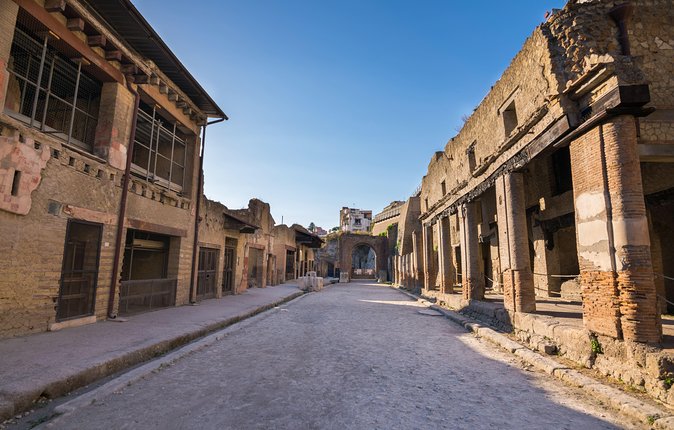
The House of the Black Salon, also called the House of the Salon of Nero, offers another look at decorated domestic space. The dark-toned room gives the house its name and lets your guide discuss color, style, and the way rooms were designed to impress.
Do not expect every room to be open or equally easy to view. Archaeological access can vary, and the value of the stop depends partly on what is visible on the day of your visit. A private guide can still give you useful context even when you cannot linger in every area.
The Samnitic House follows. Its name reflects an older cultural layer connected with the Samnite people, who lived in the region before Roman rule became dominant. This makes the house useful for understanding that Herculaneum was not created as a purely Roman town from the beginning.
The pairing of these two stops gives you a helpful contrast: one focuses on room decoration and household presentation, while the other points toward the town’s earlier identity and changing political world.
The Central Thermae
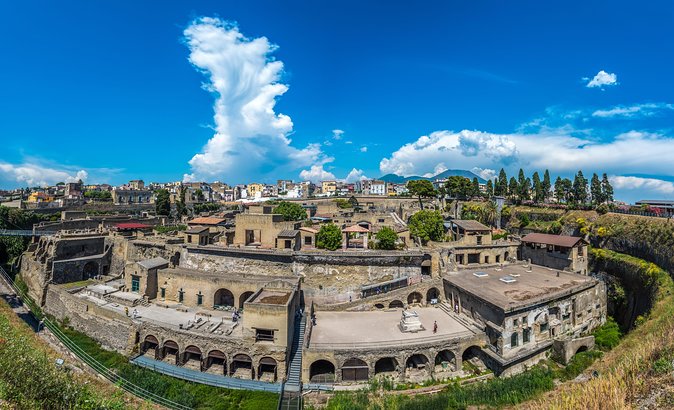
The Central Thermae, or central public baths, are one of the most important stops for understanding everyday Roman life. Bathhouses were not just places to wash. They were social spaces where people met, relaxed, and followed a familiar sequence of rooms and temperatures.
Your guide can explain the function of the different areas and how Roman bathing worked. This is also a good place to ask questions about who used the baths and how public facilities fit into town life.
The bathhouse is especially useful for visitors who want more than famous houses. It shows the shared infrastructure of Herculaneum and offers a glimpse of the services that made urban life possible.
The Fine Courtyard and Grand Portal
The House of the Fine Courtyard, or Casa del Bel Cortile, returns the focus to private architecture. Courtyards helped bring light and air into homes and could serve as an organizing feature for rooms around them.
A guide can help you notice how movement through the house may have worked. Roman homes were shaped by social rank, hospitality, work, and privacy, and the arrangement of rooms often tells part of that story.
The House of the Grand Portal is another domestic highlight. Its impressive entrance suggests that the front of a home could communicate wealth and status before you even stepped inside.
These stops are short, about ten minutes each, so do not expect an exhaustive architectural study. Instead, think of them as carefully chosen examples that give you a broad picture of domestic life across Herculaneum.
The House of the Deer
The final listed stop is the House of the Deer, one of the route’s most attractive and important residences. Its name comes from decorative elements connected with deer, and the house helps show how large homes could combine rooms, open areas, and views toward the coast.
This is a strong place to finish because it brings together several themes from the tour: wealth, decoration, domestic comfort, and the connection between the town and its coastal setting. Your guide can help you see how the building differed from more modest homes.
After the formal route, the tour ends back at the meeting point. The planned visit lasts about two hours, though the exact pace can depend on questions, site conditions, and how much time your guide spends at each location.
What the guide adds to the experience
The strongest part of this tour is the person leading it. The best guides do not simply recite dates. They explain how the buildings worked and put human activity back into the rooms.
Mena is repeatedly praised for making the site approachable and bringing a human face to the houses, shops, and baths. Sara is described as an archaeologist with strong knowledge of Herculaneum and Pompeii, and as someone who can explain the site at either a simple or advanced level.
Luciano is especially well suited to visitors who enjoy history. His tours are described as lively, detailed, and full of stories about the people who once lived in the town. Daniela, Antonella, Giuseppe, Luca, Jasmine, Nicoletta, Ivan, Giulio, and Alessia are also named as guides who provided strong explanations and friendly service.
There is one point to check before you pay a premium: the title promises an archaeologist, but not every assigned guide may hold that exact professional credential. Some descriptions identify guides as historians or teachers. They may still be excellent guides, but if the qualification is central to your decision, ask Askos Tours to confirm who will lead your visit.
Is $178.38 per person good value?
This is expensive for a two-hour site visit, especially because the entrance ticket is separate. For one person or a couple, the price can feel hard to justify if you only want a quick look at the ruins.
The calculation improves for families or small groups that value private attention. Since only your group participates, you can ask questions freely, avoid being tied to a large group’s pace, and focus on the parts that interest you most.
Group discounts are available, though the exact saving is not stated. Check the price for your party size before booking. A larger family group may get much better value than two people booking separately.
I would also compare this tour with a standard entrance ticket. If you already know Roman archaeology well and prefer to read signs at your own pace, you may not need a private guide. If you want the buildings explained clearly, the extra cost can be worthwhile, particularly at a site where the remains are impressive but not always self-explanatory.
Timing, heat, and family appeal
The tour is offered at several times during the day, which makes it easier to fit into a Naples itinerary. In summer, I would choose the earliest available start. One guide specifically recommended an early visit because the site can be very hot by noon.
Two hours is a sensible length for families. It is long enough to cover major highlights without requiring an entire day underground or among the ruins. Children who like stories about Roman homes, baths, and the eruption may enjoy the visit, especially with an engaging guide.
Most people can participate, and service animals are allowed. One guide was praised for taking care with a person who had limited mobility, but the supplied details do not promise full accessibility at every point. If mobility is a concern, ask about the route before booking.
Who should book this private tour?
I would choose it for you if you want a clear introduction to Herculaneum, prefer a private setting, or are visiting with family members who will ask different kinds of questions. It also suits anyone comparing Herculaneum with Pompeii and wanting help understanding why the two sites feel different.
History students and serious Roman-history fans should confirm the guide’s credentials in advance. The tour can still be excellent with a strong historian or teacher, but the word archaeologist carries a specific meaning, and the price makes that distinction worth checking.
I would skip it if you are trying to keep costs low, already have strong archaeological knowledge, or plan to spend many hours exploring independently. In that case, put the €178.38 toward other parts of your Naples trip and buy admission on your own.
Should you book it?
Book this tour if you want Herculaneum explained rather than merely seen. The private guide, focused route, and well-preserved homes make the experience especially good for first-time visitors and families.
Before paying, confirm the assigned guide’s credentials, add the €16 entrance fee to your budget, and choose an early time in hot weather. If Askos Tours can provide an archaeologist such as Sara or Michele, or another guide with equal site expertise, the private format is easier to justify. If not, this remains a potentially excellent guided visit, but not necessarily at the premium price suggested by the title.
FAQ
Where does the tour meet?
You meet the guide outside the ticket office of the Herculaneum archaeological site, at the red building on Via dei Papiri Ercolanesi, 80056 Ercolano, Italy.
Where does the tour end?
The activity ends back at the meeting point.
How long does the tour last?
The tour lasts approximately two hours.
Is the Herculaneum entrance ticket included?
No. Admission is separate and costs €16 for adults. EU citizens aged 18 to 25 pay €2.
Is transportation included?
No. You must arrange your own transportation to and from the meeting point.
Is this a private activity?
Yes. Only your group participates in the tour.
Is the tour offered in English?
Yes. The experience is offered in English.
Can I cancel for a full refund?
Yes, if you cancel at least 24 hours before the experience start time. Cancellations made less than 24 hours in advance are not refunded, and changes within that period are not accepted.
More Archaeological Site Tours in Naples
- Naples Walking Tour with Underground Roman Ruins Ticket
★ 4.5 · 510 reviews - Naples: City Walking Tour w/ Underground Roman Ruins Ticket
★ 4.6 · 284 reviews - Naples: National Archaeological Museum Tour & Digital Guide
★ 4.2 · 177 reviews - Naples: National Archaeological Museum audio guide
★ 4.0 · 155 reviews
More Private History Tours in Italy
- Pompeii and Herculaneum Private Walking Tour with an Archaeologist
★ 5.0 · 77 reviews - Naples Archaeological Museum 2-Hour Guided Private Tour
★ 5.0 · 51 reviews - Pompeii: Exclusive Tour with Archaeologist and Entry Tickets
★ 4.9 · 634 reviews - Ancient Ostia Antica Semi-Private Day Trip from Rome by Train with Guide
★ 4.5 · 579 reviews
Just added around Naples
- Naples: National Archaeological Museum Tour & Digital Guide★ 4.2 · 177 reviews
- Naples: City and Lapis Museum Tour with an Archaeologist★ 4.5 · 29 reviews
- Naples: Pompeii Archaeology Park Tour & Skip-the-Line Entry★ 4.8 · 190 reviews
- Naples: Historic City Center Guided Walking Tour★ 4.7 · 38 reviews
- Naples: Monuments and Historic District Self-Guided Tour★ 4.0 · 50 reviews
- Naples Archaeological Museum 2-Hour Guided Private Tour★ 5.0 · 51 reviews
- Naples: National Archaeological Museum audio guide★ 4.0 · 155 reviews
- Pompeii and Herculaneum Private Walking Tour with an Archaeologist★ 5.0 · 77 reviews
Naples History Tours, compared.
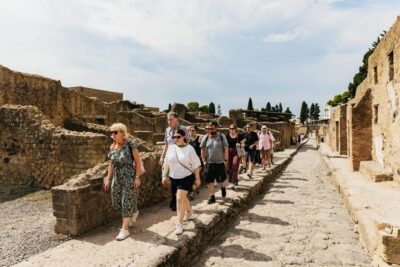
Herculaneum: Skip-the-Line Guided Tour with Archaeologist
Read our review →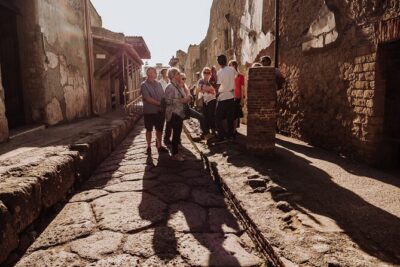
Herculaneum Small Group Tour and Ticket With an Archaeologist
Read our review →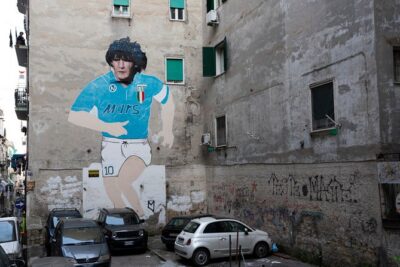
Naples Spanish Quarters Walking Tour Street Art, Folklore & Sweet
Read our review →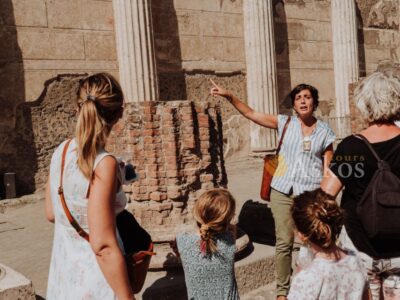
From Naples: Pompeii & Herculaneum with Archaeologist Guide
Read our review →
Naples: Street Art & History Tour in the Spanish Quarters
Read our review →
Naples Walking Tour with Underground Roman Ruins Ticket
Read our review →
Naples Panoramic Walking Tour: From the Hills to the Center
Read our review →