
Review · WARSAW
Warsaw for WWII Buffs – private tour with hotel pickup
Warsaw’s WWII story is best understood by moving through the city itself, where a wall fragment, ruined tenement, or quiet monument can explain more than a room full of dates. This private tour connects the Nazi occupation, the Warsaw Ghetto, the 1944 Uprising, and the Soviet takeover in one focused three-hour ride.
I like the retro Żuk minibus, which gives the outing a distinctly Polish feel, and I like the way the private format lets guides such as Marcin, Karol, Tom, Konrad, and Martin adjust the discussion to your interests. The main drawback is that three hours goes quickly, especially if you want long stops or detailed conversations at every site.
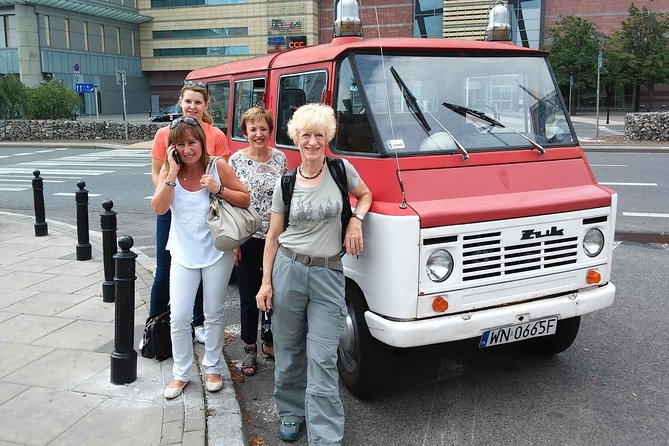
- A 1970s-era Żuk minibus provides transport between the stops, though some vehicles lack air conditioning and seat belts.
- The former Warsaw Ghetto is presented through surviving wall fragments, Waliców Street, Chłodna Street, and Muranów.
- The 1943 Ghetto Uprising and 1944 Warsaw Uprising receive separate attention, helping you understand two very different acts of resistance.
- Hotel or apartment pickup is available within 3 kilometers of central Warsaw, but transfer time counts toward the three-hour tour.
- Private touring makes the history conversational, with room for questions, personal interests, and extra context about postwar communist Poland.
- The $169.38 per-person price makes the most sense for a small group that values a private guide and door-to-door convenience.
A Fast, Focused Introduction to Warsaw’s Wartime Story
This is not a museum tour with a few outdoor stops added on. You spend most of the time traveling between sites, getting out for short walks, and using the streets of Warsaw as your classroom.
The opening sets the political stage. You learn about the German invasion of Poland in 1939, the Soviet attack from the east soon afterward, and the pressure these two powers placed on Polish society. That background matters because Warsaw’s wartime story is not only about German occupation. It also includes Soviet deportations, executions, the Katyń massacres, and the postwar imposition of communist rule.
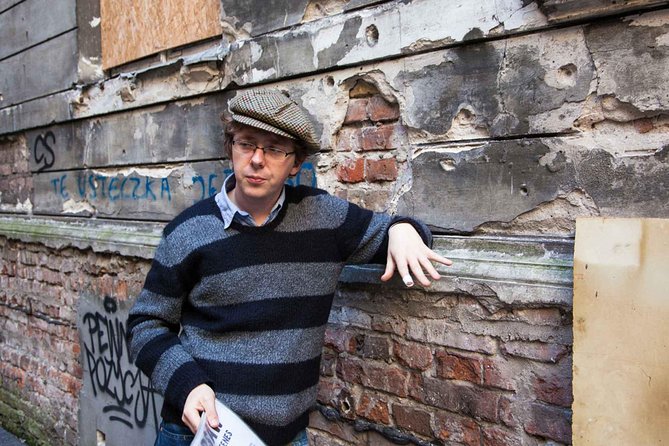
The guide’s role is central. Names mentioned by past participants include Marcin, Karol, Tom, Konrad, Martin, Marek, Lukas, Lucas, and Rocky, but you are not guaranteed a particular person. The strongest guides use photographs, answer questions in clear English, and turn the tour into a conversation rather than a lecture.
That private setup is useful if you already know the basic WWII story. You can ask about the Warsaw Ghetto, the Home Army, the Soviet advance, or how the city was rebuilt after 1945. If you know little about the period, the guide can provide the framework first.
Riding Warsaw in a Retro Żuk
The vehicle is part of the experience. The Żuk was a Polish utility minibus associated with the communist era, and riding in one adds a local historical note before the first memorial appears.
Each minibus holds up to eight people, and the operator has a fleet of five. That keeps the group small, though the word vintage also means practical limits. The minibuses are primarily used to move between locations, not as a continuous sightseeing cabin.
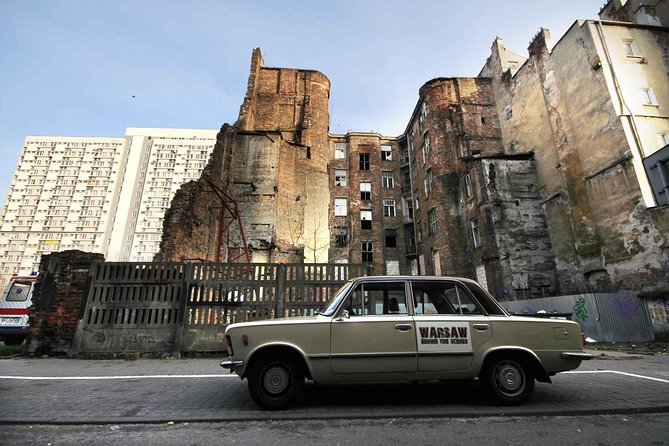
Some vehicles do not have air conditioning, and some lack seat belts because of their historic status. Heating is provided in winter. The ride can be bumpy, and getting in and out may be awkward for a small older passenger. One account specifically noted uncomfortable seats and a vehicle that felt more like a minivan than the car shown in promotional material.
If the exact vehicle matters to you, ask before booking. The supplied information identifies the transport as a retro Żuk minibus, but the fleet may not be identical from one departure to another. Wear comfortable shoes and clothing because the tour includes repeated walking segments.
More Private History Tours in Poland
- Private Tour: Warsaw’s Jewish Heritage by Retro Fiat
★ 5.0 · 208 reviews - Private Historical Tour of Warsaw by a Retro Fiat with Pickup
★ 5.0 · 190 reviews - Private Tour: Warsaw’s Communist History by Retro Fiat
★ 5.0 · 115 reviews
Warsaw Before the War and Under Two Occupations
The first portion gives you a short orientation to central Warsaw and the events of 1939. Poland was attacked by Germany on September 1, followed by the Soviet invasion from the east on September 17. The two occupations produced different systems of repression, but both reshaped Polish life.
This opening is brief, yet it prevents the rest of the tour from becoming a string of disconnected memorials. You begin to see why Warsaw developed such a strong underground movement, and why the city’s resistance cannot be explained without discussing both Germany and the Soviet Union.
The guide also connects wartime events to what followed. After Germany’s defeat, Soviet forces entered the largely destroyed city and Poland moved into decades of communist rule. That wider frame is one of the tour’s real strengths, especially if you want more than a narrow account of military events.
Waliców Street and the Surviving Ghetto Wall
The Warsaw Ghetto was created by Nazi Germany in 1940. Nearly half a million people were forced into a confined area, while the prewar Jewish population of Warsaw had been roughly 300,000.
At first glance, the surviving wall fragment can seem small and easy to miss. That is precisely why a guide helps. The wall survives between modern buildings and along old property lines, so you need someone to explain where the boundary ran and how the city was divided.
Waliców Street offers another powerful reminder. A ruined tenement remains as a kind of open wound in the modern city, with a fragment of the ghetto wall preserved nearby. You are not looking at a grand memorial complex here. You are looking at a damaged piece of an ordinary street, which makes the scale of the destruction harder to push aside.
The stop is free, but it is not light. The tour deals directly with persecution, confinement, deportation, and murder. If you prefer a gentler sightseeing outing, this may feel intense. If you want a serious account of Warsaw’s wartime experience, the direct approach is appropriate.
Chłodna Street and the Bridge Between Two Ghettos
Chłodna Street once divided the ghetto into two sections. It remained important for east-west traffic, and a wooden bridge was built near the junction with Żelazna Street to connect the two parts.
The bridge reached the third floor of nearby buildings. Trams, German military vehicles, and cars passed underneath while Jewish residents were forced to move above the street. Photographs of the bridge make the arrangement easier to picture, and a guide can explain how this piece of infrastructure became a symbol of forced separation.
You spend only about ten minutes here, so do not expect a long walk or a large preserved structure. The bridge is gone. What remains is the street pattern and the explanation, which show how normal city movement continued around a population being isolated and persecuted.
More WWII and D-Day Tours in Poland:
- Amsterdam: Life of Anne Frank and World War II Walking Tour
★ 4.8 · 10,467 reviews - Berlin: Third Reich & Cold War Guided Walking Tour
★ 4.9 · 8,378 reviews - Normandy D-Day Sites & Cemetery Day Trip from Paris with Lunch
★ 5.0 · 6,877 reviews - Munich: Third Reich & WWII Walking Tour
★ 4.6 · 6,181 reviews
Muranów and the City Built Over Ruins
Muranów can look like an ordinary district of apartment blocks. Its present-day appearance hides the fact that it was built over the destroyed ghetto area, and that much of the old neighborhood disappeared during and after the war.
This is one of the places where a good guide changes what you see. Without context, the squared-off buildings may seem unremarkable. With context, the ground beneath them becomes part of the story. The tour helps you read the district as both a living neighborhood and a site of destruction, rebuilding, and memory.
The walk here is short, usually around ten minutes. That brevity is useful on a three-hour itinerary, but it also means you will not explore every corner of Muranów. Think of this as a guided introduction rather than a full neighborhood visit.
The Ghetto Heroes Monument and POLIN Area
The Monument to the Ghetto Heroes marks one of Warsaw’s most important memorial spaces. The first armed clashes of the 1943 Ghetto Uprising took place nearby, and the area now includes the POLIN Museum of the History of Polish Jews.
The tour visits the area of both sites. Admission to the museum is not listed as part of the experience, so do not assume that this three-hour outing includes time inside POLIN. If the museum interests you, plan a separate visit.
The monument and surrounding space also raise questions beyond the fighting itself. They speak to Jewish life before the war, the destruction of the ghetto, the choices made during the uprising, and the long work of remembrance after 1945. The location has also become a place of Polish, Jewish, and German dialogue.
You get roughly twenty minutes here. That is enough to understand the setting and ask questions, but not enough for a museum visit or a detailed examination of every memorial feature.
Soviet Deportations and the Monument to the Fallen in the East
The Monument to the Fallen and Murdered in the East shifts the focus from Nazi crimes to Soviet repression. It honors Poles deported to Siberian labor camps, people killed in executions, and victims of the Katyń massacres.
This stop is important because a tour centered on WWII in Warsaw can easily focus almost entirely on German occupation. The Soviet attack on Poland, deportations, and the later political takeover are essential parts of the Polish account of the war.
The visit lasts about ten minutes. The monument provides a concentrated explanation rather than a long walking tour, and the guide can help place it within the broader story of Poland’s lost eastern territories and postwar silence around Soviet crimes.
The Warsaw Uprising Monument and the City’s Destruction
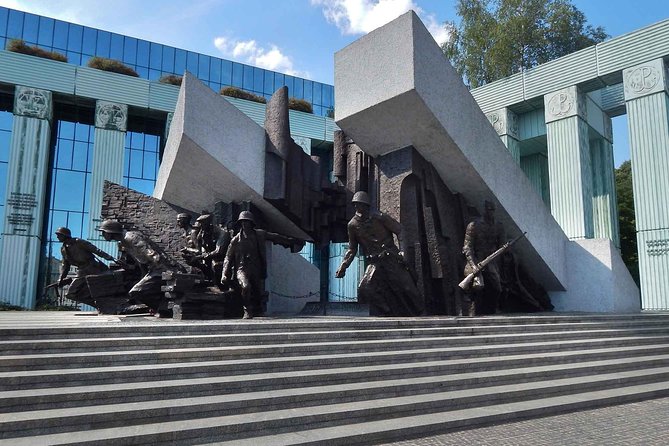
The final major stop concerns the Warsaw Uprising of 1944, when the Polish underground attempted to liberate the capital before Soviet forces arrived. The uprising was defeated, and German forces then destroyed much of what remained of Warsaw.
The Soviet army entered the ruins in January 1945. That timing is central to the city’s painful memory: liberation from Nazi rule was followed by Soviet domination, not the independent Poland the resistance had hoped to restore.
The monument provides a strong ending because it brings together military failure, civilian suffering, deliberate destruction, and the postwar political order. You also gain a better sense of why Warsaw’s rebuilt center can look old while being, in large part, a reconstruction.
What Three Hours Can and Cannot Do
Three hours is a smart length for a busy visit. You cover a wide area without giving up an entire day, and hotel pickup can make the outing easy to fit around other plans.
The trade-off is pace. Most stops last between ten and twenty-five minutes, with the vehicle handling the longer distances. You can ask questions, but a passionate guide may have more to say than the schedule allows. One guide reportedly needed at least four hours to cover everything he wanted to explain.
If you have only a short stay in Warsaw, this format gives you a useful map of the major WWII locations. If you have several days, use the tour as an introduction, then return to places that deserve more time, especially POLIN, Muranów, and the Warsaw Uprising Museum, which is not listed as a stop on this tour.
Is $169.38 Per Person Good Value?
At $169.38 per person, this is not a budget sightseeing ride. The price is easier to justify for a small private group, since you are paying for a dedicated guide rather than joining a large coach.
You also receive hotel or apartment pickup and drop-off within 3 kilometers of the city center. That saves time and removes the need to find an unfamiliar meeting point. Still, pickup and return count toward the three-hour duration. If your accommodation is farther away, meeting in central Warsaw may give you more actual sightseeing time.
The strongest value comes from the personal attention. You can ask about family history, resistance movements, Jewish Warsaw, Soviet repression, or postwar Poland without being limited to a fixed script. For two or more people with a serious interest in the subject, the private format can be worth the extra cost.
Who Should Book This Tour?
I would choose this tour if you want a clear WWII framework, prefer a private guide, and like seeing meaningful sites away from the main postcard stops. It suits history-focused adults, families with older children, and anyone who wants to connect Warsaw’s memorials with the streets around them.
It is also a good fit for visitors who are not yet WWII experts. The guides are described as able to explain the period in an informal, accessible way, and several are comfortable adjusting the route and level of detail.
I would hesitate if you dislike vintage vehicles, need air conditioning, have difficulty stepping into a minibus, or want to spend substantial time inside museums. The emotional material is serious, and the schedule is tight. Bring suitable shoes, and ask in advance about the vehicle if comfort or seat belts are a concern.
Should You Book Warsaw for WWII Buffs?
Book it if you want more than a standard city drive. The combination of ghetto wall fragments, Chłodna Street, Muranów, the Ghetto Heroes Monument, the Soviet memorial, and the Warsaw Uprising Monument gives you a strong three-hour outline of Warsaw’s wartime past.
The best reason to choose it is the guide. Names such as Marcin, Karol, Tom, Konrad, Martin, and Marek appear among the available guiding team, and the experience depends heavily on the person leading your group. Ask whether your guide can tailor the route and which Żuk vehicle will be used.
For a short stay, this is a useful first look. For a full study of Warsaw during WWII, treat it as a starting point and leave time for museums and longer walks afterward.
FAQ
How long does the Warsaw WWII tour last?
The tour lasts approximately three hours, including hotel pickup and drop-off when that service is used.
Where is hotel pickup available?
Pickup and drop-off are available from hotels, apartments, and Airbnb accommodations within 3 kilometers of Warsaw’s city center.
What happens if my accommodation is farther than 3 kilometers away?
The tour operator can suggest the closest practical meeting point if your accommodation is too far away or inaccessible by car.
Is the tour private?
Yes. Only your group participates in the private activity.
How many people fit in each minibus?
Each retro minibus accommodates up to eight passengers. The operator has a fleet of five minibuses.
Is the tour offered in English?
Yes. The tour includes a professional local English-speaking guide.
Does the tour include admission to POLIN Museum?
The tour visits the area of the POLIN Museum and the Ghetto Heroes Monument, but museum admission is not listed as included.
Are children allowed on the tour?
Adults and children over 150 centimeters can book instantly online. For a child under 150 centimeters, contact the operator in advance to ask about a required booster seat.
Can I cancel for a full refund?
Yes. You can cancel at least 24 hours before the local start time for a full refund. Cancellations or changes made less than 24 hours before the start time are not accepted for a refund.
Just added around Poland
- Best of Wroclaw 3-Hour History and Culture Walking Tour★ 4.9 · 49 reviews
- Krakow: Vistula River Cruise with Historical Views★ 3.5 · 357 reviews
- Krakow: Kościuszko Mound Ticket – History & Views!★ 4.4 · 303 reviews
- Krakow Old Town Segway Tour — 2H of History, Fun & Discovery★ 4.8 · 91 reviews
- Warsaw: Historic Private Tour in Retro Fiat★ 4.9 · 41 reviews
- Archaeological Museum of Krakow Entrance Ticket★ 3.8 · 31 reviews
- Private Tour: Warsaw’s Communist History by Retro Fiat★ 5.0 · 115 reviews
- Private Historical Tour of Warsaw by a Retro Fiat with Pickup★ 5.0 · 190 reviews
Warsaw History Tours, compared.
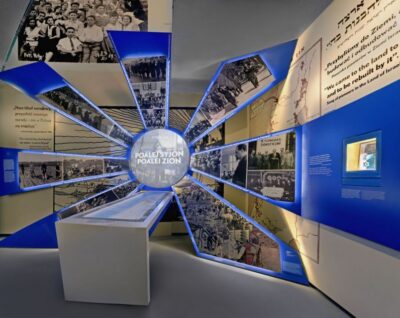
Warsaw: POLIN Museum of the History of Polish Jews Ticket
Read our review →
Warsaw: Chopin Concert at Historical Venue in Old Town
Read our review →
Warsaw: Jewish History Guided Walking Tour in English
Read our review →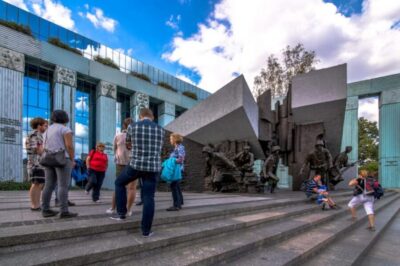
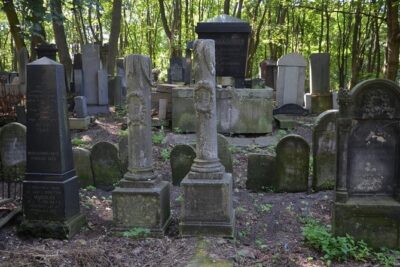
Private Tour: Warsaw’s Jewish Heritage by Retro Fiat
Read our review →
Private Historical Tour of Warsaw by a Retro Fiat with Pickup
Read our review →
Private Tour: Warsaw’s Communist History by Retro Fiat
Read our review →
Browse the lists this tour appears in