
Review · VIENNA
Vienna: Essential History Walking Tour
Vienna’s grand center makes more sense once you know what happened behind its polished façades. This two-hour walk links Roman ruins, Habsburg power, imperial weddings, wartime destruction, and the city’s most famous cathedral in a compact route through the old center.
I like the small groups, which make it easier to ask questions, and I like the guides’ use of stories rather than a dry list of dates. Herbert is often singled out for his humor, iPad visuals, and practical advice about museums, food, wine, and local sights. The main drawback is that the tour spends much of its time around the Hofburg and Habsburg buildings, so it may feel less like a broad survey of all Vienna.
You also need to plan for two hours on foot, in any weather. The tour is not suitable for children under 12 or people with mobility impairments, and entrance fees to places such as the Imperial Treasury or Imperial Crypt are not included.
Key points to know before booking
- Roman beginnings at Michaelerplatz: Start with excavations that show Vienna’s earlier life before the imperial court took over the center.
- Habsburg stories with human detail: Learn why some royal grooms were absent from their own weddings and how the imperial family handled burial.
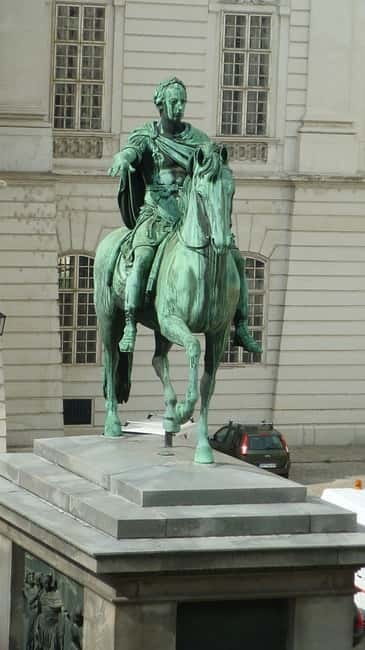
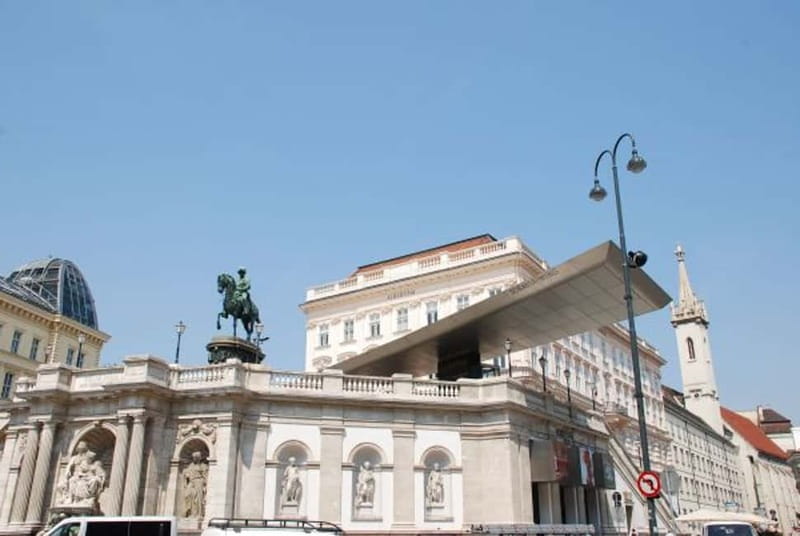
- A compact route: Cover the Hofburg, Heldenplatz, National Library, Albertina, State Opera, Neuer Markt, and St. Stephen’s Cathedral without spending the day walking.
- Strong guide-led interpretation: Herbert, Dorothy, and Wolfgang have led tours noted for clear explanations, dry humor, visual aids, and useful recommendations.
- A useful first-day orientation: The walk helps you decide which museums and interiors deserve your time later, though admission is extra.
- A sober look at the twentieth century: The Albertina and Monument Against War and Fascism bring Vienna’s darker wartime past into the route.
Starting at Michaelerplatz, where Roman Vienna meets the Hofburg
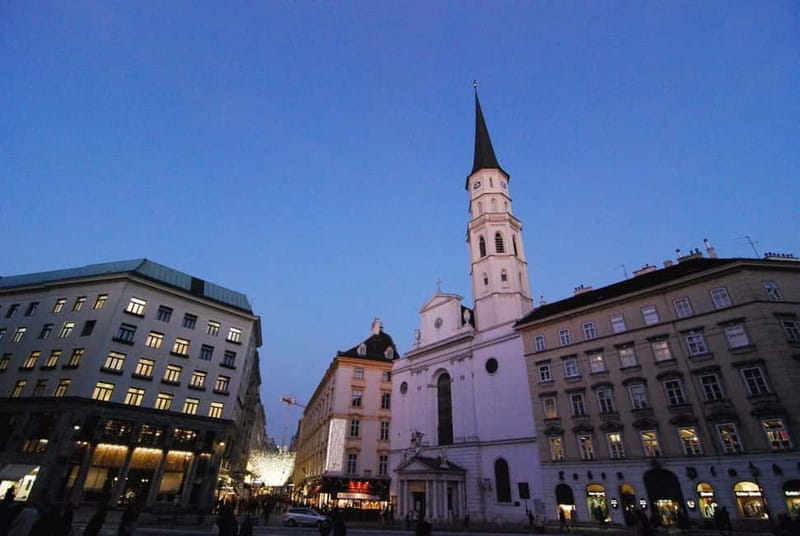
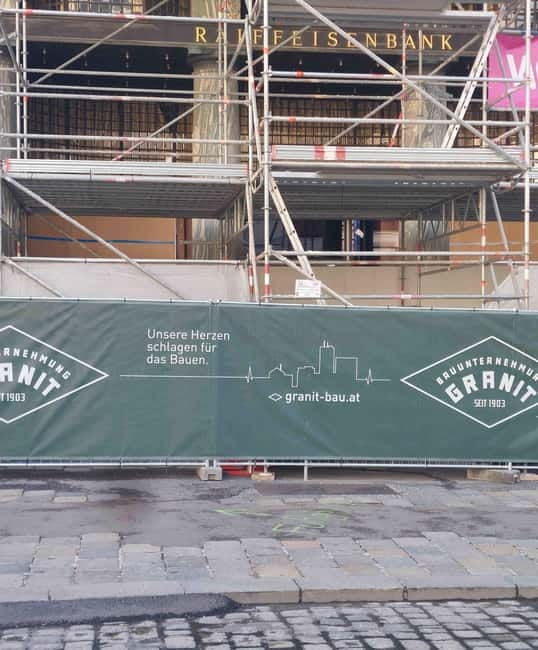
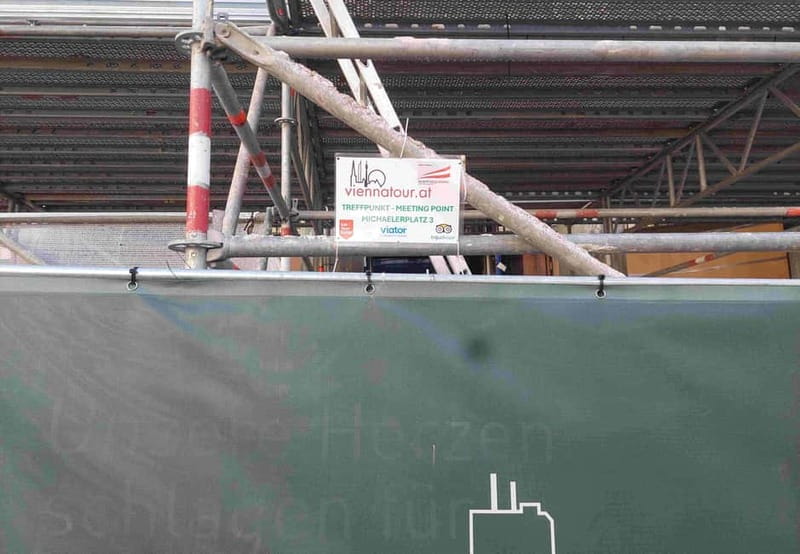
Meet in front of the Loos Haus at Michaelerplatz 3, between Kohlmarkt and Herrengasse. Look for the Raiffeisenbank name on the façade. Herrengasse station on the U3 line is about a three-minute walk away, making the meeting point easy to reach from elsewhere in central Vienna.
The first stop is the Michaelerplatz excavations. This is a smart place to begin because it gives you a physical sense of Vienna before the Habsburgs. Instead of viewing the city only as a parade of palaces, you see that the imperial center grew over earlier Roman foundations.
Your guide also tackles a basic question: why was a castle built here? That question helps explain Vienna’s location and the gradual growth of power around the Hofburg. You do not need a detailed knowledge of Austrian history to follow the story.
The walk then moves to St. Michael’s Church, described as Vienna’s third-oldest church. Its mixture of three architectural styles makes it useful for learning how the city changed over time. You see that Vienna was not built in one grand campaign. Its buildings were altered, extended, and reshaped as tastes and rulers changed.
More History Walking Tours in the world:
- History and Hauntings of Salem Guided Walking Tour
★ 5.0 · 14,564 reviews - Lisbon: History, Stories and Lifestyle Walking Tour
★ 4.8 · 10,902 reviews - Amsterdam: Life of Anne Frank and World War II Walking Tour
★ 4.8 · 10,467 reviews
St. Michael’s Church and the power center of the Hofburg
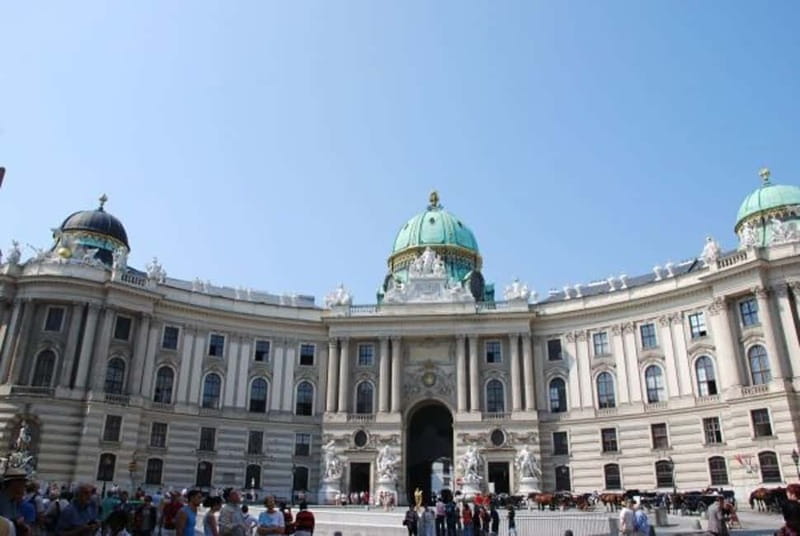
The Hofburg Palace is the tour’s main historical stage. Its grounds cover 555,000 square meters, a scale that is easy to underestimate when you first see the surrounding façades. Your guide explains what the various parts of the complex meant and introduces the rulers who shaped the city.
I find this section especially useful for first-time visitors because the Hofburg can otherwise feel like a series of impressive but disconnected buildings. The guide supplies the links between the palace, the court, the church, the treasury, the library, and the public squares.
The route does not simply tell you that the Habsburgs were powerful. It explains how that power appeared in daily life, ceremony, architecture, and royal custom. Expect anecdotes about rulers and court traditions alongside the larger political story.
This is also where the tour’s focus becomes clear. You are getting an introduction to imperial Vienna, not a full survey of every district, museum, and period in the city. If you want a broad look at neighborhoods beyond the center, this walk will not provide it.
Heldenplatz and the facades of imperial ambition
Heldenplatz, or Heroes’ Square, gives you a better sense of the Hofburg’s scale. The open space is imposing, and the guide explains what lies behind the façades rather than leaving you with a simple architectural photo stop.
The square also helps put Vienna’s rulers into a public setting. The buildings around you were designed to communicate authority, ceremony, and order. Once you understand that purpose, the grand scale feels less abstract.
This is one of the places where a guide’s visual material can help. Herbert has used an iPad to show historical photographs of Vienna and its buildings, including images connected with wartime damage. That kind of comparison lets you see how much of the city’s appearance has changed, and how much has been restored or reconstructed.
The pace is generally manageable. One former participant described the group as only six people, while other accounts refer to similarly small groups. Group size can vary, but the format is intended to be small, which is helpful when the guide is explaining details beside a busy square.
The Imperial Treasury and the National Library
The Imperial Treasury is discussed as one of the places you should consider visiting after the walk. The entrance fee is not included, so treat the guide’s explanation as orientation rather than a visit inside. You learn why the treasury matters and what it contains, then decide if it fits your schedule and budget.
That is an important value of this tour. At $34 per person, you are not paying for a package that includes multiple admissions. You are paying for a live guide who helps you choose which paid sights deserve your time. If you plan to visit even one or two of the suggested museums or collections, the advice can save you from wandering through Vienna without a plan.
The Austrian National Library comes next, including its famous state room. You learn about the symbol on the roof and why the square carries the name of Emperor Joseph II. These are precisely the details that are easy to miss when you walk past on your own.
The library stop also shows the tour’s method. The guide points out a visual feature, explains its meaning, then connects it with a ruler or period. You leave with more than a photograph of an ornate building.
More History Tours in the world:
- Prague: Medieval Dinner with Unlimited Drinks
★ 4.4 · 19,847 reviews - Pompeii: Entry Ticket and Guided Tour with an Archaeologist
★ 4.8 · 19,459 reviews - Athens: Acropolis & up to 5 Archaeological Sites Combo Pass
★ 4.2 · 13,904 reviews - Colosseum: Underground and Ancient Rome Tour
★ 4.7 · 12,691 reviews
Habsburg weddings and the church where the groom might be absent
The route includes the church where Habsburg weddings were held. The church is closed on Sundays and public holidays, so you should not expect the same access on every departure. Even when the interior is unavailable, the surrounding explanation still gives the stop a clear place in the story of the dynasty.
The unusual detail here is the wedding ritual itself. Your guide explains why the groom was not present at some ceremonies. For a family associated with palaces, uniforms, and formal portraits, this kind of odd custom makes the history feel human.
I like this part because it moves beyond dates and succession charts. You hear how royal marriages worked as political arrangements and how ceremony could matter more than personal presence.
You should also keep expectations in check. This is not a dedicated Habsburg wedding tour, and the stop is part of a larger route. The explanation is designed to fit within the two-hour walk rather than provide a full study of dynastic marriage.
The Albertina and Vienna’s wartime scars
The Albertina marks a shift from imperial culture to the darker side of Vienna’s modern past. The museum is known for one of the world’s largest collections of graphic art, but the walk focuses on its place in the city and the surrounding history rather than including museum admission.
Nearby, the Monument Against War and Fascism confronts the consequences of the Second World War. This is not a light sightseeing stop, and it should not be. The monument gives the tour a needed change of tone after the royal anecdotes and grand buildings.
The guide explains what happened to Vienna during the war and how the city’s buildings suffered. Historical images shown on an iPad can make the damage easier to understand, especially when the present-day streets look polished and intact.
This section is valuable because Vienna’s imperial image can hide the violence and political upheaval that followed. You see a city shaped not only by emperors and art, but also by destruction, memory, and reconstruction.
The State Opera, Hotel Sacher, and the lost Carinthian Gate Theatre
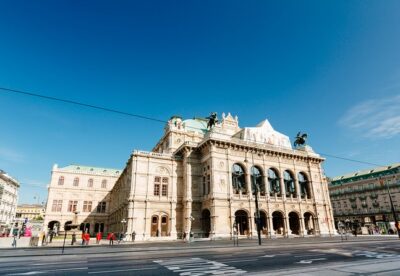
The State Opera brings the walk back to Vienna’s cultural identity. Rather than stopping only for a photograph, you hear why the Hotel Sacher now occupies the site of the former Carinthian Gate Theatre.
That detail captures the tour’s strength: it explains changes in the city that are not obvious from street level. A hotel may look like an ordinary grand building, but its location can reveal an earlier layer of Vienna’s entertainment and urban history.
This part also helps you plan later evenings. The tour gives context for the opera district, but it does not include a performance or admission. You will need to arrange those separately if they interest you.
The guide’s recommendations are useful here and throughout the walk. Advice may include museums, local foods, and Viennese drinks. One specific suggestion from the tour was Gemischter Satz, a Viennese wine style worth remembering if you want to try something local rather than defaulting to familiar Austrian choices.
Neuer Markt and the Imperial Crypt
At Neuer Markt, the Providentia Fountain provides another chance to hear a story attached to an everyday landmark. This is the kind of stop that rewards a guided walk. You might notice the fountain on your own, but without context it can remain just another decorative feature in a city full of them.
The tour then discusses the Habsburg burial ritual and the Imperial Crypt. The crypt is another optional paid sight, not an included entrance. The guide explains why the burial customs were unusual and how the imperial family handled the remains of its rulers.
Again, the value lies in knowing what you are looking at before you pay to enter. If the story catches your interest, you can return with a clearer idea of what the crypt represents. If not, you have still gained useful context without spending part of your limited sightseeing time inside.
The route’s mix of solemn history and dry humor works well here. Several guides, especially Herbert, have been praised for keeping the tone lively without turning the subject into a comedy routine.
Ending at St. Stephen’s Cathedral
The walk ends at Stephansplatz, outside St. Stephen’s Cathedral at Stephansplatz 8A. This is a strong finish because the cathedral is Vienna’s best-known landmark and a practical place to continue sightseeing on your own.
You hear about the cathedral’s partial destruction during the Second World War. The guide also challenges a commonly repeated schoolbook version of its history, reminding you that familiar stories are not always accurate in the details.
The ending is convenient. You are left in the central city, near shops, cafés, transport, and the cathedral itself. You can continue inside if it suits your plan, though that entrance is separate from the tour.
What the $34 price really gets you
At $34, this is fairly priced for a two-hour small-group walk led by a live guide. You are paying for explanation, local perspective, historical connections, and the chance to ask questions. You are not paying for museum tickets, palace interiors, or a full-day sightseeing package.
The value is strongest if you are visiting Vienna for the first time. The tour helps you decide which places deserve a return visit and gives you a basic map of the old center. It can also prevent a common Vienna mistake: spending hours admiring grand buildings without understanding who built them or why they matter.
The price is less attractive if you want extensive interior access. Much of the walk takes place outdoors or beside major sights, with entrance fees extra. You should budget separately for the Imperial Treasury, Imperial Crypt, National Library state room, Albertina, and any other paid attractions you choose.
You also get free cancellation up to 24 hours before the start and the option to reserve now and pay later. Those terms are useful when your Vienna plans are still shifting.
Who will get the most from this walk?
I would choose this tour early in a Vienna visit, ideally on the first or second day. Several people found the recommendations useful for planning later museum visits, and that is where the walk gives you more than a standard photo tour.
It suits adults and older teenagers who enjoy history, architecture, royal customs, and stories about how a city changed. The stated minimum age is 12. It also suits people who want a solid introduction without committing to a half-day or full-day tour.
The walk is less suitable if you need step-free access or have difficulty walking for two hours. It runs in all weather, so wear practical shoes and bring weather protection. Large bags and luggage are not allowed, and you cannot make audio or video recordings.
English and German departures are available. Guides have included Herbert, Dorothy, and Wolfgang. Herbert receives especially frequent praise for his humor, personal manner, visual aids, and broad knowledge of Vienna, but the guide on your date may be someone else.
Should you book the Vienna Essential History Walking Tour?
Book it if you want the imperial center to make sense before you tackle Vienna’s museums. The route is compact, the price is reasonable for a small-group guided walk, and the strongest feature is the human detail: royal weddings without the groom, burial rituals, vanished theaters, wartime damage, and the people behind the palace façades.
Skip it if you want a broad tour of all Vienna, extensive time inside museums, or a route designed for visitors with mobility limits. Also remember that the Hofburg and Habsburg story takes up much of the two hours.
For most first-time visitors who enjoy history, I would book this near the start of the trip. It gives you a useful framework, points you toward worthwhile paid sights, and helps you see central Vienna as a lived-in city rather than a row of impressive buildings.
FAQ
How long does the Vienna Essential History Walking Tour last?
The tour lasts two hours.
How much does the tour cost?
The listed price is $34 per person.
Where does the tour begin?
It begins in front of Loos Haus at Michaelerplatz 3 in Vienna’s first district. The building is between Kohlmarkt and Herrengasse, and the façade carries the name Raiffeisenbank.
How close is the meeting point to public transport?
The meeting point is about a three-minute walk from Herrengasse station on Vienna’s U3 metro line.
Where does the tour end?
The walk ends at St. Stephen’s Cathedral, at Stephansplatz 8A.
Which languages are available?
The tour is offered in English and German.
Are admission tickets included?
No. Entrance fees are not included, including admission to paid sights discussed along the route.
Can children join the tour?
The tour is not suitable for children under 12 years old.
Does the tour operate in bad weather?
Yes. The tour takes place in all weather conditions.
Can I cancel for a full refund?
Yes. You can cancel up to 24 hours in advance for a full refund.
Just added around the world
- Scenic Train ride to historical cities of Morretes and Antonina★ 4.0 · 188 reviews
- 6-Day Cultural Tour to Machu Picchu★ 5.0 · 76 reviews
- Jewish Heritage of Curacao★ 4.5 · 68 reviews
- The Curacao’s Colorful History Walking Tour★ 5.0 · 55 reviews
- Discover Scuba Diving Amathounta’s Ancient Port★ 5.0 · 30 reviews
- Olous – Guided Snorkelling Excursion to Discover Olous Sunken Ancient City★ 4.5 · 31 reviews
- Night Walking Tour of Medieval Cuenca★ 5.0 · 64 reviews
- WWII – The Battle of Crete Day Tour★ 5.0 · 103 reviews
Vienna History Tours, compared.
Skip-the-Line Schonbrunn Palace Guided Tour and Vienna Historical City Tour
Read our review →
Vienna Mozart Concert in Historical Costumes at the Musikverein
Read our review →

Vienna: historical tours with locals in the unknown City,
Read our review →Browse the lists this tour appears in