
Review · TOKYO
Asakusa: A Big-picture History Walk to Know Japan
Asakusa is one of the best places in Tokyo to make sense of Japan. This walk links the Sumida River, Edo’s long isolation, ukiyo-e, Buddhism, Shinto, and the country’s opening to the West into one readable story. I like that you are not simply told what a gate or temple is. You learn why it matters.
I especially like the clear comparison between Buddhism and Shinto, and the explanation of how Japanese woodblock prints influenced Western art. Guides such as Choco, Sachi, Amy, and Yoko have also been praised for keeping the material lively for children and adults. The main drawback is pace: two hours is enough for a strong overview, not a slow, detailed study of every building.
Key points to know before you book
- Japan’s opening begins beside the Sumida River: Learn how the shogunate restricted foreign contact and how Admiral Perry’s arrival changed the country.
- Buddhism and Shinto are explained on location: The tour makes the difference between temple and shrine customs easy to follow.
- Ukiyo-e gets a global connection: Nakamise becomes a starting point for understanding how Japanese prints influenced European Impressionist painters.
- The route stays compact: You cover major Asakusa sights without spending hours crossing Tokyo.
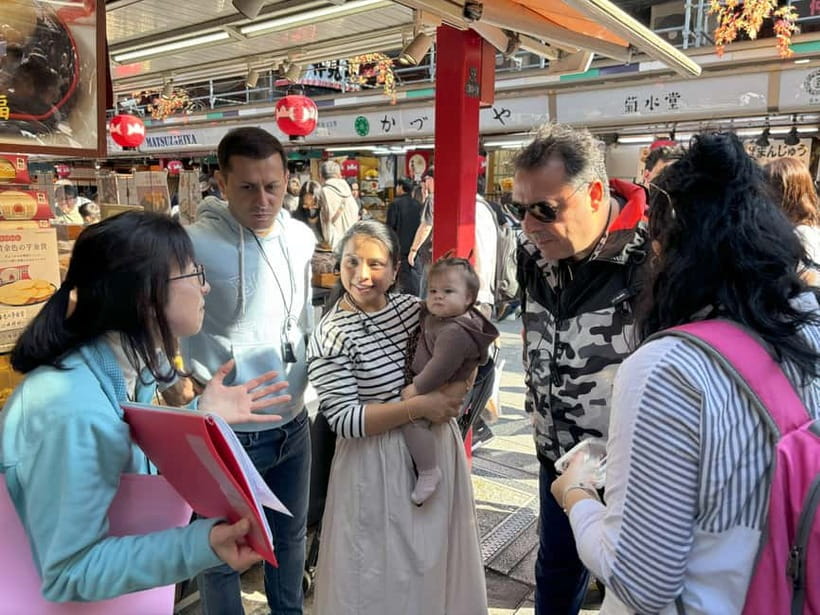
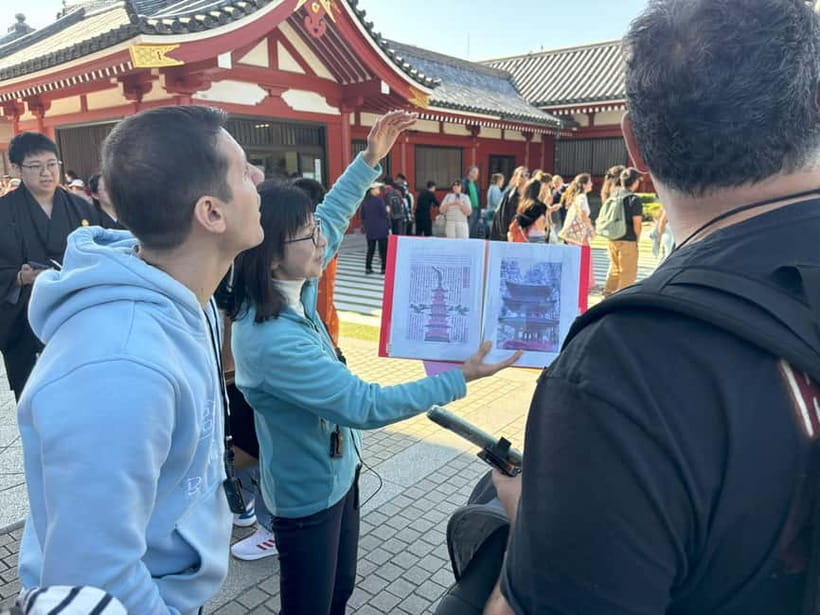
- Guides use practical teaching aids: Amy brought printed materials, while other guides have used simple activities to keep younger visitors engaged.
- Expect moderate walking outdoors: Wear comfortable shoes and dress for rain or sun.
Why this Asakusa walk gives you more than a temple visit
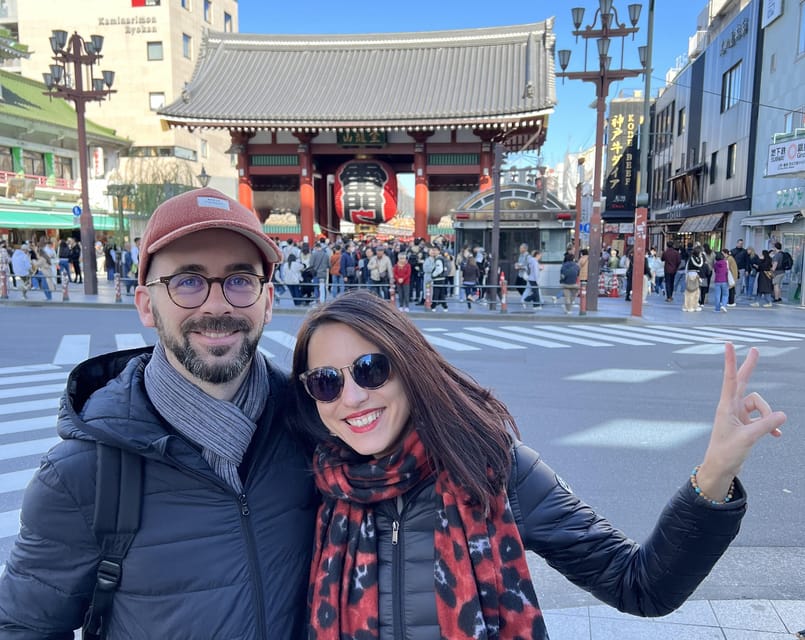
Many visitors arrive in Asakusa, take a photo at Kaminarimon, walk up Nakamise, and enter Sensō-ji. That is pleasant, but it leaves much of the place unexplained. This tour gives you a framework before the details pile up.
The central idea is simple: Asakusa lets you see Japan as a meeting point between religion, commerce, art, politics, and foreign influence. The guide uses seven stops to connect those subjects. You begin with Japan’s relationship to the outside world, move into religious practice, then finish by looking at the unusual way Buddhism and Shinto developed side by side.
I like this approach for a first or second day in Tokyo. You are not asked to memorize a long list of dates. Instead, each stop answers a practical question: Why is this gate here? Why are there both Buddhist and Shinto buildings? Why did Japanese prints matter to artists in Europe? Why did Japan close itself off, and why did it later change so quickly?
The tour costs $58 per person for two hours. That is not bargain-basement pricing, but the value depends on what you want. If you only need directions and photo stops, you can explore Asakusa on your own. If you want someone to explain the symbols, connect the sites, and answer questions in English, the price is reasonable for a focused history walk.
More History Walking Tours in Japan
- Tokyo: Imperial Palace and Shogun Historical Walking Tour
★ 5.0 · 2,251 reviews - Tokyo Castle & Imperial PalaceーShogun Walking Tour
★ 4.7 · 1,068 reviews - Tokyo: Imperial Palace Japanese History Walking Tour
★ 4.9 · 987 reviews
Starting beside the Sumida River
The meeting point is in front of the Burger King beside Exit 4 of Asakusa subway station on the Ginza Line. Step outside Exit 4 rather than waiting underground. The listed starting address is 2-chōme-20-6 Kaminarimon.
The first stop is Tokyo Cruise Asakusa Pier, where you spend about 15 minutes. This is an effective beginning because the river gives you a physical view of Japan’s connection to the wider world. The guide explains why the Edo shogunate restricted overseas contact for more than 200 years, why the Netherlands remained the one European trading partner permitted to maintain a link, and how Admiral Perry’s arrival forced Japan to reopen.
This is also where the tour connects old history with modern Tokyo. You learn about Odaiba’s former gun batteries and the Statue of Liberty replica facing the Pacific. The point is not that every modern landmark is an exact historical monument. It is that Tokyo still reflects the country’s long relationship with the sea, foreign pressure, and selective borrowing.
I find this opening useful because it puts the later sights into context. Japan’s isolation was not a complete disappearance from the world, and its opening was not a simple switch from old to new. The guide gives you a way to see those changes as part of a longer story.
Getting the religious basics at the Tourist Information Center
At the Asakusa Culture Tourist Information Center, the guide spends about 15 minutes introducing Buddhism and Shinto. This stop may sound less exciting than the famous gates, but it solves one of the biggest problems first-time visitors face: knowing what kind of place they are looking at.
You learn the basic difference between a Buddhist temple and a Shinto shrine, along with how prayer and ritual differ. That background becomes useful within minutes, since the route takes you to both Sensō-ji and Asakusa Shrine.
The explanations are designed for people who may know almost nothing about Japanese religion. You do not need to prepare by reading a guidebook. The strength here is visual teaching. Instead of giving you abstract definitions, the guide prepares you to recognize the features and behavior you will see at the next stops.
This is also a good point to ask questions. Guides such as Sachi and Kay have been praised for explaining how to approach shrines respectfully. That practical advice matters more than a pile of religious vocabulary. You leave better prepared to observe without treating a sacred place like a stage set.
Reading the dragons at Kaminarimon
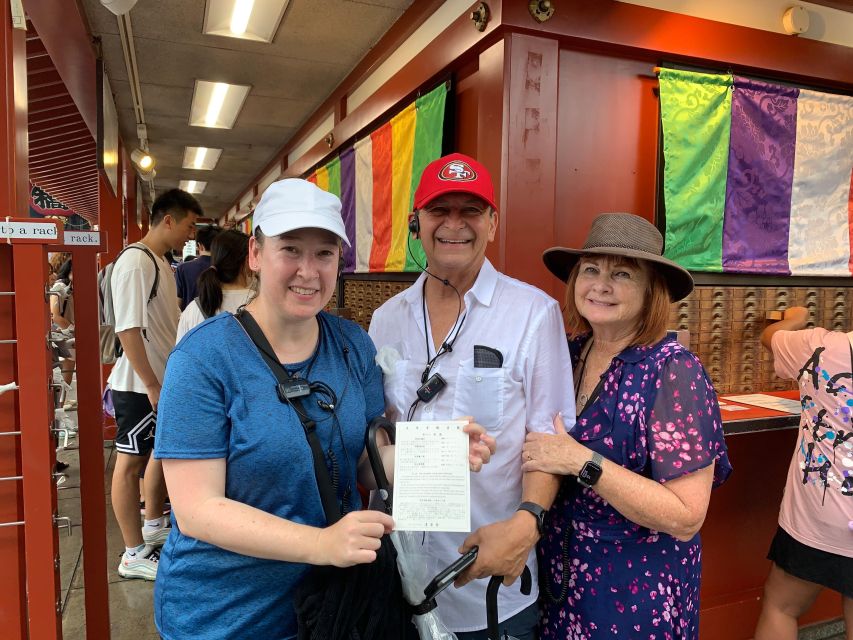
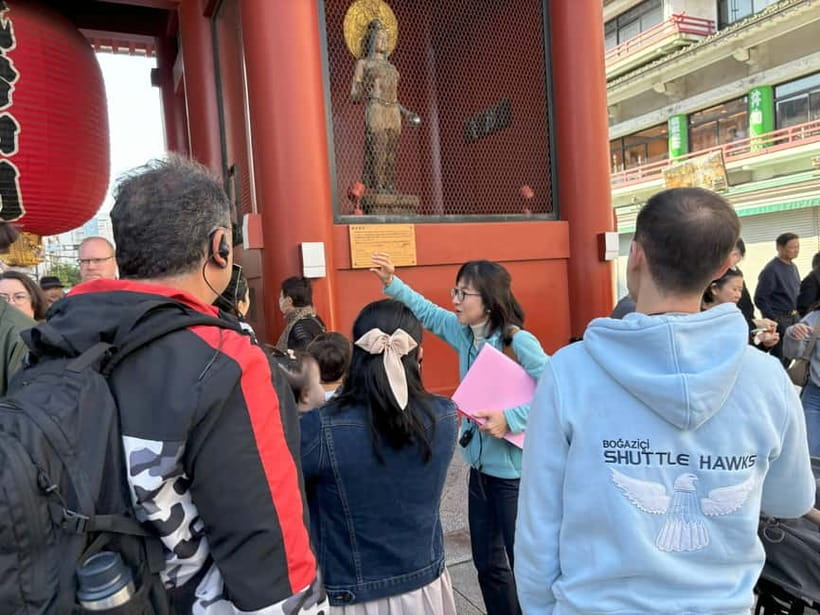
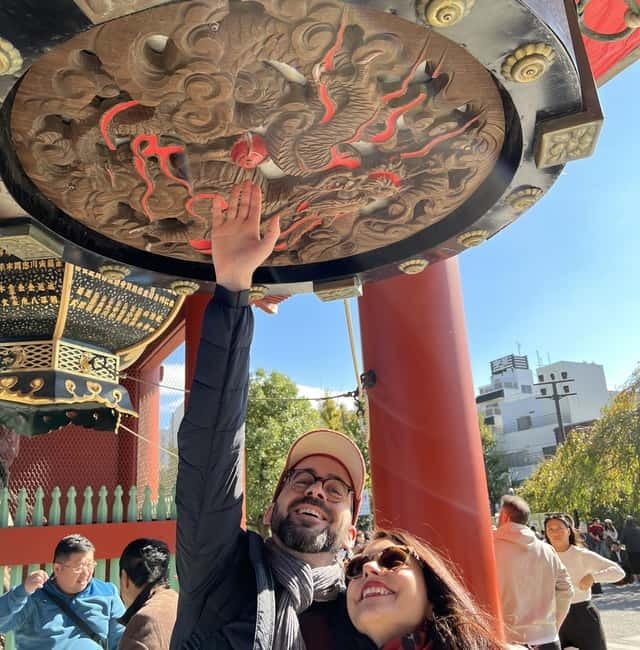
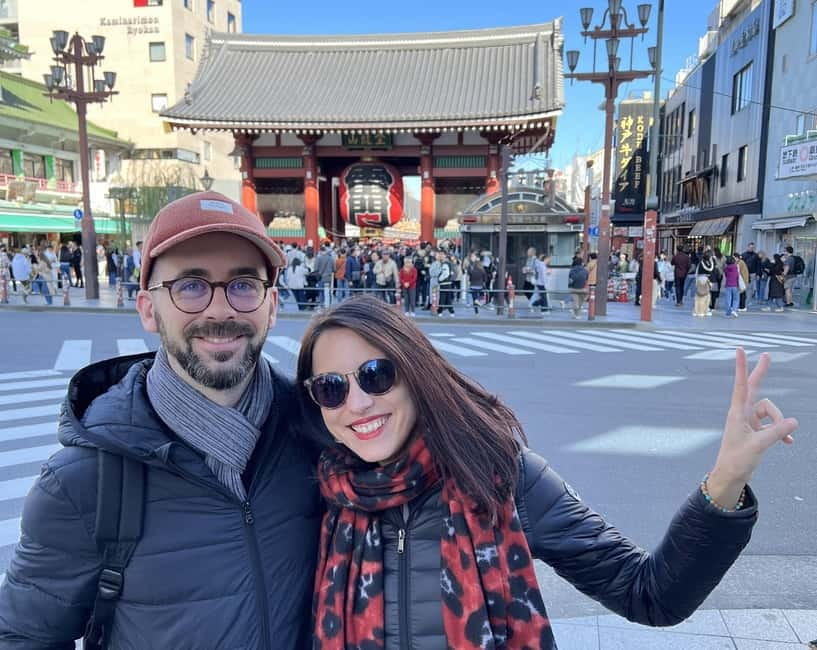
Kaminarimon, or Thunder Gate, gets roughly 15 minutes. The enormous red lantern is the obvious attraction, but the guide shifts your attention to the protective figures and the Japanese dragon.
The tour compares Japanese and Western dragons, including the surprising difference in their roles. In much of Western mythology, dragons are linked with danger, greed, or a hero’s opponent. The Japanese dragon has a different cultural position and can be connected with water and protection. The comparison makes the gate easier to read instead of leaving it as a colorful photo stop.
You will likely pause for pictures here, and the tour allows that while keeping the story moving. This is one reason the walk works well for families. An eight-year-old may not want a lecture about religious history, but a giant lantern, dragons, and fortune telling later in the route give the information something concrete to attach to.
The area can be busy, so do not expect a quiet private encounter with the gate. Your guide’s headset, supplied for groups of three or more, helps you hear the explanation in a crowd. One person found the ear pieces occasionally created an echo, so sound quality may not be perfect for every group or listener.
More History Walking Tours in Tokyo:
- Tokyo Castle & Imperial PalaceーShogun Walking Tour
★ 5.0 · 724 reviews - Tokyo: Shinjuku Historical Walking Tour & Secret Backstreets
★ 5.0 · 530 reviews - Imperial Palace East Garden and Edo Castle Walking Tour in Tokyo
★ 5.0 · 510 reviews - Asakusa: 3.5-hour Big-picture History Walk
★ 4.7 · 39 reviews
Nakamise connects shopping, symbols, and European art
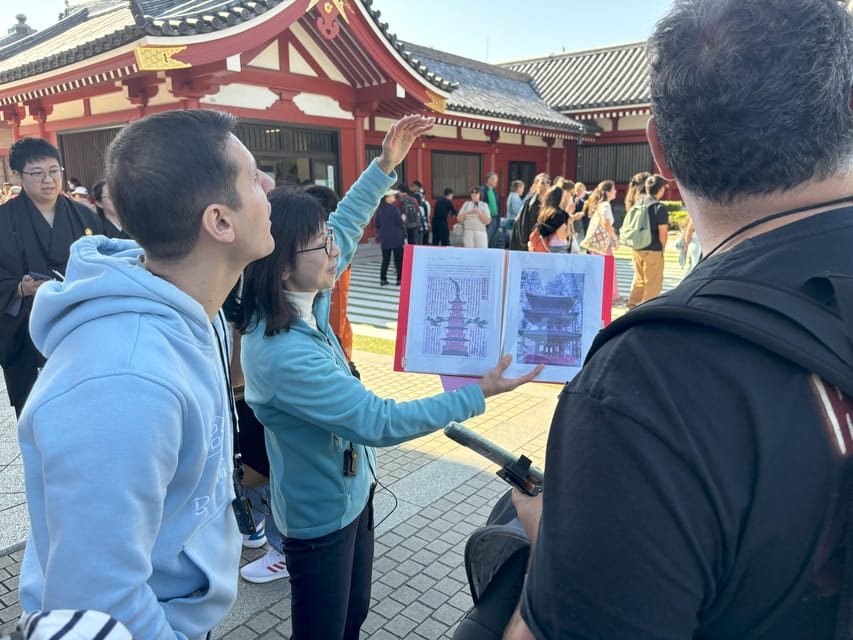
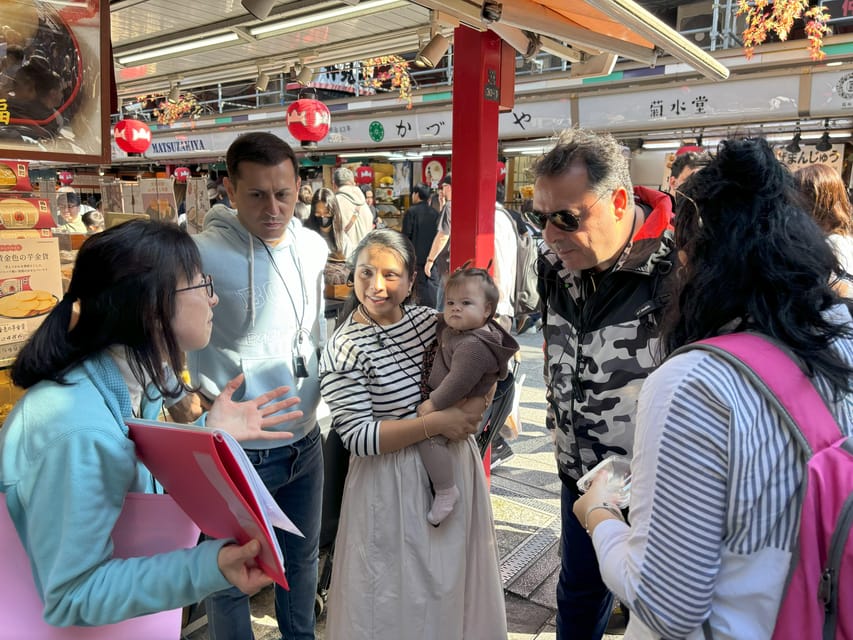
The 30-minute stretch along Nakamise Shopping Street is the longest part of the walk. That makes sense. Nakamise is both a historic approach to Sensō-ji and a working shopping street, so you have more to see and more chances to connect daily life with the larger story.
The guide explains Buddhist symbols such as the vajra, also called tokko, and points out how religious imagery can carry meaning beyond decoration. You are encouraged to look closely rather than simply move toward the temple gate.
The most unusual subject here is ukiyo-e woodblock printing. The guide explains how Japanese prints reached Europe and affected Western painters, including the Impressionists. This is a worthwhile connection because it shows that cultural exchange did not move in only one direction. Japan was not simply receiving Western influence after the nineteenth-century opening. Japanese art also changed how European artists thought about composition, line, cropping, and everyday scenes.
I like this section for its broad payoff. You can return home and notice Japanese influence in a museum painting, a poster, or a print without treating it as an isolated art-history fact. The guide gives you a reason to connect what you see in Asakusa with a much larger exchange between Japan and Europe.
Nakamise is also the most tempting place to stop for shopping. The schedule allows only 30 minutes, so save major purchases for after the tour if you want time to browse. Traditional snack tastings are included, but the supplied details do not specify which snacks appear on each departure. Think of them as a small taste of the neighborhood, not a full food tour.
Hōzōmon and the shared ideas of medieval cultures
Hōzōmon Gate receives about 15 minutes. Here, the guide makes one of the tour’s more thought-provoking comparisons: Japanese and European people had surprisingly similar ways of thinking about society, religion, and the world around 1,000 years ago.
The point is not that Japan and Europe were identical. They developed in different settings and followed different political and religious paths. The useful lesson is that medieval people in both places wrestled with familiar human concerns: faith, protection, hierarchy, death, community, and the meaning of sacred buildings.
This stop is especially valuable if you have seen Japanese history presented as completely separate from European history. The comparison gives you a better sense of Japan as part of a wider human past, while still respecting the ways its traditions developed differently.
The tour stays at the gate for only a quarter hour, so the treatment is necessarily broad. If you want a detailed study of medieval Japan, this is not the right format. If you want one clear idea that makes the architecture and religious practice easier to understand, it works well.
Sensō-ji reveals the heart of the route
Sensō-ji is the oldest Buddhist temple in Japan, and the tour spends about 15 minutes here. This is the point where the earlier explanations come together: the river and foreign contact, the difference between temple and shrine, Buddhist symbols, and the comparison with medieval Europe.
The guide explains how prayer works in Buddhism and how it differs from Shinto practice. That distinction is easy to blur when you are moving through several sacred places in one morning, so hearing it directly at Sensō-ji is useful.
You will also get another comparison between medieval Japan and Europe. The goal is not to claim that one tradition copied the other. Instead, you see that people in both regions built major religious institutions, used symbols to teach and protect, and shaped public life around faith.
Sensō-ji is a busy, active place. You may see people praying, buying charms, drawing fortunes, or simply taking in the buildings. One young visitor particularly enjoyed the fortune activity near the temple entrance. If you are with children, that hands-on moment can make the cultural material easier to remember.
The short stop means you should not expect every building or statue to be explained. You get the main story and the tools to explore more on your own afterward. I would treat the visit as an introduction, not a substitute for unhurried time at the temple.
Asakusa Shrine shows a thousand years of coexistence
The final stop is Asakusa Shrine, with about 15 minutes devoted to it. This is perhaps the most surprising part of the route because the Shinto shrine and Buddhist temple share the same grounds and history.
The guide explains how Buddhism and Shinto coexisted in Japan for more than 1,000 years. That fact helps correct a common assumption that the two traditions always operated in completely separate spaces. In Asakusa, their relationship is visible on the ground: you can move from the Buddhist temple to the Shinto shrine within the same historic complex.
This stop gives the tour its strongest ending. You have just learned how to tell a shrine from a temple, and now you see that Japanese religious life does not always fit into neat categories. The coexistence is not presented as a vague slogan. It is explained through the actual places around you.
For me, this is the kind of detail that makes a guided walk worthwhile. You can see the shrine by yourself, but without context you may miss why its location matters. The guide gives you a useful question to carry through the rest of Japan: are these traditions competing, blending, or sharing space?
How the guides handle the two-hour format
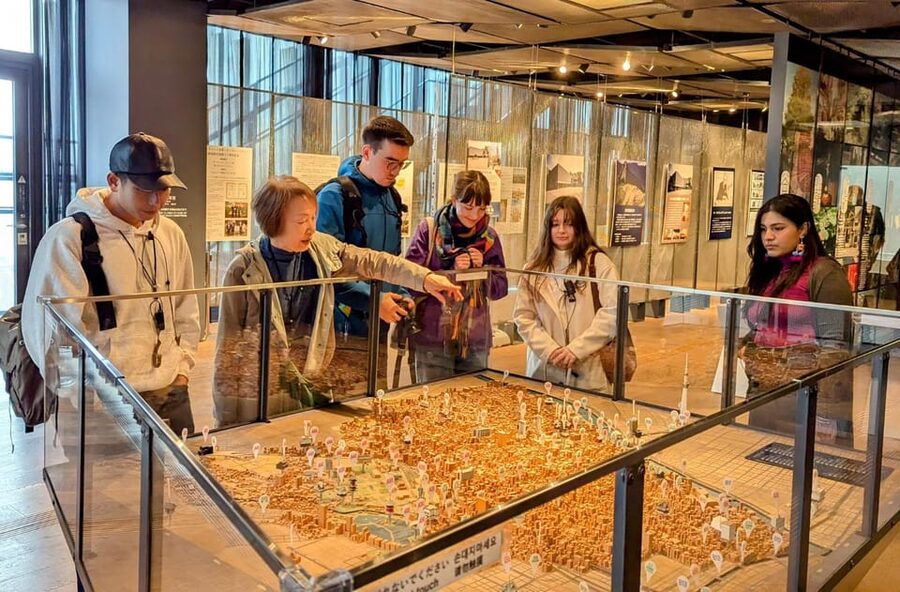
The tour is in English, with a live guide and an English audio option. Guides named in visitor feedback include Choco, Sachi, Amy, Yoko, Yasu, and Kay. The strongest pattern is a friendly, clear teaching style, with several guides praised for keeping teenagers and children involved.
Amy used printed sheets to make explanations easier to follow. Choco was especially effective with families, and Sachi has been praised for answering questions and making temple history feel approachable. These details suggest that the quality depends partly on the guide assigned to your departure, but the format gives the guide plenty of strong visual material to work with.
Groups of three or more receive headsets so you can hear while walking. That is helpful around Kaminarimon and Nakamise, where street noise can compete with the guide. Still, if you are sensitive to audio equipment, be aware that one person found the sound slightly echoing.
Two hours is a smart length for this route. You get enough time to understand the main themes without turning a first Asakusa visit into an all-day lecture. The tradeoff is that each famous site receives only about 15 minutes, apart from Nakamise. You will need to return later if you want quiet photographs, shopping, or a close look at temple details.
Who will get the most from this walk
I would recommend this tour if you want a clear first look at Asakusa rather than a specialist lecture. It suits adults who enjoy history, families who want a manageable activity, and anyone confused by the difference between a Buddhist temple and a Shinto shrine.
It is also a good choice early in a Tokyo visit. The tour gives you cultural habits and visual clues that can help throughout the rest of Japan. You will recognize the basic religious setting more quickly and have a better sense of how modern Japan grew from older institutions.
Families are welcome, and children younger than six may join without charge. The material is aimed more at adults, but the guides have shown they can keep an eight-year-old or a 13-year-old interested. The fortune activity, dragons, river, and snack tasting help break up the history.
I would skip it if you want a food-focused tour, extensive shopping time, or a slow architectural study. I would also think carefully if moderate walking is difficult. The route is compact, but it includes outdoor walking and is listed as unsuitable for people with mobility impairments. Contact the supplier before booking if you have mobility concerns, since accommodations may be possible.
The tour runs rain or shine, so bring water, comfortable shoes, and clothing suited to the weather. Its minimum participant requirement also matters: if that number is not met, the operator cancels and sends notice at least 24 hours beforehand, with a full refund.
Should you book this $58 Asakusa experience?
Book it if you want the major Asakusa sights to tell one connected story. The best value comes from the explanations: Edo isolation beside the river, the Netherlands connection, ukiyo-e’s effect on European art, and the long shared life of Buddhism and Shinto.
Do not book it expecting a private, slow-paced temple visit. The walk is short, public, and fairly structured. You will see the essentials, sample a traditional snack, and gain a useful overview, then you can return to Sensō-ji or Nakamise on your own.
For a first visit to Tokyo, I think the format earns its price. It turns a famous sightseeing area into a place you can read, not just photograph.
FAQ
Where does the Asakusa history walk meet?
Meet in front of the Burger King restaurant next to Exit 4 of Asakusa subway station on the Ginza Line. The listed address is 2-chōme-20-6 Kaminarimon.
How long does the tour last?
The walking tour lasts two hours. The route includes the Tokyo Cruise Asakusa Pier, Asakusa Culture Tourist Information Center, Kaminarimon, Nakamise Shopping Street, Hōzōmon Gate, Sensō-ji Temple, and Asakusa Shrine.
What language is the tour in?
The live tour guide speaks English, and an English audio guide is included.
Are headsets provided?
Headsets are provided for groups of three or more so you can hear the guide clearly while walking. One person found the equipment occasionally created an echo.
Are children allowed to join?
Yes. Children younger than six may join without charge. The tour is recommended mainly for adults because of its historical focus, but families are welcome.
What should I bring?
Bring comfortable shoes, water, and clothing suitable for the weather. The tour operates rain or shine and includes a moderate amount of walking.
Just added around Tokyo
- Tokyo: Edo Castle & East Garden of the Imperial Palace Tour★ 4.7 · 112 reviews
- Tokyo: Imperial Palace, the history of Japan (ENGLISH GUIDE)★ 5.0 · 77 reviews
- Tokyo: Customized Private Historical Guided Photoshoot Tour★ 5.0 · 25 reviews
- Kyoto: Nijo Castle World Heritage Guided Tour with Admission★ 4.9 · 37 reviews
- Historic Kanda Sake Tasting at Tokyo’s Oldest Shop (1596)★ 4.9 · 33 reviews
- From Tokyo: Private Nikko World Heritage Sights One Day Trip★ 4.7 · 52 reviews
- From Tokyo: Guided Day Trip to Nikko World Heritage Sites★ 4.8 · 51 reviews
- Asakusa: 3.5-hour Big-picture History Walk★ 4.7 · 39 reviews
Tokyo History Tours, compared.
Tokyo: Imperial Palace and Shogun Historical Walking Tour
Read our review →
Tokyo Castle & Imperial PalaceーShogun Walking Tour
Read our review →
Tokyo: Imperial Palace Japanese History Walking Tour
Read our review →Tokyo Castle & Imperial PalaceーShogun Walking Tour
Read our review →
Tokyo: Shinjuku Historical Walking Tour & Secret Backstreets
Read our review →
Imperial Palace East Garden and Edo Castle Walking Tour in Tokyo
Read our review →
From Tokyo: Nikko World Heritage Site Private Full-Day Trip
Read our review →
Tokyo: The Best of Izakaya in Shinjuku Food & Cultural Tour
Read our review →Browse the lists this tour appears in