Review · BERLIN
Berlin: Historic Center Walking Tour with a Real Berliner
Berlin’s past comes at you fast on this walk. In two hours, you move from the city’s medieval roots near Nikolaikirche to the grand royal buildings of Unter den Linden, then finish at Brandenburg Gate, the symbol of German reunification. It is a useful first look at Berlin because the route connects places instead of treating them as isolated sights.
I like the small group limit of 10 and the broad historical sweep. Guides such as Carlo are praised for making complicated events clear, from Prussian kings to the Cold War, while still answering questions and adjusting to the group. The main drawback is the pace: two hours covers a lot, so you will see many landmarks from outside rather than tour their interiors.
Key points to know before you book
- A strong first-day orientation: The route helps you understand how Berlin’s central districts fit together.
- A guide-led history lesson: Expect context on Prussia, imperial Berlin, World War II, division, and reunification.
- Nine central sights in two hours: The walk includes Nikolaiviertel, Museum Island, the Humboldt Forum, Unter den Linden, Berlin Cathedral, State Opera, and Brandenburg Gate.
- Small groups matter: With no more than 10 participants, it should be easier to hear the guide and ask questions.
- Good for several language preferences: Tours are offered in English, German, and Italian.
- Outdoor sightseeing in every kind of weather: Wear comfortable shoes and bring clothing suited to the forecast.
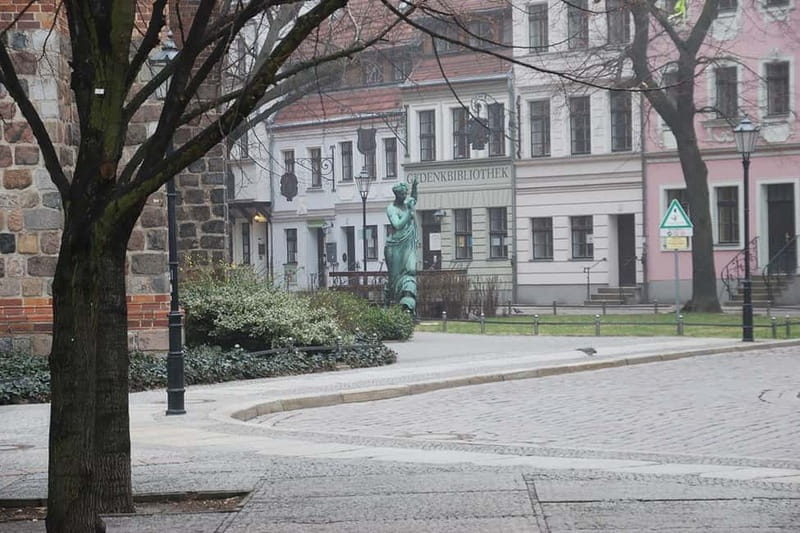
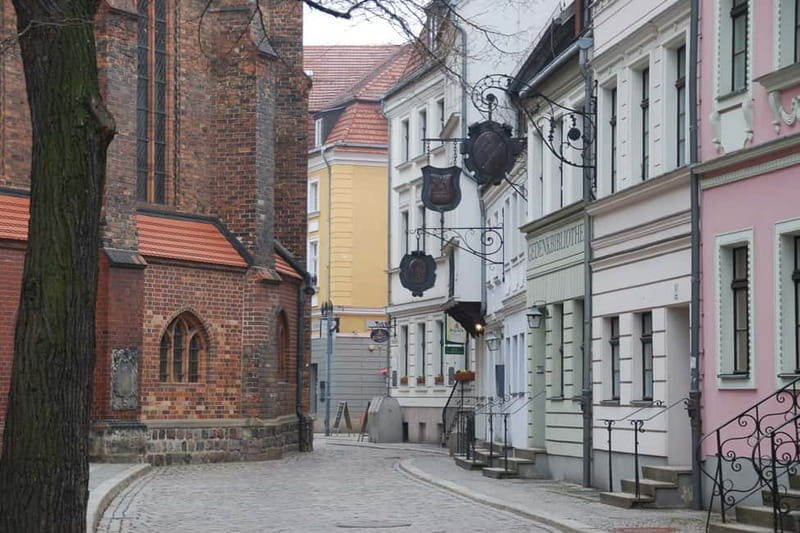
Starting beside Nikolaikirche in Berlin’s oldest quarter
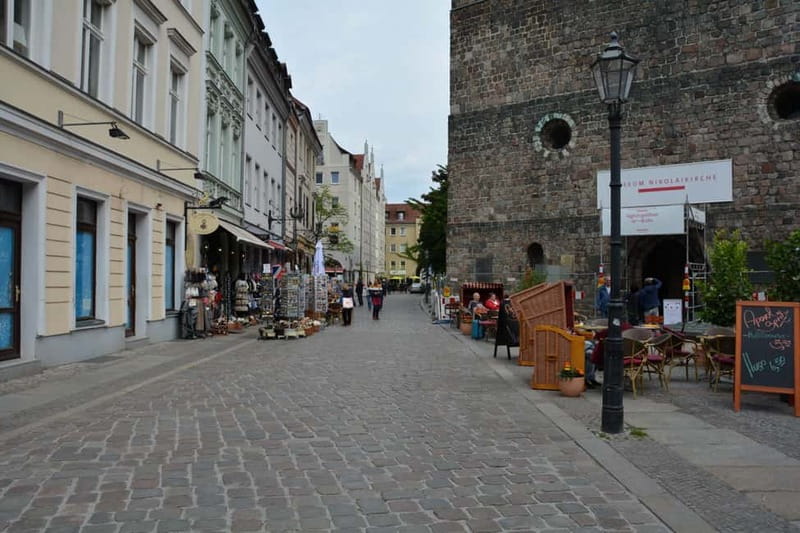
Meet your guide outside the main entrance of the St. Nicholas’ Church Museum. Look for the Get Your Guide, You in Berlin flag, which is the clearest way to identify the meeting point.
The walk begins in Nikolaiviertel, the quarter around Nikolaikirche. This is an important starting place because Berlin did not begin as the huge capital you see today. The tour uses the area to explain the city’s early development from a small trading settlement into a political and cultural center.
That opening context is valuable. Berlin can feel like a collection of grand avenues, memorials, museums, and modern buildings. Starting with its older core gives you a simple framework for the rest of the walk. You begin with the city’s origins, then follow its growth toward royal power and national politics.
The route is outdoors, and you will be walking for the full two hours. Comfortable shoes are not optional here. The tour operates in all weather and on public holidays, so bring an umbrella or rain layer if the forecast looks doubtful. One guide has even carried umbrellas for the group, but I would still pack your own.
More History Walking Tours in Berlin
- Berlin: Third Reich & Cold War Guided Walking Tour
★ 4.9 · 8,378 reviews - Berlin’s Best: 2 Hour Walking Tour Third Reich and the Cold War
★ 5.0 · 5,486 reviews - Third Reich Berlin: Hitler and WWII Walking Tour
★ 5.0 · 3,301 reviews
Seeing Berlin’s changing skyline near the Spree
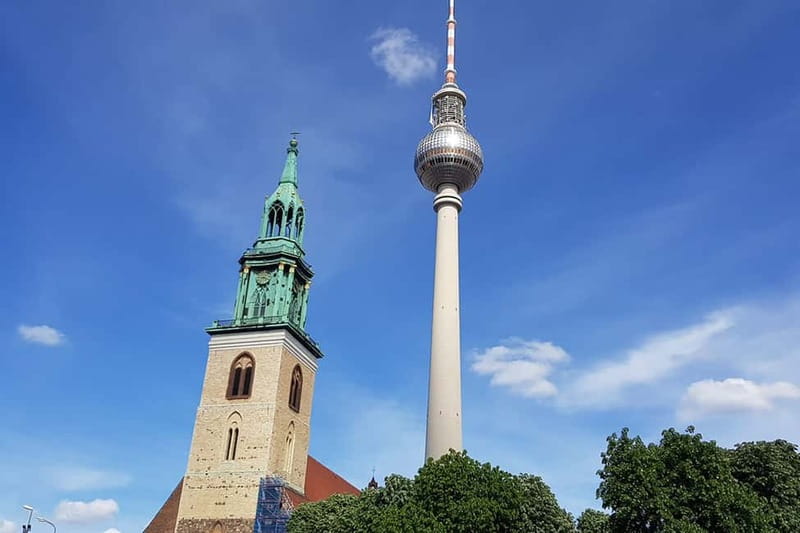
From Nikolaiviertel, the walk heads toward the Spree and central Berlin. One early landmark is the Television Tower, Berlin’s tallest building. Its height makes it an easy reference point, and seeing it from street level helps you get your bearings in the Mitte district.
The tower also brings the city’s divided past into view. It was built during the East German period and remains one of Berlin’s most recognizable features. The route does not focus only on the Cold War, but it gives that period a place within the longer story of the capital.
This is one of the walk’s best qualities. You are not simply moving from one postcard sight to another. The guide links the city’s physical changes to shifts in power, government, and identity. That broad approach suits you if you want more than a short lesson about World War II or the Berlin Wall.
Museum Island and the Humboldt Forum
The walk continues along the Spree to Museum Island, one of Berlin’s most important cultural areas. You will see the Berlin Cathedral and the Old Museum, with the river and monumental architecture providing the setting.
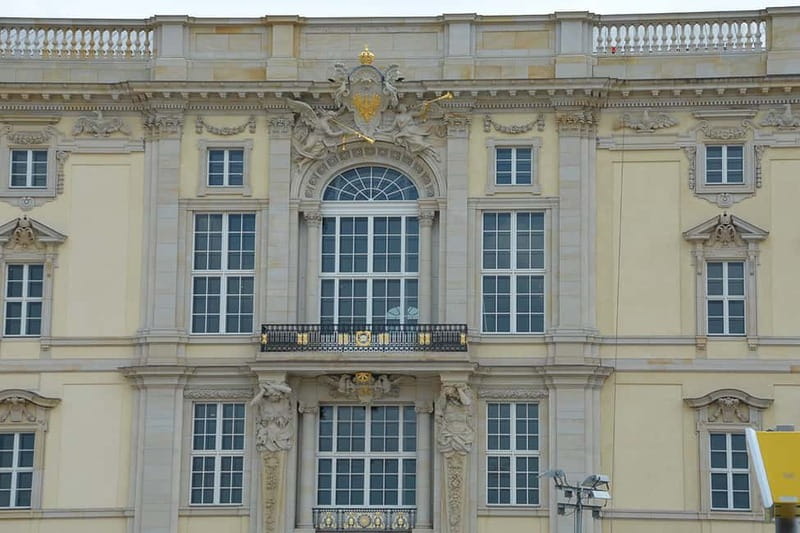
You also stop at the Humboldt Forum, where the reconstructed Berlin City Palace gives the area a complicated historical layer. The palace was first associated with the Prussian and German monarchies, later damaged in World War II, and removed during the East German period. Its reconstruction has prompted debate about how Berlin should present its past.
The guide’s role matters here. These buildings can look impressive without being easy to understand. A good explanation helps you connect the palace, museums, monarchy, war damage, East Germany, and present-day Berlin without treating the past as a tidy story.
The route gives you exterior views rather than extended museum visits. If you want to enter the museums or explore the Humboldt Forum at length, plan a separate visit. This tour is better at showing how the buildings relate to one another and why this riverside area became the cultural heart of central Berlin.
Crossing Schlossbrücke into royal Berlin
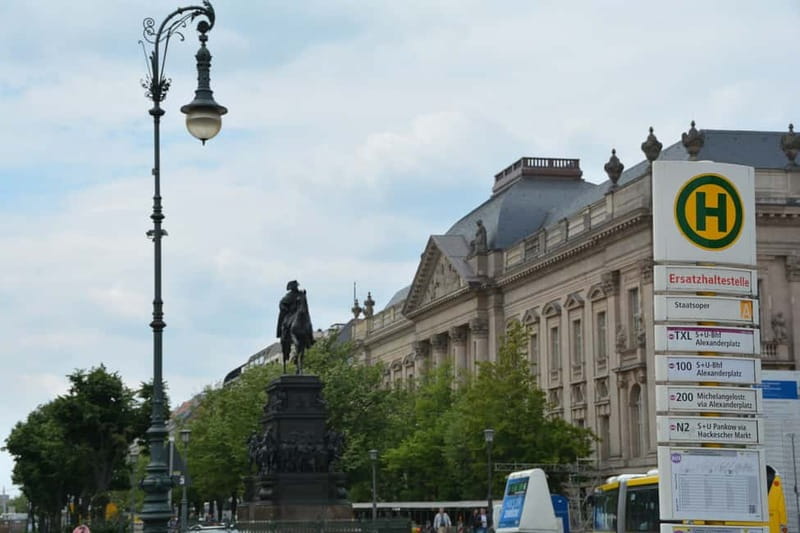
After Museum Island, you cross Palace Bridge, or Schlossbrücke, and continue through Berlin’s historic center. Here, the architecture shifts toward the city’s royal and imperial identity.
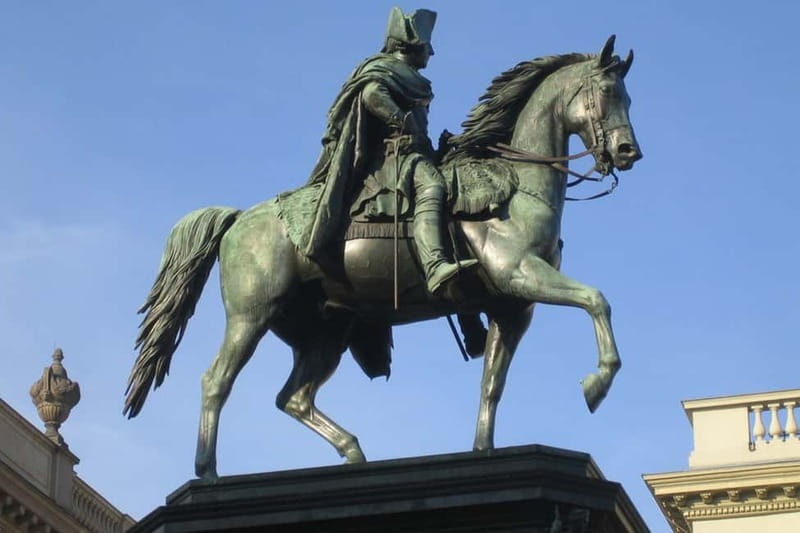
You will see grand buildings connected with the Prussian monarchy and later German state. The walk includes the equestrian statue of Frederick the Great, a useful stop for understanding the rulers who shaped Berlin’s political power and urban form.
This part is especially helpful if you do not know much about Prussia. Berlin’s major buildings were not placed at random. They reflect the ambitions of a kingdom that grew into a major European power. The guide explains that transition while you stand among the buildings themselves, which makes the subject easier to follow than a detached lecture.
The drawback is that central Berlin contains a great deal of information in a small space. You may hear names, dates, political changes, and architectural details in quick succession. Carlo is repeatedly praised for making the material easy to follow, but you should still expect a serious amount of history for a two-hour walk.
More History Walking Tours in Germany
- Berlin: Third Reich, Hitler, and WWII Walking Tour
★ 4.9 · 1,757 reviews - Berlin: History of the Third Reich Guided Walking Tour
★ 4.7 · 791 reviews - Berlin Historical Highlights Walking Tour
★ 4.9 · 657 reviews - Berlin Private Complete History All Day Walking Tour
★ 5.0 · 474 reviews
Unter den Linden, Berlin’s grand central avenue
Unter den Linden is Berlin’s oldest boulevard and the central spine of this part of the tour. Walking along it gives you a direct sense of how royal Berlin connected its palace, university, opera house, cathedral, and public institutions.
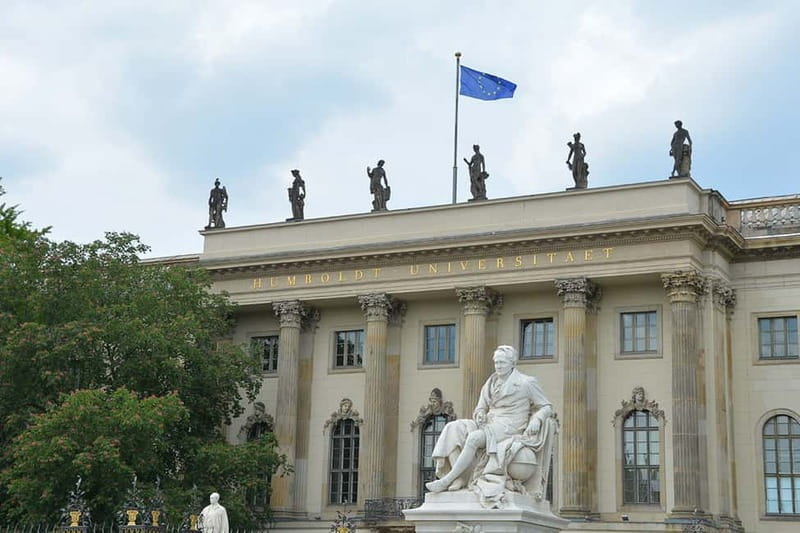
The route passes the Equestrian Statue of Frederick the Great, the Berlin State Opera, Humboldt University, and St. Hedwig’s Cathedral. Each stop adds another piece to the city’s political, intellectual, and religious life.
The State Opera represents Berlin’s courtly and cultural ambitions. Humboldt University points to the importance of education and scholarship. St. Hedwig’s Cathedral adds a religious landmark to a boulevard otherwise dominated by royal and state architecture.
I like this section because it makes Berlin’s historic center feel legible. You are not just collecting names for a camera roll. You are seeing how a ruler’s avenue became a public urban space, and how different institutions were placed within that system.
There may not be time to go inside every building. The value lies in the guide’s explanation and the walk between them. If your priority is an opera performance, a university visit, or cathedral interiors, you will need additional time after the tour.
Berlin Cathedral and the city’s monumental core
Berlin Cathedral appears as one of the route’s major sights. Its large dome and riverside position make it one of the most recognizable buildings on Museum Island.
The cathedral helps show the scale of Berlin’s imperial ambitions. Along with the museums, palace, and boulevard, it forms part of a carefully planned monumental center. The guide can also place the building within the city’s many changes, rather than presenting it as an isolated church.
You should expect to view the cathedral during the walk, not take a full interior tour. That is typical of a route covering so many central landmarks in only two hours. If the cathedral is high on your list, note its location so you can return later with enough time to see it properly.
Finishing at Brandenburg Gate
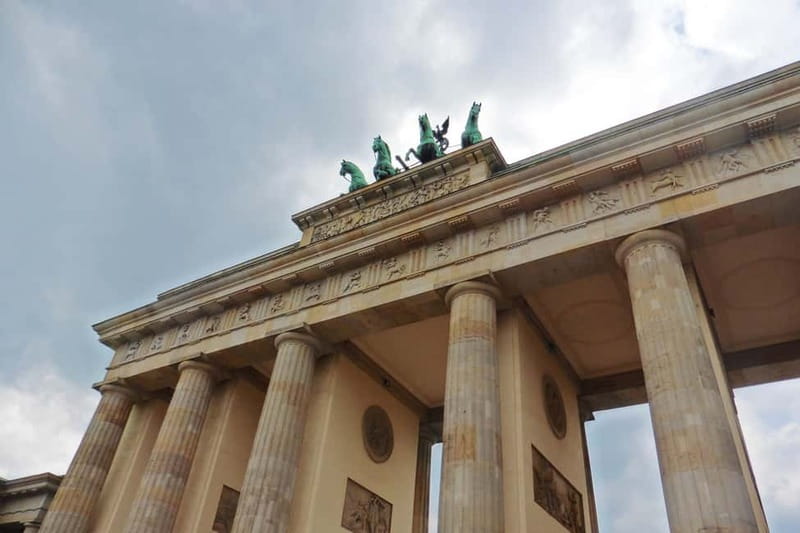
The final stretch leads to Brandenburg Gate, where the tour ends. This is more than a photogenic arch. It has been tied to Prussian power, the German nation-state, Berlin’s division, and the reunification of Germany.
The guide tells the story of the gate before, during, and after the city’s division. That time line is important because the gate’s meaning changed sharply over the years. During the divided era, it stood near the border between East and West Berlin. After the Wall fell, it became one of the clearest symbols of reunification.
Ending here gives the walk a strong narrative shape. You begin with Berlin as a small settlement and finish at a landmark associated with the reunited capital. You also end in a useful location for further sightseeing, though no hotel transfer is included.
Brandenburg Gate can be crowded and noisy, especially at popular times. The tour is about understanding the place, not having a quiet private moment with it. Still, hearing its history on site gives the landmark more meaning than simply taking a photograph.
What the two-hour format does well
Two hours is enough to cover the historic center without turning the experience into an exhausting half-day march. It works well on your first day because it helps you get your bearings and gives you a map in your head.
The route is also compact enough for a first introduction to Mitte. You move through several major areas on foot rather than spending time waiting for transport. That makes the experience efficient, especially if you have only a few days in Berlin.
The tradeoff is depth. You will not have long museum visits, extended stops inside churches, or detailed coverage of every period in Berlin’s history. You are getting a connected overview, with the chance to return later to the places that interest you most.
The small group limit of 10 improves the format. It should be easier to hear the guide beside busy streets, and you have a better chance to ask about a building, date, or historical figure. Some departures may be smaller still, and the tour has operated with only one or two participants. That can create a more personal experience, though you should not book it expecting a private tour every time.
The guides and language options
The tour is offered in English, German, and Italian. Carlo is the guide name most often associated with this experience, and his approach appears to combine clear history with a friendly manner. He has been praised for covering Berlin beyond the usual World War II focus, including the city’s earlier development and Prussian period.
That matters because Berlin is easy to oversimplify. A tour that focuses only on Nazi Germany and the Cold War misses the reasons the city became a capital in the first place. Here, you get a longer timeline, from medieval beginnings to monarchy, dictatorship, division, and reunification.
A particularly useful feature is the guide’s willingness to answer questions and help with practical orientation. After the walk, you should have a better sense of where central Berlin’s main areas sit relative to one another. If you are new to the city, that can save time during the rest of your visit.
Is $43 good value?
At $43 per person, the tour is not the cheapest way to walk around Berlin. You can see many of these landmarks on your own for free from the outside.
The fee pays for the interpretation, structure, and local guidance. You are getting two hours with a certified, multilingual city guide and a carefully arranged route through the historic center. For a first visit, that can be good value because one clear explanation may help you understand several days of independent sightseeing.
I would book it if you enjoy history but do not want to spend your first day reading plaques and guidebooks. I would be less enthusiastic if you prefer long interior visits or silent, self-paced exploration. The price makes the most sense when you use the walk as an introduction, then return to the museums and buildings that catch your interest.
Who should take this Berlin walking tour?
This tour suits first-time visitors who want a clear overview of Mitte. It is also useful for anyone who wants Berlin explained as a whole city, not only through its twentieth-century tragedies.
History fans should appreciate the movement from medieval origins to Prussia, imperial Berlin, East Germany, and reunification. Families and mixed-age groups may like the short two-hour format, although the amount of historical detail may be demanding for young children.
It also suits solo visitors. The group size is limited, and the guide-led route removes the need to work out the historic center alone. English, German, and Italian options make it practical for several types of visitors.
The walk is wheelchair accessible, but you should still allow for outdoor conditions and city streets. Wear comfortable clothing and shoes, and prepare for rain, heat, or cold because the tour runs in all weather.
My call: book it for context, not interiors
I recommend this tour as a first introduction to Berlin’s historic center. Its best feature is the way it connects Nikolaiviertel, Museum Island, Unter den Linden, and Brandenburg Gate into one story.
Book it if you want a friendly guide, a small group, and a broad explanation of Berlin’s development. Skip it if you already know central Berlin well or want to spend two hours inside museums and historic buildings.
The best plan is to take it early in your stay. Let the walk show you what deserves a longer visit, then return on your own to the cathedral, museums, palace, or other sights that caught your attention.
FAQ
Where does the Berlin historic center walking tour begin?
It begins outside the main entrance of the St. Nicholas’ Church Museum, also called Nikolaikirche Museum.
Where does the tour finish?
The walk finishes at Brandenburg Gate.
How long does the tour last?
The tour lasts two hours.
What sights are included on the route?
The route includes Nikolaiviertel, Museum Island, the Humboldt Forum, Berlin Cathedral, Humboldt University, Berlin State Opera, Unter den Linden, and Brandenburg Gate. You also see the Television Tower and the Equestrian Statue of Frederick the Great.
Is the walking tour offered in English?
Yes. The available languages are English, German, and Italian.
How large is the group?
The group is limited to 10 participants.
Is the tour wheelchair accessible?
Yes, the activity is listed as wheelchair accessible.
What should I bring?
Bring comfortable shoes and comfortable clothes. Since the tour runs in all weather, weather-appropriate clothing is also sensible.
Is food or drink included?
No. Food and drinks are not included.
Can I cancel the tour for a full refund?
Yes. You can cancel up to 24 hours in advance for a full refund.
More Old Town and Historic Centre Walks in Berlin
- Madrid Essential: Historic Center, Plaza Mayor & Royal Palace
★ 5.0 · 6,416 reviews - Lisbon: Live Fado Show with Port Wine in Historic Center
★ 4.7 · 4,166 reviews - Valencia Old Town Tour with Wine & Tapas in 11th Century Historic Monument
★ 5.0 · 3,234 reviews - Prague Old Town, Medieval Underground and Dungeon Historical Tour
★ 4.5 · 3,227 reviews
More Old Town and Historic Centre Walks in Germany
- Historic center of Berlin – Tour in Italian
★ 5.0 · 143 reviews - Berlin: 1-Hour Guided Tour of the Historic Center
★ 4.2 · 33 reviews - The Local Tour of Hamburg Historic Centre
★ 5.0 · 1,058 reviews - Trier: Guided Old Town Highlights and History Walking Tour
★ 4.7 · 687 reviews
Just added around Berlin
- Berlin Food & Cultural Tour: Must-Try German & Berliner Classics★ 5.0 · 51 reviews
- Berlin Half-Day World War II Walking Tour★ 4.5 · 48 reviews
- Small-Group Historical Bike Tour in Berlin★ 4.5 · 103 reviews
- Historic center of Berlin – Tour in Italian★ 5.0 · 143 reviews
- Berlin Cold War & World War II Third Reich Walking Tour★ 4.5 · 30 reviews
- Private Taxi Tour City East & West History and Architecture 3-4h★ 5.0 · 42 reviews
- Berlin Wall and Cold War Bike Tour in Small Groups★ 5.0 · 114 reviews
- Private Tour: Jewish Heritage Walking Tour of Berlin★ 5.0 · 29 reviews
Berlin History Tours, compared.

Berlin: Third Reich & Cold War Guided Walking Tour
Read our review →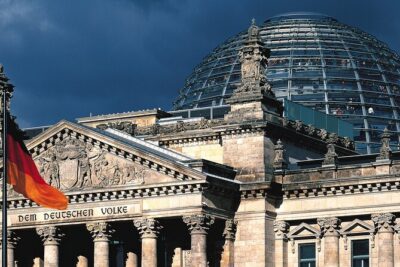
Berlin’s Best: 2 Hour Walking Tour Third Reich and the Cold War
Read our review →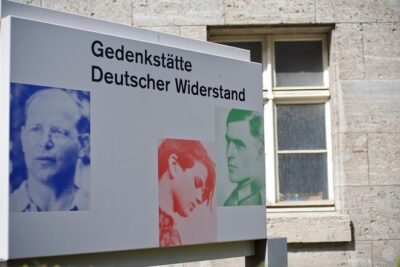
Third Reich Berlin: Hitler and WWII Walking Tour
Read our review →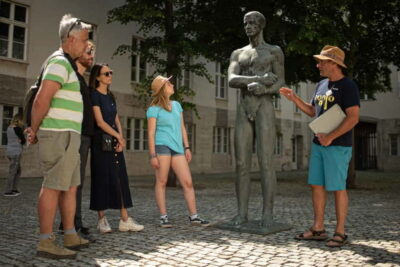
Berlin: Third Reich, Hitler, and WWII Walking Tour
Read our review →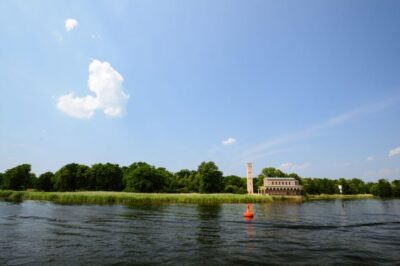
Berlin: 3-Hour World Heritage Cruise to Potsdam
Read our review →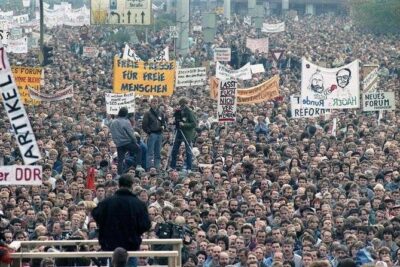
Cold War, Berlin Wall, Spies and the East Side Gallery
Read our review →
Berlin: History of the Third Reich Guided Walking Tour
Read our review →