
Review · BERLIN
Berlin History Walking Tour with a French-Speaking Guide
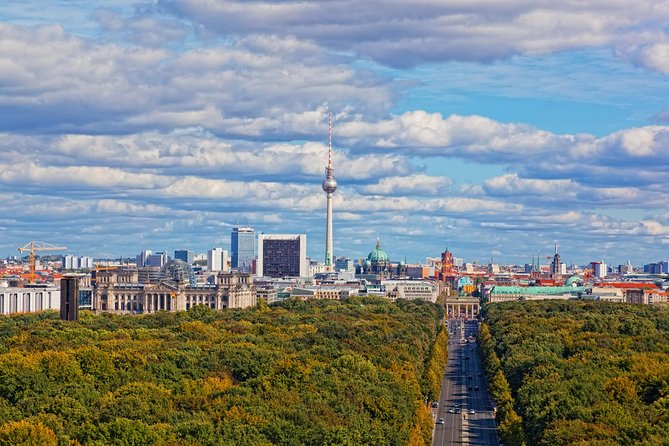
Berlin’s past is never far from the pavement. On this French-language walking tour, you move from Potsdamer Platz and Checkpoint Charlie to the Holocaust Memorial, Hitler’s Bunker site, Brandenburg Gate, and Museum Island. The route gives you a useful first look at how war, dictatorship, division, and reunification shaped the city.
I like the wide historical range and the fact that the tour stays on foot, so Berlin’s story unfolds block by block. I also like the morning start, which leaves you free for lunch and an afternoon museum visit. The main drawback is the lack of audio equipment, so you need to stay close to the guide in a group of up to 25 people.
Key points to know before you book
- A strong first-day introduction: The route links Berlin’s best-known historical sites in roughly three hours.
- French-speaking guidance: Guides named in past departures include Anouk, Martin, Arthur, Paul, Jean-Charles, and Céline.
- A serious, thoughtful route: The Holocaust Memorial and Hitler’s Bunker site are handled as places of memory, not as casual photo stops.
- Central Berlin on foot: You do not pay for transport between stops, but you do need comfortable shoes and moderate fitness.
- Morning timing: The 10:00 am departure usually finishes in time for lunch and further sightseeing.
- Good value at $27.81: For a small-price orientation to central Berlin, the tour offers useful context that is hard to gather by simply walking past monuments.
Why this route works so well for a first look at Berlin
Berlin can be confusing at first. Its major sights are spread across a broad central area, and the city’s story does not follow a tidy timeline. A grand avenue may lead to a Nazi-era memorial, then to a Cold War landmark, then to a rebuilt palace-like structure.
This tour makes those connections for you. You get a basic framework for Berlin’s imperial past, the Nazi dictatorship, the destruction of the Second World War, the division between East and West, and the city’s present-day identity.
I especially like the way the route mixes famous sights with places that need explanation. Brandenburg Gate is instantly recognizable, but its meaning has changed several times. Hitler’s Bunker is barely visible today, yet it carries enormous historical weight. The guide’s words matter because the physical remains alone cannot tell the whole story.
The tour is conducted in French, and the strongest praise has focused on guides who explain clearly, answer questions, and keep a comfortable walking pace. Anouk has been described as precise and attentive to individual questions. Martin is known for enthusiasm, while Arthur has been praised for combining humor with a strong command of Berlin’s past and present. Paul and Céline have also led well-regarded departures.
That variety is worth keeping in mind. Your experience will depend partly on the guide assigned that day, but the recurring pattern is a personable guide who treats the city as a living place rather than a list of dates.
More History Walking Tours in Berlin
- Berlin: Third Reich & Cold War Guided Walking Tour
★ 4.9 · 8,378 reviews - Berlin’s Best: 2 Hour Walking Tour Third Reich and the Cold War
★ 5.0 · 5,486 reviews - Third Reich Berlin: Hitler and WWII Walking Tour
★ 5.0 · 3,301 reviews
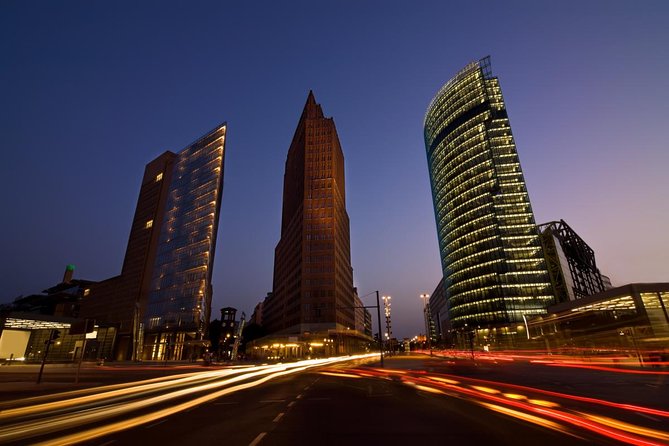
Starting at Potsdamer Platz and the Sony Center
The meeting point is at Potsdamer Platz 10, near the corner of Gabriele-Tergit-Promenade. This is a practical place to begin because the square shows modern Berlin at its most rebuilt and forward-looking.
Potsdamer Platz was heavily damaged during the war and later sat in the divided city’s restricted border zone. After reunification, it became a major redevelopment project filled with offices, shops, hotels, and contemporary architecture. The nearby Sony Center gives you an immediate contrast with the historic sites that follow.
Allow about ten minutes here. That is enough for an introduction and a quick explanation of how Berlin moved from destruction and division to ambitious reconstruction.
Do not expect a long architectural tour of the square. The value is the context. You begin by seeing the new Berlin, then spend the rest of the morning understanding what had to happen before this modern district could exist.
Checkpoint Charlie and the pressure of the Cold War
Checkpoint Charlie represents the Cold War in a compact, highly symbolic form. It was one of the crossing points between East and West Berlin, and it became a place where American and Soviet power faced one another.
The stop lasts about ten minutes. That is enough for the guide to explain the checkpoint’s role and the wider system of walls, controls, and divided neighborhoods that shaped daily life for decades.
Checkpoint Charlie is also one of the more commercialized historical sites in central Berlin. The famous guardhouse and signs make a clear photograph, but the surrounding area can feel busy and tourist-oriented. I would rely on the guide here for the historical meaning rather than expecting the site itself to provide a complete sense of the former border.
That is exactly why a walking tour helps. Without explanation, you might see a photo opportunity. With explanation, you begin to understand how a small crossing point became a symbol of a divided world.
Hitler’s Bunker site and the value of an empty place
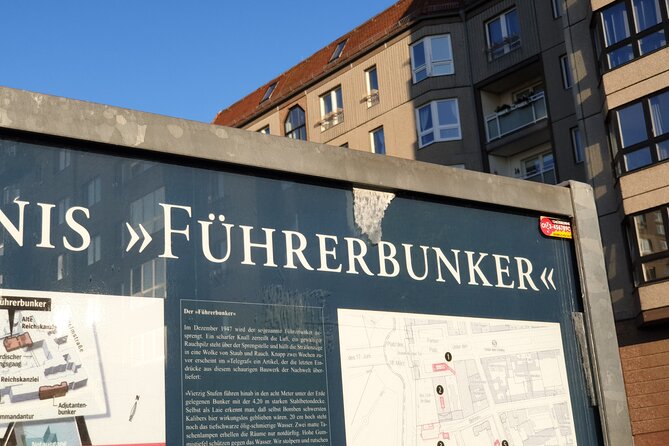
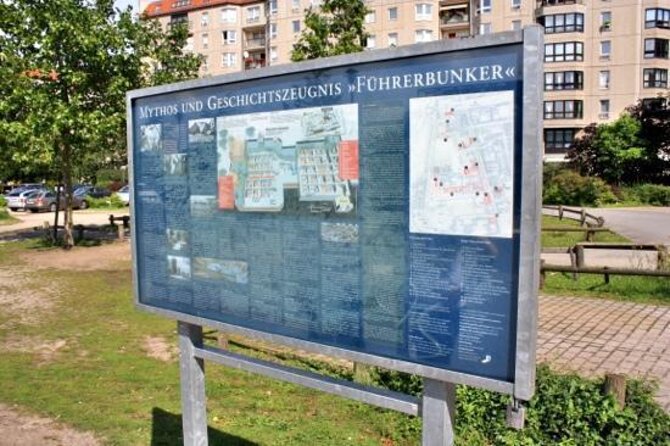
The stop at Hitler’s Bunker is one of the most important and easily misunderstood parts of the tour. You are not entering a preserved underground complex. The original bunker is beneath the area, but the site visible today does not offer a dramatic ruin or exhibition interior.
The guide explains where the bunker was, what happened there during Hitler’s final days, and why the location looks so ordinary now. That absence is part of the story. The site does not glorify the dictator, and it does not turn the bunker into a shrine.
The visit lasts around ten minutes. This is a short stop, but it can carry more weight than a longer visit to a conventional monument. I appreciate that the tour frames the site through historical responsibility rather than spectacle.
You should expect a serious discussion. This is not a stop for casual jokes or sensational stories, and a good guide will keep the focus on the dictatorship, the war, and the consequences of Nazi rule.
More History Walking Tours in Germany
- Berlin: Third Reich, Hitler, and WWII Walking Tour
★ 4.9 · 1,757 reviews - Berlin: History of the Third Reich Guided Walking Tour
★ 4.7 · 791 reviews - Berlin Historical Highlights Walking Tour
★ 4.9 · 657 reviews - Berlin Private Complete History All Day Walking Tour
★ 5.0 · 474 reviews
The Holocaust Memorial and its difficult silence
The Memorial to the Murdered Jews of Europe is one of Berlin’s most affecting public spaces. Its field of concrete blocks creates a changing sense of height, scale, and direction as you walk between them.
The tour allows about fifteen minutes here. The guide adds the historical background needed to understand what the memorial represents: the murder of Europe’s Jews by Nazi Germany. The setting invites reflection, but the site can be difficult to interpret without context.
You will not get a full museum visit as part of this walking tour. Instead, you receive an introduction to the memorial’s meaning and to the crime it commemorates. If the subject matters deeply to you, plan additional time on another day for Berlin’s dedicated museums and documentation centers.
The guide’s role here is especially important. The best approach is calm, precise, and respectful. Several guides on this tour have been praised for clear explanations and for making complex subjects understandable without turning them into a lecture.
Unter den Linden, Berlin’s historic spine
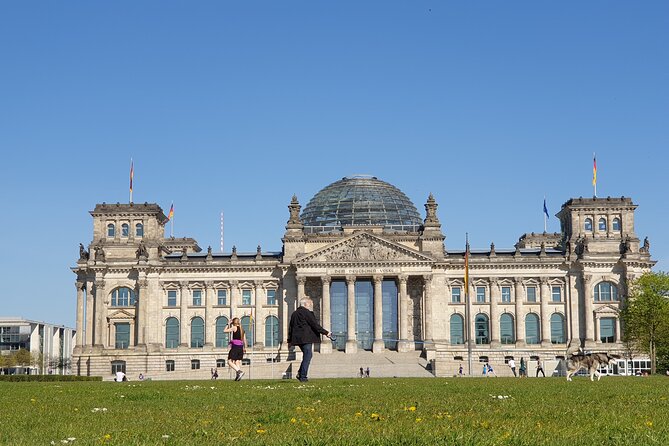
Unter den Linden gives the tour a change of pace. This broad avenue once led toward the royal palace and remains one of the city’s key ceremonial routes.
The guide points out different periods of construction and the marks left by war. This is where Berlin’s layers become visible in the buildings around you. Imperial ambitions, wartime destruction, socialist-era rebuilding, and modern restoration sit close together.
You spend about twenty minutes along the avenue. That longer stop makes sense because there is more to notice here than at a single monument. Look up at the façades, then look at the gaps and rebuilt sections. The guide helps you read the street as a record of changing political power.
I like this part of the tour because it prevents Berlin’s history from becoming only a story of Nazi Germany and the Berlin Wall. The city had a long life before those events, and it continues to change after them.
Bebelplatz, books and memory
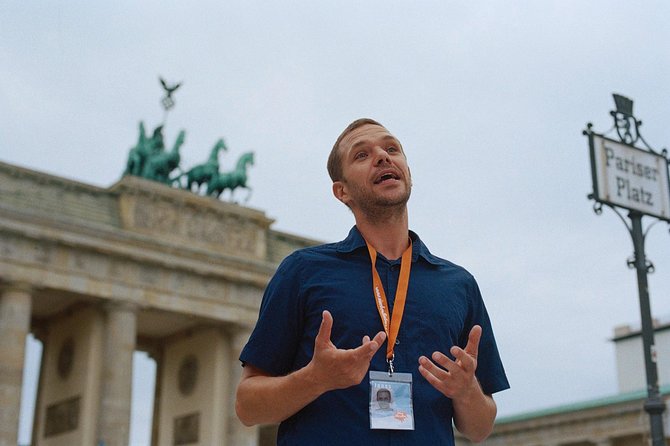
Bebelplatz is a compact square with several important institutions around it, including Humboldt University and the Catholic Cathedral. It is also associated with the Nazi book burning of 1933.
The stop lasts roughly ten minutes. The guide explains how the square became linked to the destruction of books and ideas under the Nazi dictatorship. This is a useful reminder that repression did not begin with the most extreme crimes. It also involved attacks on education, free thought, and public debate.
Bebelplatz is easy to pass without noticing. Its elegant buildings and open space can make it look like another attractive central square. The historical explanation changes that impression.
This is one of the tour’s strongest examples of why a guide adds value. You can see the architecture alone, but you need the story to understand why the square matters.
Brandenburg Gate and the changing meaning of a symbol
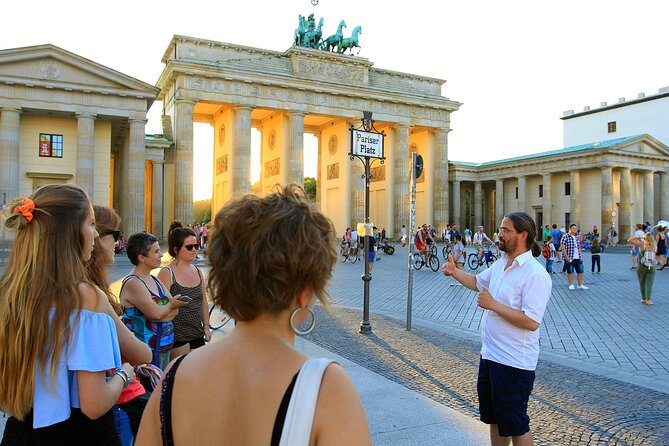
Brandenburg Gate is the tour’s most recognizable landmark. It began as a symbol of royal authority, later became linked with the division of Berlin, and eventually came to represent German reunification.
The stop takes about ten minutes. The guide traces those changes and explains why the gate means different things to different generations.
The gate is visually impressive, but its history is even more interesting than its appearance. It once marked the entrance to Berlin, later sat close to the Wall, and now serves as one of the clearest public symbols of a reunified capital.
You will likely see plenty of people taking photographs here. That is fine, but try to give yourself a moment to listen. The guide’s explanation turns a famous façade into a short lesson about power, borders, and national identity.
The route information places Brandenburg Gate among the major stops and ends near Museum Island. Because central Berlin’s sights are close but not adjacent, listen carefully to the guide’s directions about the final walking stretch and meeting point.
Museum Island, the Berliner Dom, and the final stop
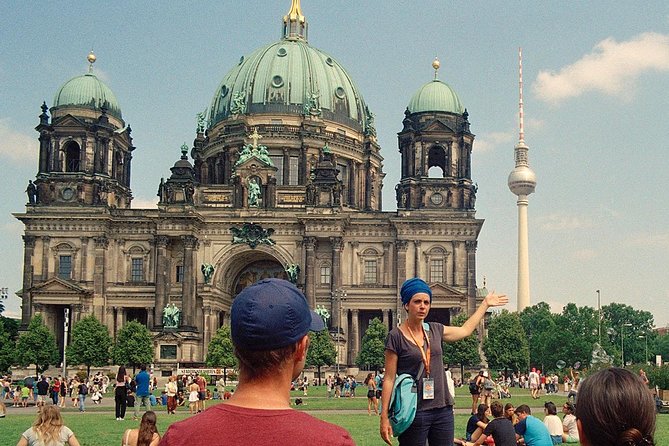
The tour concludes near Museum Island, close to Alexanderplatz and the Berliner Dom. You also see the reconstructed Humboldt Forum, which offers another example of Berlin’s habit of rebuilding, reinterpreting, and debating its architectural past.
This final area is useful for planning the rest of your stay. Museum Island contains major cultural institutions, and the Berliner Dom is one of the city’s most prominent buildings. The walking tour does not include museum entry, so you can choose later whether to return for a longer visit.
The tour allows around fifteen minutes here. It is enough for orientation, exterior views, and an explanation of the area’s place in Berlin’s architectural story.
The endpoint is convenient if you want to continue sightseeing. You can also stop for lunch or use the surrounding public transport connections. Food and drinks are not included, so plan to handle that separately after the walk.
What $27.81 gets you
At $27.81 per person, this is a low-cost way to get a structured introduction to central Berlin. You are paying for a local guide, French-language explanations, local taxes, and a route that connects several major sites without requiring you to plan the order yourself.
The value is not in paid museum entry. There is no substantial indoor admission included, and the major stops are mainly outdoor places or public memorials. The value is in the interpretation: why Checkpoint Charlie mattered, why the bunker site is deliberately unmarked, and how Brandenburg Gate changed meaning over time.
The tour is usually booked about 22 days ahead, which suggests that you should not leave it until the last moment if your dates are fixed. Confirmation is provided at booking, and free cancellation is available until 24 hours before the start time.
Walking comfort, weather, and group size
The tour is fully on foot. The information provided does not give a total distance, but the number of central stops and the three-hour duration make comfortable shoes essential.
You should have moderate physical fitness. Berlin’s central streets are generally manageable, but you will be standing and walking for most of the morning. Wear layers and bring weather protection because the tour operates in all weather conditions.
The maximum group size is 25 people. That is not a private tour, and the absence of audio headsets matters. One participant specifically wished the group had been equipped with an audio system, while the provider has chosen to keep the price accessible rather than add that cost.
For the best experience, stay near the guide and do not drift behind during explanations. If you have hearing concerns or simply prefer quiet, ask at the start where you can stand for the clearest sound.
Who will get the most from this French-language tour
I would choose this tour for a first visit to Berlin, especially if you want the city’s major historical themes explained in French. It is also a good fit if you have only a few days and want to get your bearings before deciding which museums deserve more of your time.
The tour suits solo visitors, couples, and families with older children who can manage three hours of walking and serious subject matter. The guides have been praised for answering individual questions, adjusting the pace, and offering restaurant and sightseeing advice beyond the official route.
It is less suitable if you want a museum-heavy experience, a private guide, or a very slow photography walk. It is also not the best choice if you want to explore the Holocaust Memorial or Berlin Wall sites in great depth. Think of it as a well-organized introduction, not a complete study of the city.
Should you book the Berlin History Walking Tour?
Book it if you want a French-speaking overview of central Berlin at a modest price, with clear links between the Nazi period, the Cold War, reunification, and the city’s modern architecture.
I would book it near the beginning of your stay. The route gives you useful orientation, and the morning finish leaves time to return to a site that deserves more attention, visit a museum on Museum Island, or simply stop for lunch.
Skip it if you dislike group walking, need a headset, or want extended time inside museums. For most first-time French-speaking visitors, though, the combination of famous landmarks, thoughtful historical context, and a convenient three-hour schedule makes this a practical choice.
FAQ
How long does the Berlin history walking tour last?
The tour lasts approximately three hours. One past departure ran for about three and a half hours, but the stated duration is three hours.
What language is the tour conducted in?
The tour operates in French with a professional French-speaking guide.
Where does the tour start?
The meeting point is Potsdamer Platz 10, 10785 Berlin, Germany, near the corner of Gabriele-Tergit-Promenade.
Where does the tour finish?
The tour ends next to Museum Island, at Museumsinsel, 10178 Berlin, near the Berliner Dom and Humboldt Forum.
Does the tour include transportation between attractions?
No. The route is completed on foot, and transportation to and from the attractions is not included.
Is food included?
No. Food and drinks are not included. The morning schedule generally leaves you free to have lunch after the tour.
Can I cancel for a full refund?
Yes. You can cancel at least 24 hours before the local start time for a full refund. Cancellations or changes made less than 24 hours before the start are not accepted for a refund.
Just added around Berlin
- Berlin Food & Cultural Tour: Must-Try German & Berliner Classics★ 5.0 · 51 reviews
- Berlin Half-Day World War II Walking Tour★ 4.5 · 48 reviews
- Small-Group Historical Bike Tour in Berlin★ 4.5 · 103 reviews
- Historic center of Berlin – Tour in Italian★ 5.0 · 143 reviews
- Berlin Cold War & World War II Third Reich Walking Tour★ 4.5 · 30 reviews
- Private Taxi Tour City East & West History and Architecture 3-4h★ 5.0 · 42 reviews
- Berlin Wall and Cold War Bike Tour in Small Groups★ 5.0 · 114 reviews
- Private Tour: Jewish Heritage Walking Tour of Berlin★ 5.0 · 29 reviews
Berlin History Tours, compared.

Berlin: Third Reich & Cold War Guided Walking Tour
Read our review →
Berlin’s Best: 2 Hour Walking Tour Third Reich and the Cold War
Read our review →
Third Reich Berlin: Hitler and WWII Walking Tour
Read our review →
Berlin: Third Reich, Hitler, and WWII Walking Tour
Read our review →
Berlin: 3-Hour World Heritage Cruise to Potsdam
Read our review →
Cold War, Berlin Wall, Spies and the East Side Gallery
Read our review →
Berlin: History of the Third Reich Guided Walking Tour
Read our review →
Browse the lists this tour appears in