
Review · GERMANY
Historical Walking Tour of Augsburg / Historische Führung
Augsburg’s story comes alive when you connect its grand Renaissance town hall with the merchant wealth of the Fuggers, the music of the Mozart family, and the sharper voice of Bertolt Brecht. This walking tour gives you that broad sweep in 150 minutes, ending at Augsburg Cathedral and the Hofgarten.
I like the route’s variety, especially Little Venice, where canals break up the formal parade of squares and monuments. I also like the way the tour links famous names to the city itself, rather than treating Augsburg as a list of unrelated sights. The main drawback is that the tour is in German, and one review noted that the guide was sometimes hard to hear.
Key points at a glance
- Rathausplatz starts the story: Begin beneath the impressive Augsburg Town Hall, the city’s grandest civic landmark.
- The Fugger connection is central: Learn how one of Europe’s most powerful merchant families shaped Augsburg.
- You cover about 5 kilometers: The route takes 2.5 hours and calls for comfortable walking shoes.
- The famous names are local: Visit the birthplace museums of Bertolt Brecht and Leopold Mozart.
- The cathedral gives the tour a strong finish: See Romanesque and Gothic features, 12th-century stained glass, and a detailed bronze door.
- The tour is German-language: A good fit if you understand German and enjoy spoken historical storytelling.
Starting beneath Augsburg’s golden Rathaus
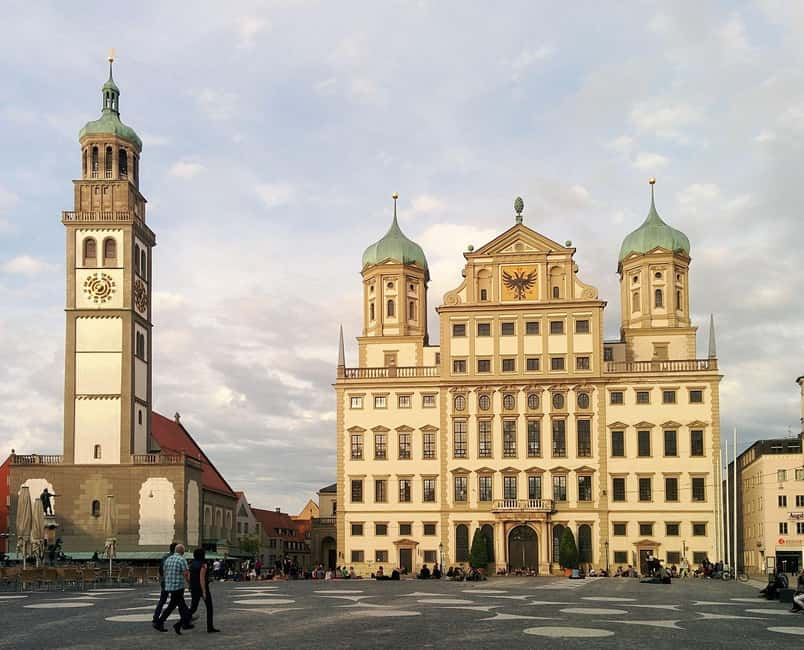
Meet at 10:30 a.m. at Rathausplatz, the central square. Look for the yellow umbrella. This is a sensible starting point because Augsburg’s Town Hall immediately gives you a feel for the city’s old wealth and political importance.
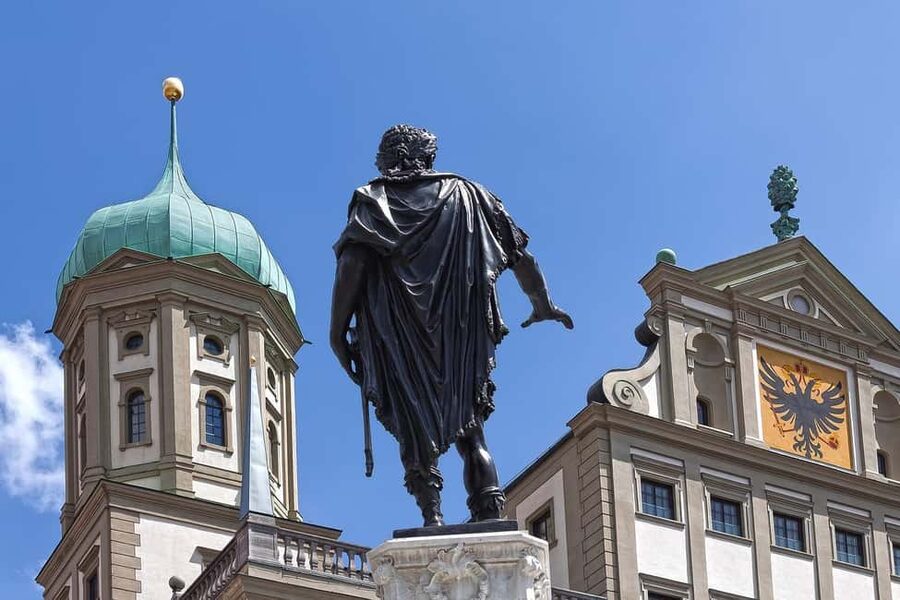
The Rathaus was designed by Elias Holl and is regarded as a Renaissance masterpiece. Its most famous interior space is the Goldener Saal, or Golden Hall. The tour introduces you to this landmark as part of Augsburg’s civic story, though you should not assume that every part of the building is included as a full interior visit. The confirmed included interior sight is Augsburg Cathedral later in the route.
Rathausplatz also puts you beside Perlach Tower, the former watchtower that rises next to the town hall. The tower helps you understand how tightly packed the historic center is. It is also associated with city views, although the tour information does not promise a climb or an observation visit.
I like this opening because you do not begin with a long lecture in an obscure corner. You start at the heart of Augsburg, with the city’s most recognizable buildings in front of you. The guide can then explain how the public face of Augsburg grew alongside the fortunes of its leading families.
More History Walking Tours in Germany
- Berlin: Third Reich & Cold War Guided Walking Tour
★ 4.9 · 8,378 reviews - Munich: Third Reich & WWII Walking Tour
★ 4.6 · 6,181 reviews - Berlin’s Best: 2 Hour Walking Tour Third Reich and the Cold War
★ 5.0 · 5,486 reviews
Following the Fuggers through Augsburg
From Rathausplatz, the walk continues toward Fugger Square. This is where the tour shifts from architecture to money, trade, and influence.
The Fugger family became one of Europe’s most powerful merchant families. Their story matters because Augsburg was not simply an old city with attractive buildings. It was a place where commerce, banking, politics, and religion met. The Fuggers left a mark on the city that you can still trace through its streets and public spaces.
The information here is presented in a relaxed way rather than as a heavy list of dates. That is useful if you are new to Augsburg. One of the strongest parts of the experience is the balance between factual explanation and human stories about the city’s famous figures.
If you already know a great deal about the Fuggers, this portion may feel like an overview rather than a specialist lecture. For most visitors, though, the setting makes the subject easier to remember. You are hearing about the family while walking through the city they helped shape.
The tour also touches on other major cultural figures, including Hans Holbein, according to the experience feedback. That gives the discussion a wider frame and helps you see Augsburg as a center of trade and culture, not only a stop connected to one wealthy family.
A change of pace in Little Venice
The route then reaches Little Venice, a picturesque district defined by canals. This is a welcome change after the formal scale of the Rathaus and the historical weight of Fugger Square.
The nickname points to the water channels and the area’s Venetian feel. You are not getting a full canal excursion or a boat ride. Instead, this is a walking stop where the canals give you a different view of Augsburg’s old center.
I like this part because it prevents the walk from becoming a procession of grand façades. You get a more intimate side of the city, with water and narrower streets adding visual variety. It is also a good place to take photographs, so keep your camera ready.
The tour’s route has been described as roughly 5 kilometers. That is not a brutal distance, but it is enough to matter. You will be on your feet for most of the 2.5 hours, with stops for explanations and sightseeing. Wear shoes you would happily use for a long city walk, not just something that looks good in photos.
Brecht’s birthplace and Augsburg’s sharper voice
Next comes the Brechthaus, the birthplace of playwright Bertolt Brecht. The building now serves as a museum devoted to his life and work.
This stop adds a different tone to the tour. The Fuggers represent commercial power and the Mozarts represent music. Brecht brings literature, theatre, and social criticism into the story. His birthplace makes the connection personal and physical: you are not only hearing that he was associated with Augsburg, but seeing the place where he began his life.
The tour information identifies the Brechthaus as a stop on the walking route, but it does not state that a full museum visit is included. Treat it as a guided look at the site unless your guide tells you otherwise. If Brecht interests you, you may want to return later with more time for the museum.
This is one of the reasons I would choose the tour early in an Augsburg visit. It gives you several names to follow up on. You can decide later if you want more time at the Brechthaus, the Fugger sites, or the Mozart museum.
Same city, a different century:
- Leipzig: City History Canal Sightseeing Tour on a Motorboat
★ 4.7 · 7,671 reviews - Third Reich Berlin: Hitler and WWII Walking Tour
★ 5.0 · 3,301 reviews - Leipzig: 1.5-Hour Historical Walking Tour in German
★ 4.7 · 2,217 reviews - Nuremberg: Medieval Dungeons Guided Tour
★ 4.8 · 2,214 reviews
The Mozart family in Augsburg
The next major cultural stop is the Leopold Mozart Haus, birthplace of Leopold Mozart, Wolfgang Amadeus Mozart’s father.
Many people associate Mozart first with Salzburg or Vienna. Augsburg gives you a different part of the family story. Leopold Mozart was born here, and the house now presents the musical history of the Mozart family.
This is a useful stop for music lovers, but it also works for anyone who enjoys seeing how a major historical figure connects to a particular street and building. The tour does not ask you to treat Mozart as an abstract name. It places his family’s background within Augsburg.
As with the Brechthaus, the route includes the birthplace as a sight, but the supplied details do not promise a full museum admission. If you want to study the exhibits in detail, plan a separate visit. The walking tour is designed to give you context and orientation, not hours inside every museum.
The sequence is well judged. After the commercial story of the Fuggers and the literary story of Brecht, the Mozart stop keeps the tour focused on Augsburg’s links to wider European culture.
Entering Augsburg Cathedral
The final major stop is Augsburg Cathedral, or the Dom. Cathedral access is included, making this more than a photo stop from the street.
The building combines Romanesque and Gothic elements, so you can see different periods of medieval church architecture in one place. Inside, pay attention to the 12th-century stained-glass windows. They are among the key details singled out for this visit and give the cathedral a real sense of age.
Also look for the detailed bronze door. It is an easy feature to miss if you rush toward the main interior, so let the guide direct your attention. The cathedral works well as the closing sight because it brings together art, religion, craftsmanship, and Augsburg’s long urban story.
The tour finishes at the Hofgarten, rather than returning to Rathausplatz. That matters when planning your day. You will need to make your own way back to your hotel, station, or next sight, but ending in the Hofgarten gives you a pleasant place to pause after the walk.
How the guide shapes the experience
The tour is conducted in German, so you should be comfortable following spoken German for 150 minutes. The strongest feedback describes the explanations as relaxed, engaging, and not overloaded with dates. That approach suits Augsburg, where the story can become dry if it is reduced to names and centuries.
A guide named Michael received particular praise for presenting Augsburg with warmth and local feeling. His style was described as authentic, appreciative, and full of useful side comments. If Michael is leading your departure, you can expect a personal connection to the city rather than a purely memorized script.
The main practical caution is volume. One person found the guide occasionally too quiet to understand everything. If you are in a larger group or have difficulty hearing, stay near the guide and mention the problem early. This is a simple step, but it can make a major difference on a walking tour.
The tour is also interactive, according to the feedback provided. That suggests you should expect more than a one-way speech, although the exact format can vary by guide and group.
Pace, walking demands, and weather
The advertised duration is 150 minutes, and the route is described as roughly 5 kilometers. That makes it a moderate city walk. You do not need hiking gear, but comfortable shoes are important.
The route is not suitable for wheelchair users or people with mobility impairments. The tour involves historic streets and a moderate amount of walking, so anyone with concerns should consider that limitation before booking.
The tour runs in weather conditions other than rain or snow. Bring water, dress for the forecast, and carry a camera if you enjoy architectural details. Since there is no hotel pickup, you also need to reach Rathausplatz on your own.
Photography is allowed. The canals at Little Venice, Rathausplatz, Perlach Tower, and the cathedral details give you plenty to photograph without turning the tour into a formal photo walk.
Is $22 a fair price?
At $22 per person, this is a reasonable price for a 2.5-hour guided introduction to Augsburg. You are paying for a live guide, a planned route through several important areas, and access to Augsburg Cathedral.
The value comes from the connections. You are not merely seeing a town hall, a tower, a canal district, two birthplace museums, and a cathedral one after another. The guide ties them to Augsburg’s merchants, artists, writers, musicians, and religious institutions.
Food and drinks are not included, and there is no hotel pickup. Those exclusions are normal for a city walking tour, but you should budget for your own refreshments before or after the route. Since the tour ends at the Hofgarten, you may prefer to plan lunch or a break after finishing rather than interrupting the walk.
The reserve-now-and-pay-later option also gives you some flexibility. You can cancel up to 24 hours in advance for a full refund. That is useful when your Augsburg plans depend on weather or a changing day trip schedule.
Who should book this Augsburg walk?
I would recommend this tour if you want a first look at Augsburg and prefer local explanation to exploring every monument alone. It is especially useful for anyone who wants to understand how the Fuggers, Brecht, Leopold Mozart, Holbein, the Rathaus, and the cathedral fit into one city story.
It suits visitors who can follow German and enjoy a spoken tour with a relaxed pace. It also works well at the beginning of an Augsburg stay because the route helps you choose which museums and buildings deserve a longer return visit.
I would think twice if you need step-free access, dislike walking several kilometers, or want an English-language tour. I would also avoid it in rain or snow, since the tour does not operate in those conditions.
Should you book it?
Book it if you want a compact, well-connected introduction to Augsburg for $22. The best reasons are the varied route, the included cathedral access, and the chance to hear local stories about the Fuggers, Brecht, and the Mozart family in the places linked to them.
Skip it if you need a wheelchair-accessible outing, an English guide, or a detailed museum-by-museum visit. For everyone else who can manage a moderate walk and understand German, this is a practical way to get your bearings and see why Augsburg deserves more than a quick look from the train window.
FAQ
Where does the Augsburg walking tour begin?
The tour begins at Rathausplatz in Augsburg. Meet at 10:30 a.m. and look for the yellow umbrella.
Where does the tour finish?
The tour finishes at the Hofgarten.
How long does the walking tour last?
The tour lasts 150 minutes, or 2.5 hours.
What language is the tour conducted in?
The live tour guide speaks German.
What sights are included on the route?
The route includes Rathausplatz, Augsburg Town Hall, Perlach Tower, Fugger Square, Little Venice, Brechthaus, Leopold Mozart Haus, and Augsburg Cathedral.
Is Augsburg Cathedral included?
Yes. Access to Augsburg Cathedral is included in the tour.
Is hotel pickup provided?
No. Hotel pickup is not included, so you must reach Rathausplatz on your own.
How much walking is involved?
The tour involves a moderate amount of walking and is described as roughly 5 kilometers. Comfortable shoes are recommended.
Does the tour operate in bad weather?
The tour does not operate when it is raining or snowing. It runs in other weather conditions, so dress appropriately.
Can I cancel for a full refund?
Yes. You can cancel up to 24 hours in advance for a full refund.
Just added around Germany
- Berlin Food & Cultural Tour: Must-Try German & Berliner Classics★ 5.0 · 51 reviews
- Berlin Half-Day World War II Walking Tour★ 4.5 · 48 reviews
- Small-Group Historical Bike Tour in Berlin★ 4.5 · 103 reviews
- Historic center of Berlin – Tour in Italian★ 5.0 · 143 reviews
- Berlin Cold War & World War II Third Reich Walking Tour★ 4.5 · 30 reviews
- Private Taxi Tour City East & West History and Architecture 3-4h★ 5.0 · 42 reviews
- Berlin Wall and Cold War Bike Tour in Small Groups★ 5.0 · 114 reviews
- Private Tour: Jewish Heritage Walking Tour of Berlin★ 5.0 · 29 reviews
Germany History Tours, compared.

Berlin: Third Reich & Cold War Guided Walking Tour
Read our review →
Leipzig: City History Canal Sightseeing Tour on a Motorboat
Read our review →
Berlin’s Best: 2 Hour Walking Tour Third Reich and the Cold War
Read our review →
Third Reich Berlin: Hitler and WWII Walking Tour
Read our review →
Leipzig: 1.5-Hour Historical Walking Tour in German
Read our review →
Berlin: Third Reich, Hitler, and WWII Walking Tour
Read our review →Browse the lists this tour appears in