Review · BERLIN
Private Walking Tour: World War 2 and Cold War Sites in Berlin
Berlin’s most important 20th-century sites are scattered across the city, and many look ordinary until someone explains what happened there. This private walk connects Hitler’s bunker site, the Holocaust Memorial, Checkpoint Charlie, the Berlin Wall, and other key places into one clear story.
I like the private format, since your guide can spend more time on the subjects that matter to you. I also like the chance to adjust the pace and route, a real help when you have already seen some central sights or want to focus on one period.
The main catch is that the advertised stops cover more ground than a normal three or four-hour walk can reasonably include. You must tell the operator your priorities before the tour, and you should expect a serious amount of walking with no food or drinks included.
Key points at a glance
- Choose your history: Focus on Nazi Germany, the Cold War, or a blend of both.
- Private attention: Only your group takes part, so questions and pacing can be tailored.
- Major Berlin landmarks: See the Brandenburg Gate, Reichstag, Holocaust Memorial, Hitler’s bunker site, Checkpoint Charlie, and sections of the Berlin Wall.
- Useful first-day orientation: The tour links central sights and can help you decide what to visit later on your own.
- Strong guide reports: Guides including Hannah, Glen, Ariel, Maria, Jamie, Daniel, and Joerg are praised for clear explanations and flexible pacing.
- Plan the route carefully: The East Side Gallery, Tempelhofer Feld, Bernauer Strasse, and Prenzlauer Berg are not all close together.
Why this private Berlin history walk works
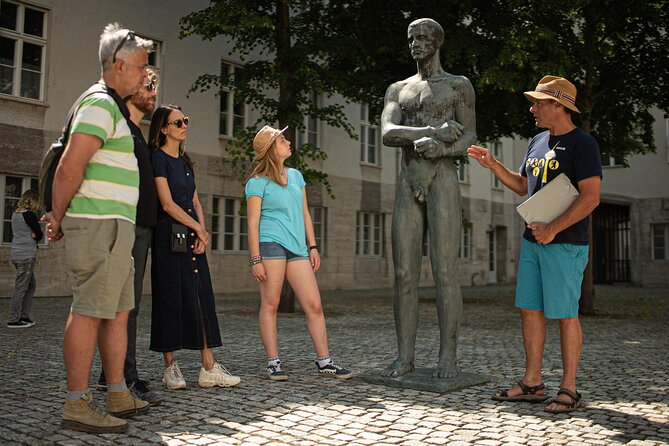
Berlin does not explain itself at street level. A plain office building may have been part of the Nazi government. An empty patch of ground may mark the end of Hitler’s regime. A wall fragment may tell a story about families separated for decades.
That is where a private guide earns the price. Instead of simply pointing out monuments, your guide can explain how the Nazi dictatorship took power, how the war destroyed Berlin, and how the city was then split between the Soviet-backed East and the Western Allies.
I especially like this tour for a first full day in Berlin. Several people who took it early in their stay used the walk to understand the city’s layout and choose what to see next. You may also learn how to use the U-Bahn and S-Bahn, as one guide, Jamie, reportedly worked into the experience.
The tour is offered in English, with morning or afternoon departures. Your guide meets you in the lobby of a central Berlin hotel, and hotel pickup and drop-off are included. The exact transport arrangement is not specified, so it is sensible to confirm how pickup and return work when you book.
More History Walking Tours in Berlin
- Berlin: Third Reich & Cold War Guided Walking Tour
★ 4.9 · 8,378 reviews - Berlin’s Best: 2 Hour Walking Tour Third Reich and the Cold War
★ 5.0 · 5,486 reviews - Third Reich Berlin: Hitler and WWII Walking Tour
★ 5.0 · 3,301 reviews
The Reichstag and Brandenburg Gate
The Reichstag is a natural starting point for Berlin’s modern political story. The building is now home to the German Parliament, but the tour uses it to discuss the fall of the Third Reich, the Battle of Berlin, and the city Adolf Hitler and architect Albert Speer imagined as Germania.
You may also hear about Claus von Stauffenberg and other Germans who opposed the Nazi regime. That adds welcome complexity to a subject often reduced to Hitler and military defeat. The focus is not only on Nazi power, but also on resistance, responsibility, and the people who tried to stop the dictatorship.
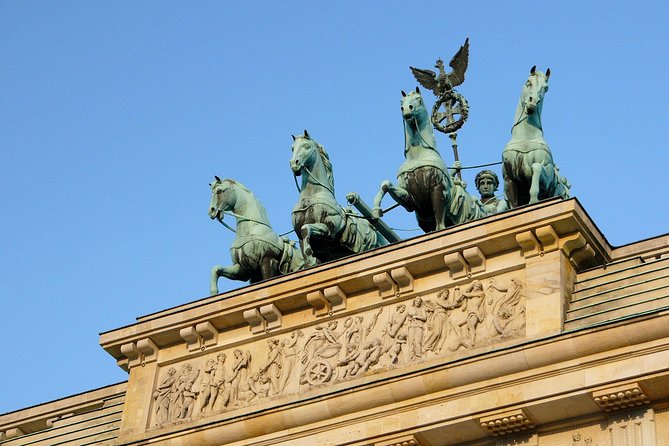
A short walk brings you to the Brandenburg Gate. Once a symbol of division, it became a sign of German unity after the Berlin Wall fell. Your guide can connect the gate to the Cold War, the political history of Berlin, and the way public monuments change meaning over time.
The Reichstag and Brandenburg Gate are free to view from outside. The tour does not include entry to the Reichstag dome, so do not book this experience expecting an interior visit.
The Holocaust Memorial and Hitler’s bunker site
The Memorial to the Murdered Jews of Europe is one of Berlin’s most powerful places. Its 2,711 concrete slabs form a grid near the Brandenburg Gate. The blocks vary in height, and walking between them can feel disorienting and uncomfortable by design.
Your guide can help provide the historical setting, but this is also a place where you should have time to pause. The underground information center contains personal accounts and historical material about the Holocaust. The itinerary allows about 15 minutes at the memorial, so ask in advance if you want more time or plan to return later on your own.
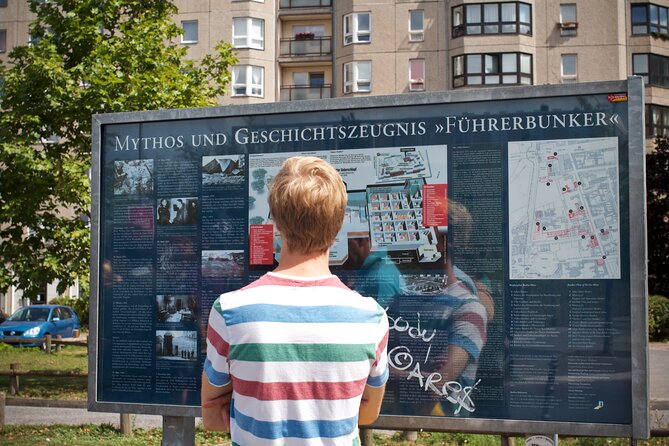
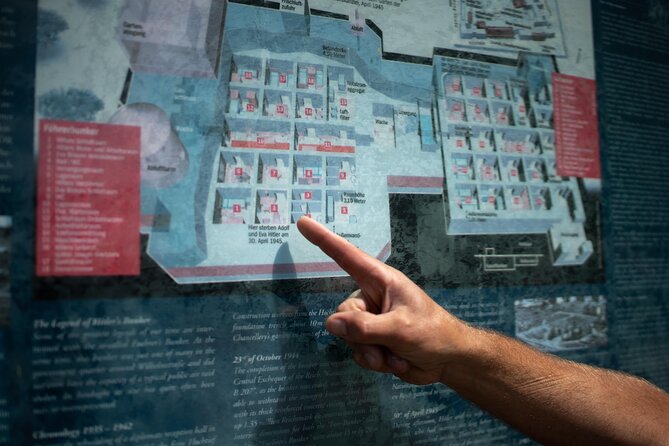
Nearby, you will visit the location of Hitler’s bunker. There is no grand entrance or preserved underground chamber to tour. Instead, you see the unremarkable site and learn why this spot mattered during the final days of Nazi rule.
That contrast is part of the lesson. One of the most infamous places in modern European history is now marked in a low-key way, rather than turned into a shrine. I find the stop most useful when the guide explains what happened there and how Berlin has chosen to remember it.
The former Aviation Ministry and Topography of Terror
The former Reich Air Ministry is one of the few large Nazi-era buildings still visible in Berlin. Built in 1936, it housed the Luftwaffe and was linked to Hermann Göring. Its size and severe design were meant to project state power.
The building survived the war and later served East Germany’s Ministry of Transport. Today, its changing use gives you a quick lesson in how Berlin’s political systems occupied and repurposed the same city.
At the Topography of Terror, you learn about the SS, Gestapo, and SD, the agencies that helped carry out Nazi persecution and terror. The site now contains an exhibition about the perpetrators and the machinery of repression.
This stop is especially valuable if you want more than battlefield stories. It focuses on administration, policing, and the everyday systems that made mass violence possible. The exhibition is also a useful place to return after the walking tour if you want more time with the material.
More History Walking Tours in Germany
- Berlin: Third Reich, Hitler, and WWII Walking Tour
★ 4.9 · 1,757 reviews - Berlin: History of the Third Reich Guided Walking Tour
★ 4.7 · 791 reviews - Berlin Historical Highlights Walking Tour
★ 4.9 · 657 reviews - Berlin Private Complete History All Day Walking Tour
★ 5.0 · 474 reviews
Checkpoint Charlie and the human cost of division
Checkpoint Charlie was the best-known crossing between East and West Berlin. In 1961, American and Soviet tanks faced each other here during a dangerous standoff. Your guide can explain how this small crossing became a global symbol of the Cold War.
The area also brings up espionage, escape attempts, and the practical cruelty of a border that split families and friends. The most important point is that the Cold War was not just a contest between superpowers. Berliners lived with walls, guards, restricted movement, and the risk of imprisonment.
Today, Checkpoint Charlie is heavily commercialized. You will find souvenir shops and a recreated guardhouse rather than a preserved border crossing in its original form. That can disappoint anyone expecting an untouched historic site, but a good guide helps separate the modern display from the real events.
I would not make Checkpoint Charlie the sole reason to book this tour. It works best as one chapter in a wider explanation of Berlin’s division.
The Palace of Tears at Friedrichstrasse
The Tränenpalast, or Palace of Tears, was the departure hall at Friedrichstrasse Station from 1961 to 1989. East Germans crossing into West Berlin often had to say goodbye to relatives and friends there, sometimes without knowing when they would meet again.
The name comes from those painful farewells. The museum inside covers the personal side of the Cold War, including travel restrictions and the emotional strain placed on ordinary families.
This is one of the most human stops on the route. Checkpoint Charlie explains the political standoff, while the Palace of Tears shows what division felt like at close range.
The listed visit lasts about 20 minutes. If the museum is important to you, mention it when arranging the tour so the guide can allow enough time.
Bernauer Strasse and the Berlin Wall Memorial
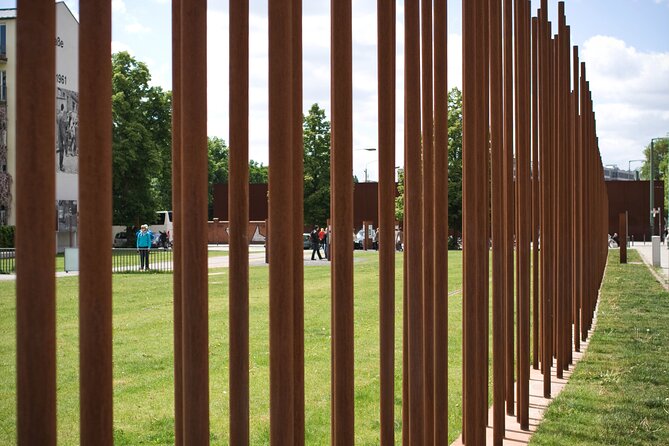
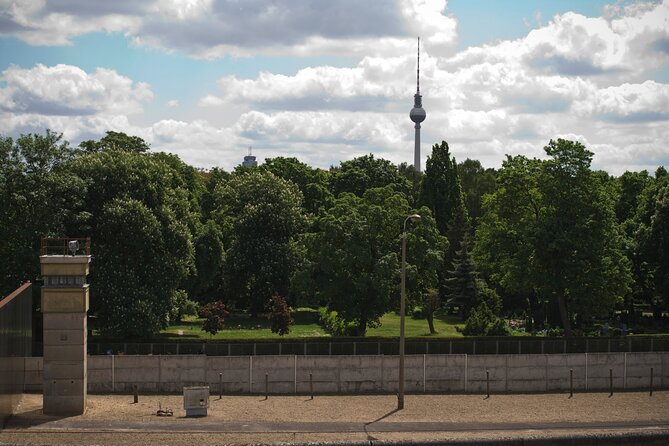
The Berlin Wall Memorial on Bernauer Strasse preserves one of the clearest sections of the former border. When the Wall went up in 1961, the street was split apart. Residents in the East were trapped on one side while people in the West watched from nearby windows.
The memorial includes sections of the Wall, a watchtower, and a documentation center. It also explains escape attempts, including Tunnel 29 and Tunnel 57. Tunnel 29 helped 29 people reach West Berlin in 1962. Tunnel 57 helped 57 people escape in 1970.
This site gives you more physical evidence than Checkpoint Charlie. You can see how the border system worked and understand why escape required planning, courage, and enormous risk.
The memorial is farther north than the central sights. Getting there as part of a walking tour takes time, so it may replace other stops rather than simply being added to them. If Bernauer Strasse is high on your list, say so before the tour begins.
Prenzlauer Berg and East Side Gallery
In Prenzlauer Berg, the tour can visit an old NKVD prison later used by the East German Stasi. The stop focuses on interrogation methods, imprisonment, and the way Germany deals with its destructive past.
This is a less polished part of the story than the Brandenburg Gate. It helps you understand that political repression did not end in 1945. Soviet security services and East Germany’s secret police continued their own systems of control after the war.
The East Side Gallery offers a very different mood. It runs along the longest remaining section of the Berlin Wall and is covered with murals about freedom, justice, and political change.
The artwork is an important part of modern Berlin, but the gallery is not near every central stop. It is best included when your group wants a Cold War focused route and is willing to give up some central locations.
Tempelhofer Feld and the Berlin Airlift
Tempelhofer Feld occupies the former Tempelhof Airport, a Nazi-era project later used by the Allies during the Berlin Airlift of 1948 and 1949. The airport is no longer operating, and the open grounds are now used as a huge public recreation area.
This stop connects Nazi architecture, postwar occupation, and the early Cold War in one place. It also gives you a change of pace from memorials and government buildings.
Tempelhofer Feld is well outside the compact central route. A 20-minute stop is enough for an overview, not a full exploration of the former airport. Include it only if the airlift and Berlin’s divided postwar years matter more to you than seeing every central landmark.
How much walking should you expect?
This is a genuine walking tour, not a sightseeing ride with a few short strolls. The complete list of possible stops would require more time than the advertised three to four hours, particularly if you include Tempelhofer Feld, Bernauer Strasse, Prenzlauer Berg, and East Side Gallery.
You will do best if you choose a theme and two or three priorities. For example:
- Nazi history: Reichstag, Brandenburg Gate, Holocaust Memorial, Hitler’s bunker site, former Aviation Ministry, and Topography of Terror.
- Cold War history: Checkpoint Charlie, Palace of Tears, Bernauer Strasse, and East Side Gallery.
- A balanced route: Brandenburg Gate, Holocaust Memorial, Hitler’s bunker site, Checkpoint Charlie, and one Berlin Wall location.
Wear comfortable shoes and bring water. One negative account described four hours without a drink break, while other accounts praised guides for adjusting the pace for older people and for handling rain or cold. The private setup gives you a chance to request breaks, but you should make that need clear at the start.
The guide makes the difference
The company uses different guides, so the individual style can vary. Hannah, Glen, Ariel, Maria, Jamie, Daniel, Joerg, Klaus, and others are praised for clear explanations, friendly manner, and the ability to shape the walk around a group’s interests.
Several guides use old photographs or visual material to show how places looked before and after the war. That can be especially helpful at the Wall and bunker site, where little remains on the ground.
A guide who knows when to linger and when to move on is essential here. The strongest experience will come from asking questions and telling the guide what you have already seen. If you have watched documentaries, studied the Nazi period, or mainly want the human story of divided Berlin, say so before the route is fixed.
One caution is worth noting. A private tour is not automatically a great history lesson. The company’s overall rating is five out of five from 230 reviews, but one account described a guide who could not explain basic political terms clearly and failed to reach expected sites. That is why your pre-tour requests matter. Confirm the main stops, walking expectations, and whether hotel pickup and drop-off fit your plans.
Is the $192.97 price fair?
At $192.97 per person, this is expensive if you are traveling alone or as a couple. The price is easier to justify for a larger family or small private group, since you are buying personal attention rather than a standard group walk.
You are paying for an expert English-speaking guide, a private route, hotel pickup and drop-off, and the ability to focus on WWII, the Cold War, or both. The attractions themselves are generally viewed from outside, and food, drinks, and paid admissions are not included.
I see the value in booking this early in your Berlin stay. You can use the guide to get oriented, learn which museums deserve your time, and avoid wandering past important sites without understanding them. I would not book it if you prefer to explore quietly, dislike long walks, or want a fixed route with guaranteed entry to museums.
Free cancellation is available up to 24 hours before the start time. The experience is near public transportation, service animals are allowed, and most people can participate, but the walking distance remains the key physical consideration.
Who should book this tour?
Book it if you want history explained on location rather than read from a guidebook. It suits first-time Berlin visitors, families with different interests, and people who want to ask many questions without slowing down a larger group.
It is also a good match for anyone who has already seen central Berlin but wants the missing connections. A guide can adjust the route around places you have visited and take you toward sites you would likely miss alone.
I would choose a different format if you want extensive museum time, a leisurely pace, or a tour limited to one neighborhood. The guide can tailor the route, but a half-day cannot cover every major WWII and Cold War site in Berlin.
Should you book it?
I would book this private walk if Berlin’s Nazi and Cold War past is a central reason for your visit, especially near the beginning of your stay. The strongest features are the private format, the chance to set priorities, and guides who can connect ordinary streets with events that changed Europe.
Before paying, send a short list of must-see sites. If you want East Side Gallery, Bernauer Strasse, Tempelhofer Feld, or the Palace of Tears, name them directly. With realistic expectations about walking and route limits, this can give you a clear, human introduction to Berlin’s hardest chapters.
FAQ
How long does the private Berlin history tour last?
The tour lasts approximately three to four hours.
Can I choose between WWII and Cold War history?
Yes. You can focus on World War II, the Cold War, or request a combination of both.
Is the tour private?
Yes. Only your group participates in the activity.
Is hotel pickup and drop-off included?
Yes. Hotel pickup and drop-off are included, with the tour beginning at a central Berlin hotel lobby.
Is the tour offered in English?
Yes. The experience is offered in English.
Which major Berlin sights can be included?
Possible sights include the Reichstag, Brandenburg Gate, Holocaust Memorial, Hitler’s bunker site, former Aviation Ministry, Topography of Terror, Checkpoint Charlie, Palace of Tears, Berlin Wall Memorial, Tempelhofer Feld, Prenzlauer Berg, and East Side Gallery.
Does the tour include food and drinks?
No. Food and drinks are not included.
Is admission to the attractions included?
The listed stops have no admission ticket included or required for the outdoor visits. The tour does not list paid museum admission as included.
Can I cancel for a full refund?
Yes. You can cancel at least 24 hours before the experience start time for a full refund. Changes or cancellations made less than 24 hours before the start time are not accepted for a refund.
More Private History Tours in Germany
- Private Walking Tour: Berlin Wall, Cold War and Checkpoint Charlie
★ 5.0 · 37 reviews - PRIVATE BEHIND THE BERLIN WALL and COLD WAR BERLIN TOUR
★ 5.0 · 36 reviews - Private Tour: Jewish Heritage Walking Tour of Berlin
★ 5.0 · 29 reviews - Private Berlin WWII and Cold War History Tour with Local Expert Guide
★ 5.0 · 28 reviews
More Private History Tours in Berlin
- Private Walking Tour Berlin Third Reich Hitler and World War II
★ 5.0 · 360 reviews - Berlin Private Half-Day Walking Tour: Discover the German Capital’s History
★ 5.0 · 244 reviews - The History of Berlin: WWII PRIVATE Walking Tour With Locals
★ 5.0 · 209 reviews - Private Taxi Tour City East & West History and Architecture 3-4h
★ 5.0 · 42 reviews
Just added around Berlin
- Berlin Food & Cultural Tour: Must-Try German & Berliner Classics★ 5.0 · 51 reviews
- Berlin Half-Day World War II Walking Tour★ 4.5 · 48 reviews
- Small-Group Historical Bike Tour in Berlin★ 4.5 · 103 reviews
- Historic center of Berlin – Tour in Italian★ 5.0 · 143 reviews
- Berlin Cold War & World War II Third Reich Walking Tour★ 4.5 · 30 reviews
- Private Taxi Tour City East & West History and Architecture 3-4h★ 5.0 · 42 reviews
- Berlin Wall and Cold War Bike Tour in Small Groups★ 5.0 · 114 reviews
- Private Tour: Jewish Heritage Walking Tour of Berlin★ 5.0 · 29 reviews
Berlin History Tours, compared.

Berlin: Third Reich & Cold War Guided Walking Tour
Read our review →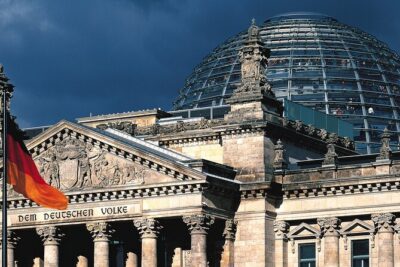
Berlin’s Best: 2 Hour Walking Tour Third Reich and the Cold War
Read our review →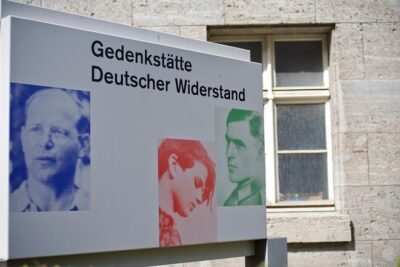
Third Reich Berlin: Hitler and WWII Walking Tour
Read our review →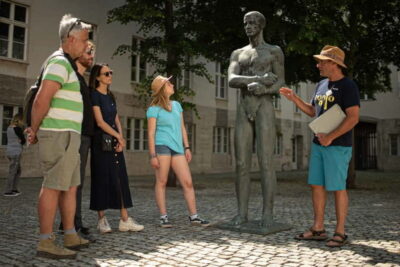
Berlin: Third Reich, Hitler, and WWII Walking Tour
Read our review →
Berlin: 3-Hour World Heritage Cruise to Potsdam
Read our review →
Cold War, Berlin Wall, Spies and the East Side Gallery
Read our review →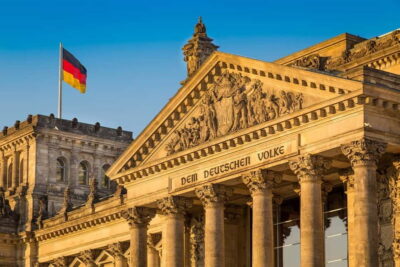
Berlin: History of the Third Reich Guided Walking Tour
Read our review →