Review · NAPLES
Herculaneum Small Group Tour and Ticket With an Archaeologist
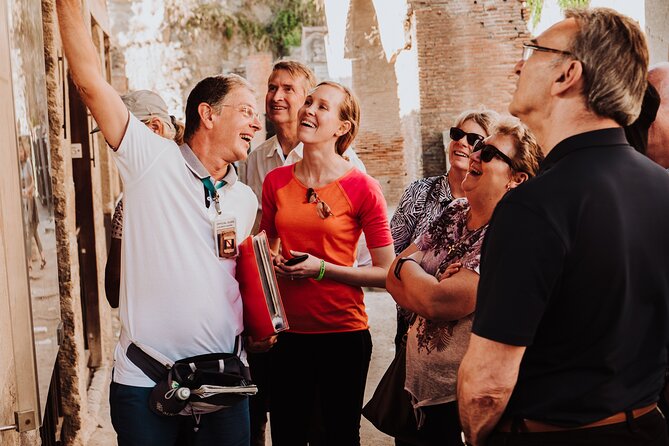
Herculaneum feels different from Pompeii because its homes still hold startling details: carbonized wood, painted walls, tiled floors, and even a wooden room divider. This tour gives you a working archaeologist to explain what you are seeing, and guides such as Luciano Leone, Paulo, Julia, and Antonella have been praised for bringing ordinary Roman life into focus.
I like the included entry ticket and skip-the-line access, and I like the headsets, which help when a guide is explaining details in a busy ruin. The main tradeoff is time: two hours goes quickly, and a guide who runs long or speaks fast can leave little room for the museum or for exploring on your own.
Key points to know before booking
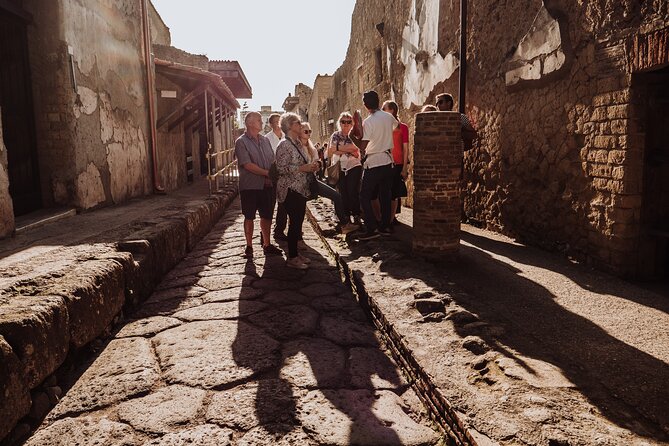
- See Herculaneum’s best-preserved homes: The route includes the House of the Deer, House of the Black Salon, Casa Sannitica, and several other major residences.
- Learn from an archaeologist: Guides connect architecture, engineering, household life, religion, and the disaster that buried the town.
- Skip the ticket queue: Your Herculaneum entry is included, saving you from arranging admission separately.
- Expect a maximum group of 20: Some departures may be much smaller, but 20 is the stated limit per guide.
- Plan for steady walking and standing: There are few chances to sit, and uneven archaeological paths require sensible shoes.
- Stay afterward if you can: The tour ends inside the ruins, so you can continue at your own pace and visit the onsite museum.
Why Herculaneum deserves its own morning
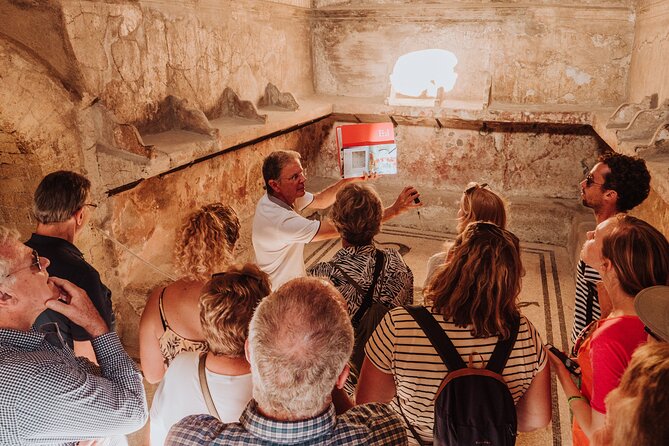
If you have already heard people compare Herculaneum with Pompeii, the short version is this: Pompeii is larger, while Herculaneum often feels more intimate and more sharply detailed. The ancient town was buried by Mount Vesuvius in AD 79, and the material preserved here includes wooden doors, beams, furniture fragments, frescoes, mosaics, and household fittings.
That level of preservation makes the site unusually good at showing daily life. You are not just looking at foundations. You might see the shape of a doorway, a decorated room, a bath complex, or a courtyard arrangement that helps you picture how a Roman family used its home.
A guide matters here because the ruins can look confusing at first. Several houses share similar plans, and the most important evidence is often a small feature at floor level or high on a wall. A trained guide can point out what deserves your attention before you walk past it.
The tour is priced at about $53.81 per person. That includes the Herculaneum ticket, which is listed at 16 euros for adults, plus the guide, assistance, small-group setup, and headsets. It is not the cheapest way to enter the site, but it is fair value if you want the remains explained rather than simply photographed.
More Ancient History Tours in Italy
- Herculaneum: Skip-the-Line Guided Tour with Archaeologist
★ 4.8 · 3,439 reviews - From Naples: Pompeii & Herculaneum with Archaeologist Guide
★ 4.8 · 665 reviews - From Naples: Ruins of Pompeii
★ 4.3 · 204 reviews
Meeting at the Corso Resina entrance
The meeting point is the Herculaneum ticket office at Corso Resina 187, near the archaeological entrance in Ercolano. The end point is inside the ruins, which is useful because you do not need to walk back to the starting point with the guide.
By train, use the Circumvesuviana station at Corso Resina 1. The station is about a 10-minute walk from the meeting point. This makes the tour practical from Naples, provided you allow enough time to find the ticket office and arrive before the scheduled start.
By car, there is an unguarded parking area close to the meeting place on Via Pignalver. Do not treat the parking as supervised or secured. If you are using public transport, the train is the simpler option because private transportation is not part of the tour.
Look for the tour coordinator at the meeting point and keep your booking confirmation available. On one occasion, a coordinator used WhatsApp to clarify the meeting details, and the team was also able to help when a participant arrived a few minutes late. Still, do not build your plan around running late. The group may need to leave on time.
House of the Deer and the terrace of M. Nonius Balbus
The first stop is the House of the Deer, named for marble statues of stags found in its peristyle. A peristyle is a courtyard surrounded by columns, often used as an open-air center for a Roman home.
This is a good opening stop because it introduces the scale and ambition of Herculaneum’s private residences. The deer statues are not just decoration. They help you see that this was a prosperous home designed to impress.
The route then moves to the terrace of M. Nonius Balbus. Balbus was a major benefactor who restored and built public structures in the town. After his death, he received honors that are recorded in a long inscription on his funeral altar.
Here, your guide can connect private wealth with public status. Roman civic life depended heavily on wealthy people funding buildings, repairs, and monuments. The stop is brief, but it helps explain why one person’s name appears so prominently in the town.
The College of the Augustales and Casa del Rilievo di Telefo
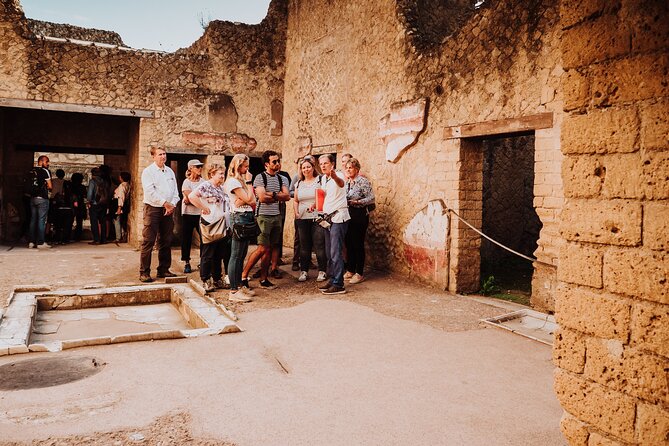
The College of the Augustales is thought to have been linked to the worship of Emperor Augustus. It may also have served as the local headquarters of the Augustales or even as a civic meeting place.
That uncertainty is useful rather than frustrating. Archaeological sites do not come with labels written by their original owners. Your guide can explain what scholars believe, what evidence supports it, and where the interpretation remains open.
Next comes the Casa del Rilievo di Telefo, a large house possibly connected with Marcus Nonius Balbus. Its unusual feature is private access to the Suburban Thermae, the bath complex south of the house.
A private route to the baths tells you something about the owner’s status and about how Roman homes could connect with public or semi-public facilities. Pay attention to the relationship between the house and the baths, not just the decoration. The layout itself is part of the story.
More Ancient History Tours in Naples
- Naples: Pompeii Archaeology Park Tour & Skip-the-Line Entry
★ 4.8 · 190 reviews - Pompeii: Private Tour with an Archaeologist
★ 4.9 · 168 reviews - Herculaneum Private Tour with an Archaeologist
★ 5.0 · 132 reviews - Pompeii and Herculaneum led by an Archaeologist with private transport
★ 5.0 · 78 reviews
Wooden survival in the House of the Wooden Partition
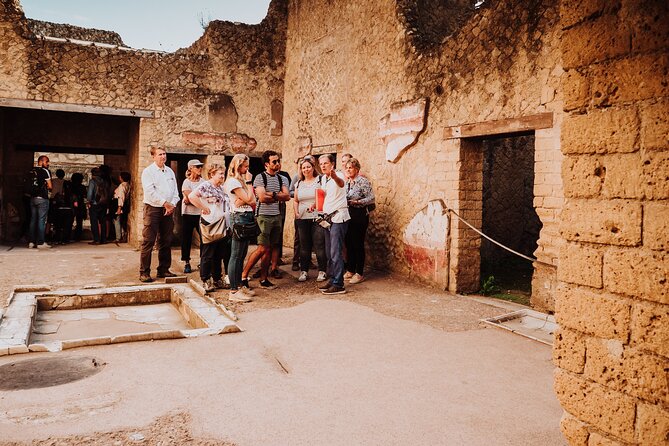
The Casa del Tramezzo di Legno, or House of the Wooden Partition, is important because a graceful wooden divider survived the eruption. Carbonized wood is one of Herculaneum’s most memorable details. It gives the ruins a human scale that bare stone cannot provide.
This is the kind of stop where a guide earns the fee. A wooden partition may look modest, but it shows how rooms were divided and how much ordinary construction has vanished at other Roman sites. Guides can also help you understand that carbonization preserved the form of the object, even though the material was changed by intense heat.
You will spend about 10 minutes at each listed stop. That keeps the visit moving, but it also means you should avoid getting stuck taking photographs at the first few houses. The tour is designed to show a broad selection of Herculaneum rather than provide a long study of one building.
The House of the Skeleton and the Central Thermae
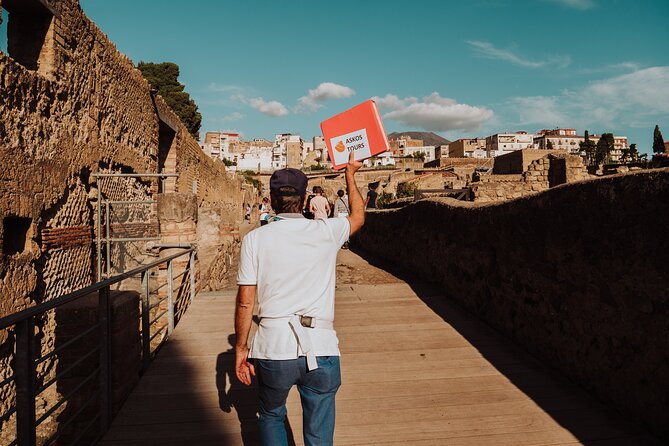
The House of the Skeleton probably formed from three smaller buildings joined together. Its name comes from human remains found in an upstairs room in 1831.
This stop brings the disaster into the tour, but it also raises questions about how archaeologists identify changes to a building over time. The combined structure is a reminder that ancient homes were altered, expanded, and reused, just as modern homes are.
The Central Thermae date from around the beginning of the first century AD. They were divided into men’s and women’s bathing areas, each with its own entrance.
The baths help you understand the social side of Roman life. Bathing was not simply a private chore. It was part of public routine and community life. Look for the practical design and the division of spaces as your guide explains how the complex worked.
This is also one of the more physically demanding portions of the visit. The tour involves walking and standing, with limited opportunities to sit. If someone in your party has trouble standing for long periods, ask the guide to help you pace yourself.
The House of the Black Salon and Casa Sannitica
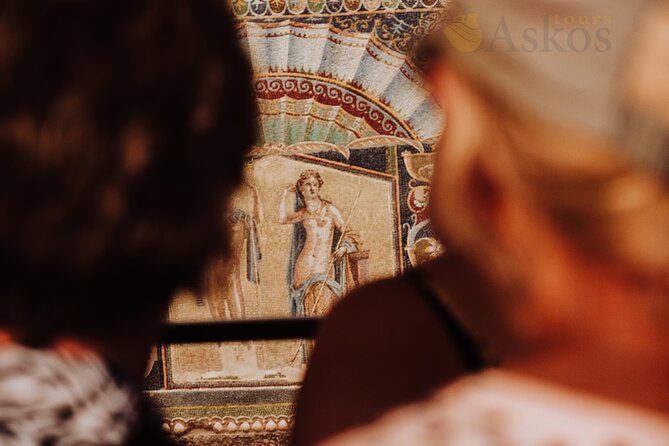
The House of the Black Salon is one of the town’s more luxurious mansions. Its entrance still preserves carbonized doorposts and a lintel, giving you a rare look at what was once a functioning doorway.
The name refers to the dark decoration of its main hall. The monumental entrance sets the tone before you even reach the interior. I would pause here to look at the contrast between the surviving architectural frame and the painted surfaces inside.
Casa Sannitica has an arrangement linked with the Samnites, an ancient people associated with this part of central Italy. Its atrium is surrounded by a gallery with Ionic columns, and its rooms retain fresco decoration.
This house is a chance to compare styles rather than simply collect names. The guide can point out how the atrium, gallery, columns, and painted rooms fit together. You begin to see each home as a designed social space, not a random collection of walls.
The headsets are particularly useful in these enclosed areas. A group of 20 can easily spread across a room or corridor, and the audio equipment helps you keep listening without crowding around the guide.
Casa del Bel Cortile and the House of the Grand Portal
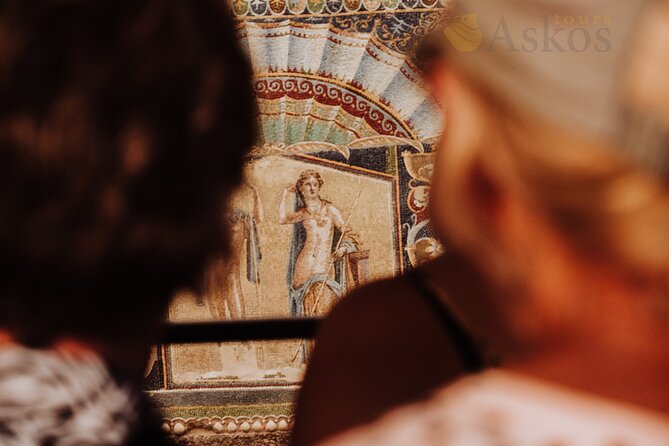
Casa del Bel Cortile is one of Herculaneum’s more unusual homes. Instead of the standard atrium arrangement, it has a courtyard with a stairway and stone balcony.
That difference is worth noticing. Roman houses followed patterns, but they were not identical. A courtyard and balcony could shape the movement through the home and change how residents used its upper and lower levels.
The last listed stop is the House of the Grand Portal, a handsome domus in the center of the archaeological area. It includes columns, frescoes, and carbonized wooden elements.
By this point, the tour has shown you a useful range of Herculaneum: wealthy homes, civic or religious buildings, bathing facilities, memorials, and modest but revealing construction details. The sequence works well as an overview, though two hours does not allow long pauses in every room.
Guides bring different strengths. Luciano Leone has used visual reconstructions and images he made himself to show how buildings may have looked 2,000 years ago. Other guides praised for their clear delivery include Paulo, Julia, Antonella, Sergio, Gennaro, Diego, Marie, and Michael. You cannot choose a particular guide from the information provided, but the guide’s skill will shape the experience.
What the archaeologist adds
The strongest reason to book this tour is interpretation. An audio guide can tell you dates and names, but an archaeologist can respond to what you are looking at and adjust the explanation to the group.
The best guides on this route have explained engineering, architecture, household routines, social rank, and the lives and deaths of Herculaneum’s residents. Some have also used humor and visual material, keeping the information lively instead of turning the walk into a string of dry facts.
Guide style can vary. One guide was described as moving quickly so the group could see as much as possible. Another was said to speak too fast. If you need a slower pace or use hearing aids, say so early. One guide regularly checked that a participant could hear, which is exactly the sort of small adjustment that makes a major difference.
The group limit is 20 people per guide, but some departures have been much smaller, including a group of six and another of 12. A smaller group makes it easier to ask questions and stay close to the guide. You should still expect a shared tour, not a private visit.
Time, weather, and practical comfort
The tour lasts about two hours and operates in all weather. Wear shoes suited to uneven archaeological surfaces, and dress for rain or sun. One highly praised tour took place in pouring rain, so weather can affect comfort even when it does not cancel the walk.
There is a lot of standing and not much seating. Keep that in mind if you are traveling with anyone who tires easily. The guide may keep a steady pace to cover the main buildings, and you may prefer to explore the site at a slower speed afterward.
Dogs are allowed at the Herculaneum Archaeological Park without breed or size limits, but they must be leashed or muzzled, and you need bags for waste. In the Antiquarium, Boat Pavilion, and houses with mosaic floors, dogs must be carried or placed in a suitable carrier.
Service animals are allowed. Most people can participate, but the walking and standing requirements still matter.
Staying inside after the guided walk
The tour ends inside Herculaneum, which is a real advantage. You can continue looking at rooms that interested you, revisit a favorite house, or spend time in the onsite museum.
The museum is worth protecting time for. It contains objects recovered from the site, including jewelry and furniture, and helps fill in details that cannot remain in the ruins themselves. One practical drawback is that a guide who runs overtime may reduce your museum time, so check the finish time if the museum is a priority.
You should also treat the two-hour route as an introduction rather than a complete examination of every open area. The guide will show the main highlights, but Herculaneum rewards a little extra time after the formal walk.
Is this Herculaneum tour worth $53.81?
I think the price makes sense for a first visit if you value context and want the ticket handled for you. The admission fee alone is 16 euros for adults, or 2 euros for EU citizens aged 18 to 25. The rest pays for the archaeologist, the route planning, the headsets, and the convenience of moving directly into the ruins.
The value is strongest for first-time visitors, families with older children or teenagers, and anyone who wants to understand how the buildings worked. It is also a good choice if Pompeii feels too large and you prefer a shorter, more focused archaeological visit.
You may prefer independent entry if you already know Roman architecture well, want to spend hours in the museum, or dislike a fixed pace. An audio guide may also suit you better if you want to stop often or study individual rooms at length.
Should you book it?
Book this tour if you want a clear introduction to Herculaneum, an English-speaking archaeologist, and a route through the site’s strongest houses, baths, and civic buildings. The guides have earned particularly strong praise for explaining small details and making ancient daily life understandable.
Skip it if your main goal is quiet, unhurried exploration or if two hours of walking and standing will be difficult. If you do book, arrive early, wear practical clothing, and plan to remain inside afterward for the museum and any rooms the fast schedule only briefly covered.
FAQ
Where does the Herculaneum tour begin?
It begins at the Herculaneum ruins ticket office at Corso Resina 187, 80056 Ercolano, Italy.
How do I reach the meeting point by train?
The Circumvesuviana station is at Corso Resina 1, about a 10-minute walk from the meeting point.
Is admission to Herculaneum included?
Yes. The Herculaneum entry ticket is included in the tour price. The listed standard adult admission is 16 euros, while EU citizens aged 18 to 25 pay 2 euros.
How large is the tour group?
The maximum is 20 people per guide. Some departures may have fewer participants.
How long does the tour last?
The guided experience lasts approximately two hours.
Is the tour offered in English?
Yes. The experience is offered in English and includes a licensed guide with an archaeological background and headsets.
Can I cancel for a refund?
You can cancel at least 24 hours before the start time for a full refund. Cancellations or changes made less than 24 hours before the start time are not refunded or accepted.
More Small-Group History Tours in Naples
- Pompeii: Small Group Tour with an Archaeologist
★ 4.8 · 12,264 reviews - London Small Group Tour of Historical Pubs
★ 5.0 · 10,422 reviews - Pompeii Small Group Tour with an Archaeologist
★ 5.0 · 6,593 reviews - Boston: Freedom Trail History Small Group Walking Tour
★ 5.0 · 6,450 reviews
More Archaeological Site Tours in Naples
- Naples Walking Tour with Underground Roman Ruins Ticket
★ 4.5 · 510 reviews - Naples: City Walking Tour w/ Underground Roman Ruins Ticket
★ 4.6 · 284 reviews - Naples: National Archaeological Museum Tour & Digital Guide
★ 4.2 · 177 reviews - Naples: National Archaeological Museum audio guide
★ 4.0 · 155 reviews
Just added around Naples
- Naples: National Archaeological Museum Tour & Digital Guide★ 4.2 · 177 reviews
- Naples: City and Lapis Museum Tour with an Archaeologist★ 4.5 · 29 reviews
- Naples: Pompeii Archaeology Park Tour & Skip-the-Line Entry★ 4.8 · 190 reviews
- Naples: Historic City Center Guided Walking Tour★ 4.7 · 38 reviews
- Naples: Monuments and Historic District Self-Guided Tour★ 4.0 · 50 reviews
- Naples Archaeological Museum 2-Hour Guided Private Tour★ 5.0 · 51 reviews
- Naples: National Archaeological Museum audio guide★ 4.0 · 155 reviews
- Pompeii and Herculaneum Private Walking Tour with an Archaeologist★ 5.0 · 77 reviews
Naples History Tours, compared.
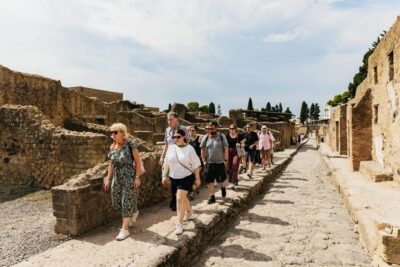
Herculaneum: Skip-the-Line Guided Tour with Archaeologist
Read our review →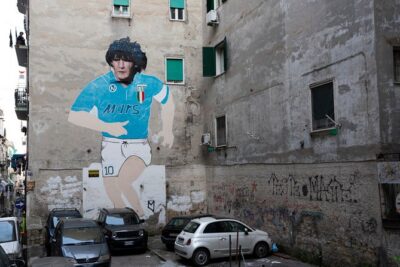
Naples Spanish Quarters Walking Tour Street Art, Folklore & Sweet
Read our review →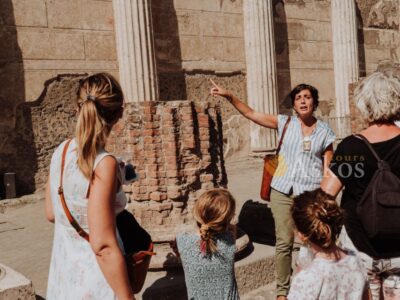
From Naples: Pompeii & Herculaneum with Archaeologist Guide
Read our review →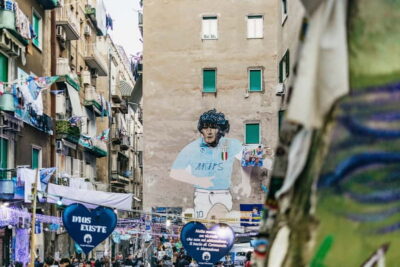
Naples: Street Art & History Tour in the Spanish Quarters
Read our review →
Naples Walking Tour with Underground Roman Ruins Ticket
Read our review →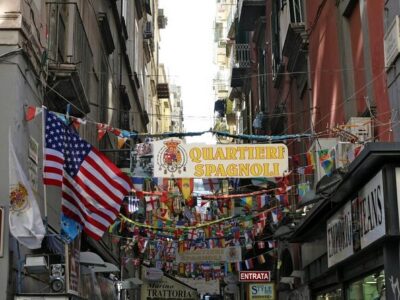
Naples Panoramic Walking Tour: From the Hills to the Center
Read our review →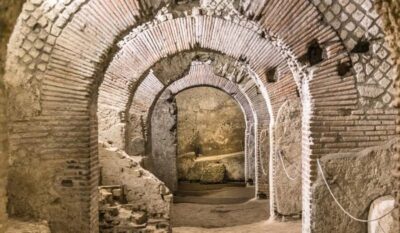
Naples: City Walking Tour w/ Underground Roman Ruins Ticket
Read our review →