
Review · TOKYO
Tokyo Castle & Imperial PalaceーShogun Walking Tour
The most useful thing about this tour is that it turns a quiet park into a readable piece of Tokyo’s past. You’ll walk through the former Edo Castle grounds, where samurai guarded the shogun and where the Imperial Palace still carries Japan’s 2,600-year imperial story. The castle was never breached, and the gates, walls, guardhouses, and watchtowers show why.
I like the small-group format of up to 10 people, which should make it easier to hear the guide and ask questions. I also like the mix of hard history and calm scenery: one minute you’re studying a defensive gate, and the next you’re beside koi ponds and seasonal plants in Ninomaru Garden.
The main drawback is that this is an outdoor walking tour with little shade. You’ll handle slopes, stairs, and about two hours on your feet. Also, the tour is English only, and the additional information gives a maximum capacity of 60, so confirm the group size at booking if that matters to you.
Key points to know before you book
- See the castle’s defenses up close: Sakurada Tatsumi Yagura, Otemon Gate, stone walls, and three surviving guardhouses explain how Edo Castle was protected.
- Get the samurai story, not just the photo stops: The route covers lower-ranking guards, larger samurai units, senior retainers, and the shogun’s security system.
- Enjoy the quieter side of the palace grounds: Ninomaru Garden offers koi, seasonal plants, and a welcome change of pace after the gates and ruins.
- Expect an English-only experience: Guides named in the tour information include K, Ai, Keiko, Tomo, Shin, Yuki, Nana, and others, but your guide is assigned by departure.
- Plan for sun and uneven walking: Wear comfortable shoes, carry water, and bring a hat or umbrella, especially in hot weather.
- Pay $23.88 for interpretation rather than entry: All listed stops are free, so the value rests on the guide’s explanations, historic context, and route planning.
Why Edo Castle is the real subject of this walk
The name Imperial Palace can make this sound like a palace interior tour. It is not. The Emperor’s residence is closed to the public, and this experience focuses on the surrounding grounds, the East Gardens, and the remains of Edo Castle.
That distinction matters. You won’t tour royal rooms or enter a grand throne hall. Instead, you’ll see the physical setting that shaped Tokyo: thick stone walls, controlled gates, guard posts, watchtowers, gardens, and the former castle tower site.
Edo Castle was the center of political power during the shogun era. The route uses its surviving features to explain how the castle worked. A good guide will help you picture the parts that disappeared, including the former main tower, and connect the site to the rise of Tokyo.
I find this kind of tour more useful than simply walking through the gardens with a map. The grounds are attractive on their own, but without context, a guardhouse can look like a small old building and a stone wall can look like scenery. The commentary explains who stood there, what they protected, and why the castle’s layout was so difficult to attack.
More History Walking Tours in Japan
- Tokyo: Imperial Palace and Shogun Historical Walking Tour
★ 5.0 · 2,251 reviews - Tokyo Castle & Imperial PalaceーShogun Walking Tour
★ 4.7 · 1,068 reviews - Tokyo: Imperial Palace Japanese History Walking Tour
★ 4.9 · 987 reviews
Starting at Wadakura Fountain Park
The meeting point is Starbucks Coffee at Kokyo Gaien Wadakura Fountain Park, 3-1 Kōkyogaien, Chiyoda City. The tour ends back at the meeting point after the route reaches the ginkgo-lined avenue before Tokyo Station.
That start and finish make the walk easy to fit into a day of sightseeing. It begins near public transportation and concludes in a part of central Tokyo with a memorable city view. You can also use the end point as a useful transition to Tokyo Station, though the activity itself does not include transportation.
A security check is required to enter the Imperial Palace grounds. Do not bring knives or alcohol. Keep your phone, booking confirmation, and meeting details handy, since the ticket is mobile.
The route lasts about two hours. A comfort break may be included around the middle of the walk, but this should not be treated as a long rest stop. Bring water before you start. The path is exposed in places, and one person specifically noted the need for water, a hat, or an umbrella in hot weather.
Sakurada Tatsumi Yagura and the castle’s first lesson
The first listed stop is Sakurada Tatsumi Yagura, a surviving turret from the Edo period. It gives the tour an immediate sense of scale and purpose. This was not a decorative palace complex. It was a fortress designed to control movement and protect the shogun.
The guide explains the security systems that still shape the Imperial Palace grounds today. This is a good place to begin because it introduces the central theme of the tour: defense through planning.
Allow about 20 minutes here, the longest stop on the route. You’ll have time to look at the turret, hear how the defenses worked, and take photographs without rushing straight to the next gate.
Otemon Gate and the logic of Edo Castle
At Kokyo Otemon Gate, you’ll see two massive gates and stone walls from the original castle. The gates are the visual proof of the castle’s layered security. Passing through was not a simple matter of opening one door. Movement could be controlled, watched, and delayed.
This stop lasts about 10 minutes. The guide uses the design to explain how the shogun was protected. Pay attention to the relationship between gate, wall, and approach rather than treating the area as a single photo stop.
For me, this is where the tour’s historical value becomes clear. A guide can point out defensive features that are easy to miss when you are focused on taking pictures. The history also gives the palace grounds more weight than a standard garden visit.
More History Walking Tours in Tokyo:
- Tokyo: Shinjuku Historical Walking Tour & Secret Backstreets
★ 5.0 · 530 reviews - Imperial Palace East Garden and Edo Castle Walking Tour in Tokyo
★ 5.0 · 510 reviews - Asakusa: A Big-picture History Walk to Know Japan
★ 4.6 · 77 reviews - Asakusa: 3.5-hour Big-picture History Walk
★ 4.7 · 39 reviews
Three guardhouses, three levels of samurai duty
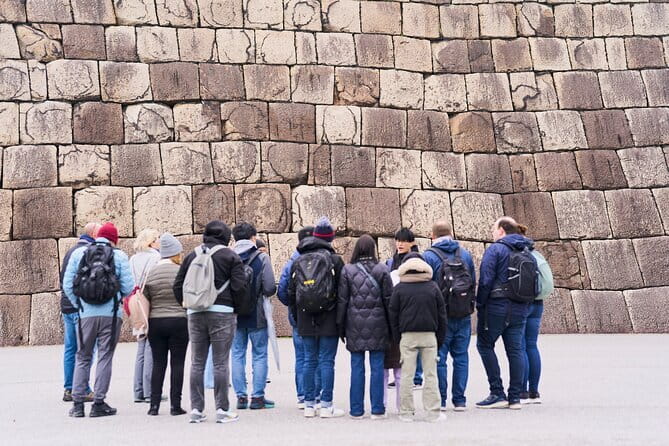
The route then moves through the Constable Guardhouse, Hyakunin Bansho Guardhouse, and Obansho Guardhouse. Each stop lasts about 10 minutes, but each adds a different piece to the castle’s security system.
The Constable Guardhouse was used by lower-ranking samurai. This is a useful reminder that castle life depended on more than famous commanders and high-ranking warriors. Ordinary guards had specific jobs, and their position inside the castle mattered.
Hyakunin Bansho was a larger guardhouse where many samurai were stationed. The name and scale help explain how security was organized at a busy entrance. The guide discusses the role of these samurai and how their presence supported the castle’s defenses.
At Obansho, the discussion turns to higher-ranking samurai and their duties near the inner gate. This gives the sequence a clear structure: lower-ranking guards, larger groups of samurai, then senior retainers closer to the shogun.
These stops are not grand architectural attractions. Some people may find the buildings modest, especially if they expect a restored castle. Their value comes from the explanation. If you already know Edo-period history, the pace may feel brisk. If the shogun era is new to you, these guardhouses provide a practical way to understand rank and responsibility.
Fujimi-yagura and the lost castle tower
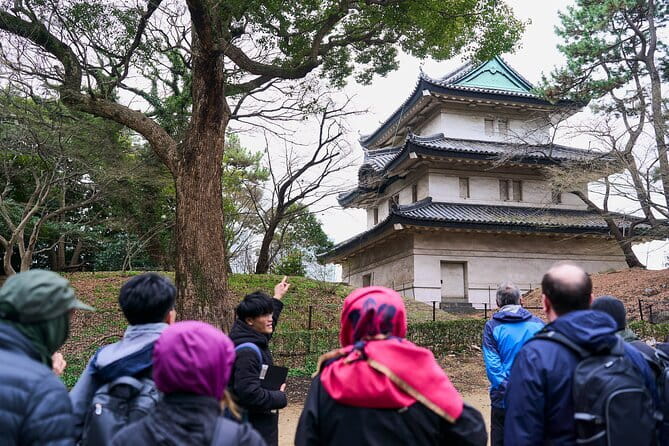
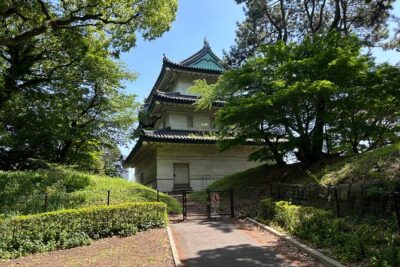
Fujimi-yagura is an old watchtower overlooking the area. The guide explains its past role and what made it special. Watchtowers were practical structures, but they also helped define the castle’s profile and sightlines.
This stop takes about 10 minutes. It is another place where the guide’s visual material can help. Keiko, one of the guides named in the tour information, used laminated pictures of earlier castle layouts and guard towers. Similar visual aids may be used by other guides, but they are not guaranteed for every departure.
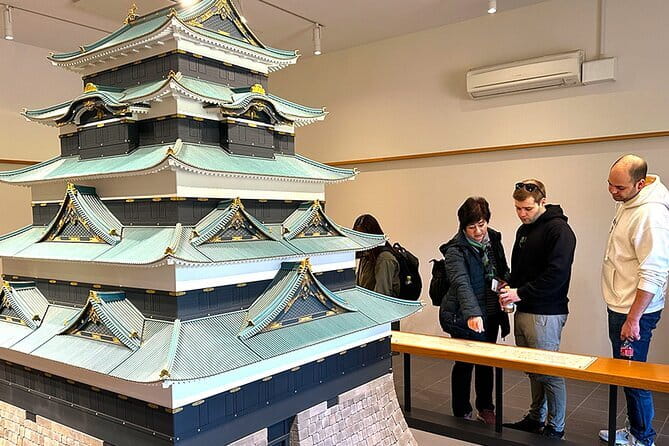
The route then reaches Kokyo Sannomaru Shozokan. Here you can see a scale model of the former Edo Castle and visit a souvenir shop with palace-related goods. The model is especially useful because so much of the original castle no longer survives. It allows you to compare the present grounds with the much larger complex that once occupied the site.
This stop is also a natural pause in the history lesson. You’re no longer looking only at one gate or one tower. The model helps you see how the pieces fitted together.
The former main tower in the East Gardens

The East Gardens of the Imperial Palace include the former site of Edo Castle’s main tower. The tower itself is gone, but the site remains an important part of the walk.
The guide explains why the tower no longer stands and what remains today. This is a valuable lesson in reading ruins. You won’t get a reconstructed tower to photograph, but you will get a clearer idea of the castle’s former size and importance.
Allow about 15 minutes here. Take time to look beyond the obvious. The absence of the tower is part of the story. A ruined foundation can tell you about destruction, rebuilding, changing political power, and the way modern Tokyo grew around the old castle center.
This is also where expectations matter most. If you want a fully restored Japanese castle, this tour will not provide it. If you enjoy seeing how a historic site survives in fragments, the stop works well.
Ninomaru Garden brings the pace down
After the military and political history, Ninomaru Garden offers a quieter finish. It has seasonal plants and a pond with koi, and it shows the refined side of the former castle grounds.
The garden stop lasts about 15 minutes. I like this balance. A two-hour route made entirely of gates, walls, and explanations could feel dense. Ninomaru gives you room to slow down, take photographs, and enjoy the setting without needing to memorize another date or title.
The garden is also a useful reminder that samurai-era sites were not only defensive machines. Beauty, ceremony, status, and daily life all existed within the castle complex. Your guide can connect the garden to the broader story, while you get a pleasant break from the more formal stops.
Finishing on Tokyo Station’s ginkgo avenue
The final walk concludes in front of the ginkgo-lined avenue stretching toward Tokyo Station. This ending gives you a strong contrast between old Edo and modern Tokyo.
You finish with castle walls and gardens behind you, then face one of the city’s most recognizable urban views. The activity returns to the meeting point, so you are not left at an unfamiliar neighborhood. It is a practical finish for continuing your day around Tokyo Station.
What the guides add to the experience
The guide is the main reason to book this walk instead of visiting the gardens alone. Several guides named in the tour information received especially warm praise for their delivery and historical explanations.
K is described as clear, funny, passionate, and able to answer questions in fluent English. Keiko used laminated images to make old layouts and guard towers easier to understand. Tomo was noted for being accommodating and engaging, while Shin was praised for strong knowledge of the Imperial grounds and Japanese history.
Other named guides include Ai, Anju, Nana, Yuko, Yuuki, Dai, Franky, Mayuko, and Yuta. You cannot select one of them based on the information provided, so treat these names as examples of the guide team rather than a promise.
The quality may vary by individual. One participant left early after finding the guide’s English difficult to follow and feeling that the garden did not require a guide. That is a fair caution. If you prefer to explore quietly and read signs at your own pace, you may find the tour unnecessary. If you want stories, answers, and a clear explanation of how the castle operated, the guide is the central benefit.
Price, group size, and overall value
At $23.88 per person, the price is modest for a two-hour guided walk in central Tokyo. The stops themselves have no admission charge, so you are paying for the guide’s time, the route, and the historical interpretation rather than entry tickets.
That can be good value if Japanese history is unfamiliar to you. The tour places the shogun, samurai, emperors, castle defenses, and modern Tokyo in one connected story. It also saves you from wandering across a large area without knowing which walls, gates, and foundations matter.
The advertised format is a small group of up to 10 people. However, the additional information gives a maximum of 60 travelers. That is an important inconsistency. A group of 10 should feel personal and make questions easy. A much larger group could make it harder to hear, especially outdoors. Ask the operator about the expected group size before booking if this is a key reason you are interested.
Free cancellation is available up to 24 hours before the start time for a full refund. Changes or cancellations made less than 24 hours ahead are not accepted and are not refunded.
Who should book this walking tour
I would choose this tour early in a Tokyo visit if you want a short introduction to the shogun era, the Imperial Palace grounds, and the physical shape of Edo Castle.
It suits you especially well if:
- You want historical explanation rather than a self-guided garden walk.
- You are interested in samurai, shoguns, castle defenses, or Japan’s imperial system.
- You prefer a two-hour activity instead of a full-day museum or castle excursion.
- You are comfortable walking in the sun and handling stairs and slopes.
- You want a small-group English tour with time for questions.
- You enjoy combining historic structures with a traditional garden.
I would think twice if you want to enter the Emperor’s residence, see lavish palace rooms, or avoid walking outdoors. This is also not the best pick for anyone who needs Japanese-language support, since the tour is conducted in English only.
Practical tips for a better walk
Wear comfortable footwear. The route includes steep slopes and stairs, and you will be standing or walking for most of the two hours.
Carry water, especially during hot weather. A hat or umbrella will help because much of the route is exposed. One person noted that a guide offered sweets and menthol napkins during an especially hot outing, but you should not rely on that. Prepare for the weather yourself.
Do not bring knives or alcohol because of the security check. Keep the mobile ticket ready at the meeting point, and arrive with enough time to locate the Starbucks at Wadakura Fountain Park.
Finally, bring questions. The most useful moments on this walk are not always the largest structures. Ask about the samurai ranks, the missing castle tower, the gate design, and how the old castle relates to the Imperial Palace today.
Should you book Tokyo Castle and Imperial Palace Shogun Walking Tour?
Book it if you want the Imperial Palace grounds to make sense. For $23.88, you get a focused two-hour route through castle gates, guardhouses, a watchtower, ruins, a model, and a garden, with the chance to connect each stop to the shogun era and Japan’s imperial story.
Skip it if you only want scenery or if you expect access to the Emperor’s residence. The grounds are free, and a self-guided walk may suit independent explorers. But for a first visit, an English-speaking guide such as K, Keiko, Tomo, or Shin can turn scattered remains into a clear story. Just prepare for sun, slopes, stairs, and the possibility that the group may be larger than the advertised small-group format.
FAQ
How long does the Tokyo Castle and Imperial Palace tour last?
The tour lasts approximately two hours.
Where does the tour begin?
It begins at Starbucks Coffee in Kokyo Gaien Wadakura Fountain Park, 3-1 Kōkyogaien, Chiyoda City, Tokyo 100-0002, Japan.
Where does the tour end?
The activity ends back at the meeting point, after concluding near the ginkgo-lined avenue stretching toward Tokyo Station.
Is the tour conducted in English?
Yes. The tour is conducted in English only, and Japanese-language support is not available.
Is the Emperor’s residence open to the public?
No. The Emperor’s residence is not open to the public on this tour.
What places are included?
The route includes Sakurada Tatsumi Yagura, Kokyo Otemon Gate, Constable Guardhouse, Hyakunin Bansho Guardhouse, Obansho Guardhouse, Fujimi-yagura, Kokyo Sannomaru Shozokan, the Edo Castle ruin in the East Gardens, and Ninomaru Garden.
Is there a security check?
Yes. You must pass a security check to enter the Imperial Palace grounds.
Can I bring a knife or alcohol?
No. Knives and alcohol should not be brought to the tour because of the security check.
Is the tour suitable for most people?
Most people can participate, but you will need to walk up steep slopes and stairs. Comfortable shoes are recommended.
What is the cancellation policy?
You can cancel at least 24 hours before the start time for a full refund. Cancellations or changes made less than 24 hours before the start time are not accepted and are not refunded.
Just added around Tokyo
- Tokyo: Edo Castle & East Garden of the Imperial Palace Tour★ 4.7 · 112 reviews
- Tokyo: Imperial Palace, the history of Japan (ENGLISH GUIDE)★ 5.0 · 77 reviews
- Tokyo: Customized Private Historical Guided Photoshoot Tour★ 5.0 · 25 reviews
- Kyoto: Nijo Castle World Heritage Guided Tour with Admission★ 4.9 · 37 reviews
- Historic Kanda Sake Tasting at Tokyo’s Oldest Shop (1596)★ 4.9 · 33 reviews
- From Tokyo: Private Nikko World Heritage Sights One Day Trip★ 4.7 · 52 reviews
- From Tokyo: Guided Day Trip to Nikko World Heritage Sites★ 4.8 · 51 reviews
- Asakusa: A Big-picture History Walk to Know Japan★ 4.6 · 77 reviews
Tokyo History Tours, compared.
Tokyo: Imperial Palace and Shogun Historical Walking Tour
Read our review →
Tokyo Castle & Imperial PalaceーShogun Walking Tour
Read our review →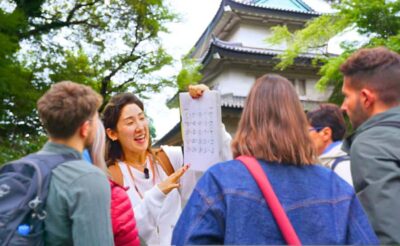
Tokyo: Imperial Palace Japanese History Walking Tour
Read our review →
Tokyo: Shinjuku Historical Walking Tour & Secret Backstreets
Read our review →
Imperial Palace East Garden and Edo Castle Walking Tour in Tokyo
Read our review →
From Tokyo: Nikko World Heritage Site Private Full-Day Trip
Read our review →
Tokyo: The Best of Izakaya in Shinjuku Food & Cultural Tour
Read our review →
Tokyo: Nikko World Heritage Private Day Trip Hotel Pick-up
Read our review →Browse the lists this tour appears in