
Review · ITALY
Ferrara: Medieval Ferrara and the Jewish Ghetto Walking Tour
Ferrara’s story comes into focus as you walk from the moat-side Castello Estense to the old Jewish ghetto. In two hours, you move through Este power, medieval commerce, church architecture, rationalist buildings, and the city’s Jewish past without leaving the historic center.
I like the private format, which lets your group of up to six keep the pace personal. I also like the unusual range of stops, from the S. Anna hospital cloister and Palazzo Roverella garden to the synagogue on Via Giuseppe Mazzini. The main consideration is that this is an outdoor walk, so you’ll want comfortable shoes and sensible clothing, and two hours gives you an overview rather than time to tour every interior.
Key points at a glance
- Start beside Castello Estense: Meet your guide at the water well near the tourist information office in the castle courtyard.
- Trace Este-era Ferrara: Connect the castle, cathedral, former Ducal Palace, and town hall to the city’s political past.
- See more than medieval buildings: The route includes 20th-century rationalist architecture alongside older streets and squares.
- Follow Jewish Ferrara: Walk through the former business lanes and Jewish ghetto, ending at the ornate Italian Synagogue.
- Hear literary and personal stories: Byron, Goethe, Torquato Tasso, Savonarola, and Lucrezia Borgia all enter the story.
- Designed for a small group: The private tour costs $169.93 for up to six people, rather than charging each person separately.
Starting at the castle where Ferrara’s power was on display
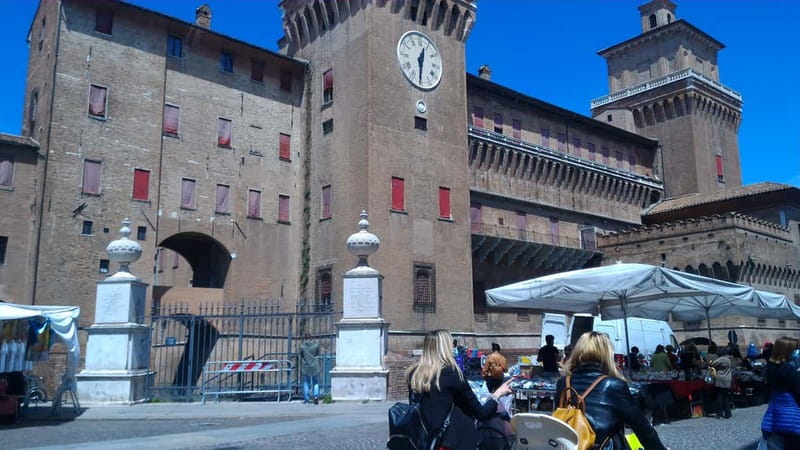
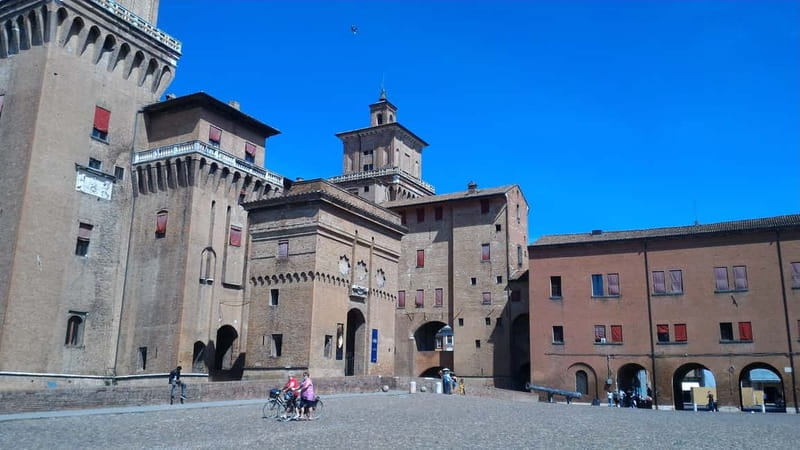
You begin in the courtyard of Castello Estense, Ferrara’s most recognizable landmark. The meeting point is specific: look for the water well beside the IAT tourist information office. That makes the start fairly easy to find, especially if you are already near the castle.
The opening stop gives your guide room to explain how Ferrara developed around the Este family. This is useful context because the rest of the walk is not just a parade of old façades. The cathedral, former Ducal Palace, town hall, theaters, and commercial lanes all make more sense once you understand how court power shaped the city.
The tour is led by Elisabetta Concetta Gulino, and the guide language can be English, Italian, Spanish, or German. Headsets are provided, a small but worthwhile touch on a walking tour. You do not have to crowd around the guide or lose the explanation when the street gets noisy.
The castle courtyard is also a practical place to get your bearings. From here, you’ll be walking through central Ferrara rather than traveling between distant sights. A paper city map is included, which can help you continue exploring after the tour.
More History Walking Tours in Italy
- Venice: City Center Historical Guided Walking Tour
★ 4.2 · 1,873 reviews - Palermo: Street Food and History Walking Tour
★ 4.9 · 1,486 reviews - Verona: History and Hidden Gems Guided Walking Tour
★ 5.0 · 1,379 reviews
From the music conservatory to the S. Anna cloister
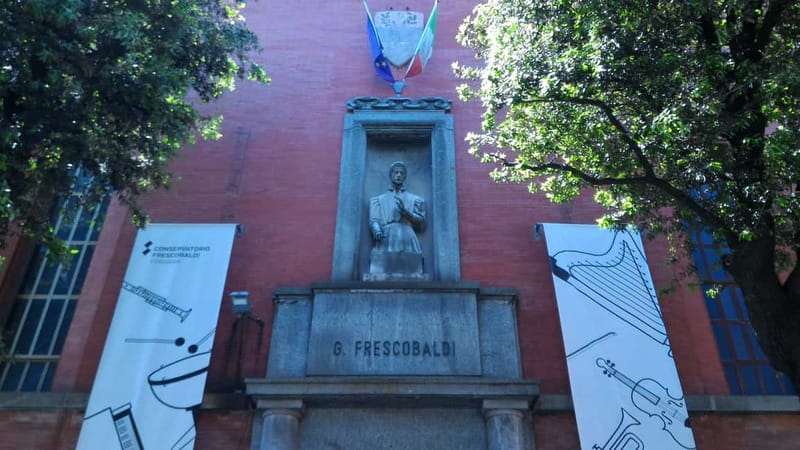
One early stop is the Frescobaldi Music Conservatory. Its presence adds a useful reminder that Ferrara is not only a city of courts and churches. Music formed part of civic and cultural life here, and the conservatory gives the route a different note before it moves into hospital and palace history.
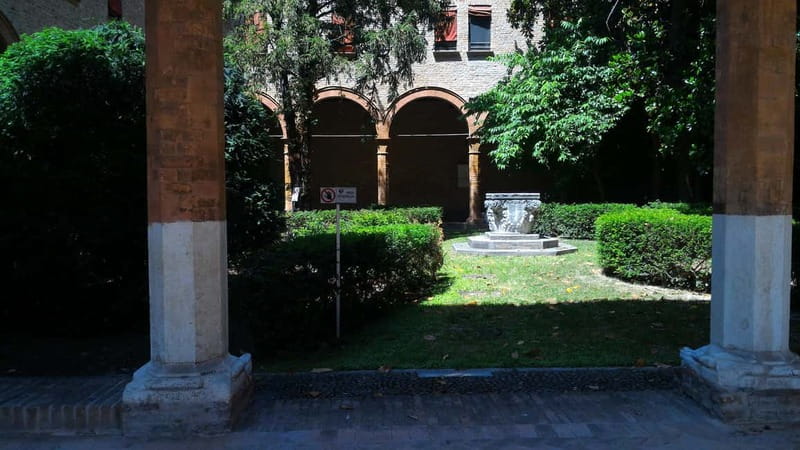
The S. Anna hospital cloister dates from the mid-15th century. A cloister may look quiet at first glance, but it carries a practical story about how urban institutions worked. This stop gives the tour a chance to explain a building connected with care and public life rather than only noble display.
I like this change of subject. Many city walks stay fixed on famous rulers and grand monuments. Here, the route includes places that show how the city functioned. You should still keep your expectations measured: the experience is primarily a guided exterior walk, and the information supplied does not promise extended interior visits.
That distinction matters if you want a museum-heavy outing. You will see architectural details and hear the story of the sites, but you should not book this expecting a long examination of castle rooms, hospital collections, or synagogue interiors.
Palazzo Roverella and the garden of the Finzi-Continis
The route continues past the garden of the early 16th-century Palazzo Roverella. A garden stop breaks up the sequence of stone streets and formal buildings, while the palace helps connect Ferrara’s civic appearance to its Renaissance past.
The Jewish heritage portion is one of the most distinctive parts of the walk. The route refers to the garden associated with the Finzi-Continis, a name closely tied to Ferrara’s Jewish cultural memory. You walk this path as part of a broader look at Jewish life in the city, rather than treating the ghetto as a single isolated monument.
This is where the tour can feel more personal and thoughtful. Jewish heritage in Ferrara is presented through streets, former businesses, buildings, and the final synagogue stop. That approach lets you see how a community occupied the city day by day, not only where a memorial happens to stand.
The Finzi-Continis reference may be especially meaningful if you know the literary work connected with the family. If you do not, the guide can still place the name within Ferrara’s cultural and Jewish story. The exact amount of literary detail will depend on your guide and the pace of your group.
Theatre Square and the Savonarola statue
The walk reaches the 18th-century oval Theatre Square, where you’ll find a statue of the Ferrarese friar Savonarola. Its shape and scale provide a change from the tighter medieval lanes, and the statue opens a conversation about a local religious figure whose reputation reaches well beyond Ferrara.
This stop also helps you notice how Ferrara’s public spaces changed over time. The tour moves from medieval and Renaissance buildings into an 18th-century urban setting, then later points out 20th-century rationalist architecture. You are not looking at one single style repeated from street to street.
I find that architectural range one of the tour’s strongest features. The guide is not simply naming dates. The walk asks you to compare periods and see how the city kept adding new layers while retaining its older core.
The mention of Byron and Goethe adds a human angle. Both passed through Italy during the era of the Grand Tour, when educated Europeans traveled in search of art, history, and literary associations. In Ferrara, that story connects with the search for Torquato Tasso, giving you a glimpse of how the city was viewed by outsiders looking for famous cultural figures.
These literary details will appeal to you if you enjoy history that includes people, curiosity, and odd connections. If you prefer only architectural facts, they may feel like a brief side road, but they help keep the walk from becoming a list of building dates.
More Medieval History Tours in Italy
- Private Tour of the Medieval Village of Ostuni by Tuk Tuk
★ 4.5 · 278 reviews - Discover the Medieval Charm of Siena on a Private Walking Tour
★ 5.0 · 247 reviews - Roman countryside Food & Wine Tasting in a medieval winery
★ 4.5 · 220 reviews - Renaissance & Medieval Florence Guided Walking Tour plus mobile App
★ 4.0 · 140 reviews
Between the archbishop’s palace and the cathedral
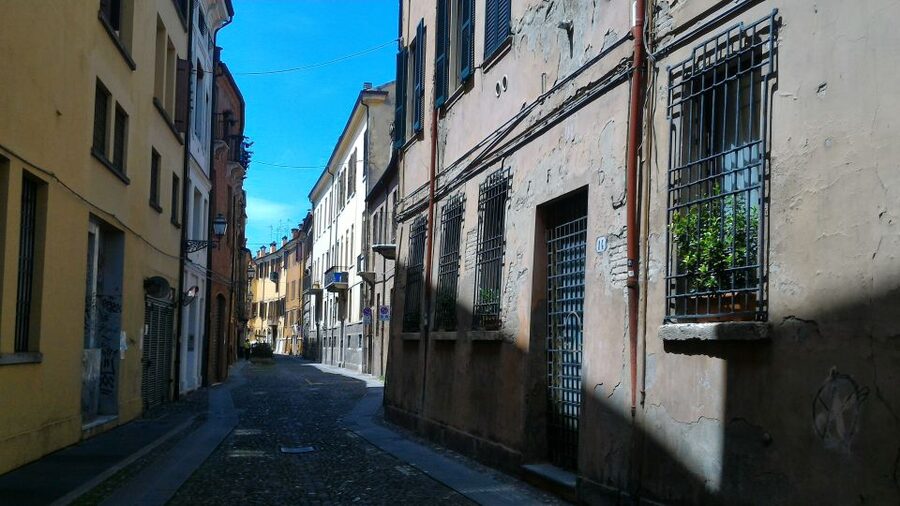
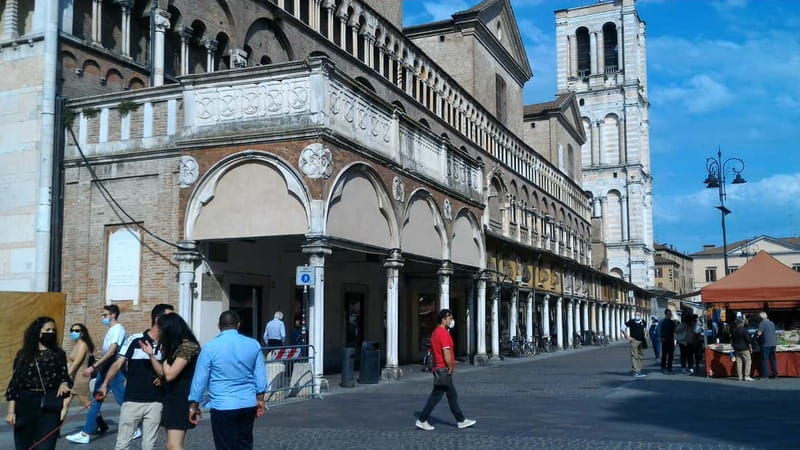
The route then passes between the archbishop’s palace and the former Ducal Palace before reaching the cathedral and town hall. This is one of the most concentrated parts of the walk, bringing religious, political, and civic buildings into the same view.
The cathedral gives the group a chance to consider Ferrara’s religious center, while the former Ducal Palace points back to secular rule. The town hall adds another layer, showing how public administration occupied the same central zone.
The town hall square is noted for its beautiful brick paving. That detail is easy to miss when you are focused on major façades, so having a guide point it out is useful. Ferrara rewards slow looking, and small surface details can tell you as much about the city’s character as a famous statue.
This section may be the best fit for first-time visitors who want a quick orientation. In a short distance, you get the city’s main symbols and a working sense of how the center is organized. You also receive a paper map, so you can return later to places that deserve more time.
Lucrezia Borgia and life inside Castello Estense
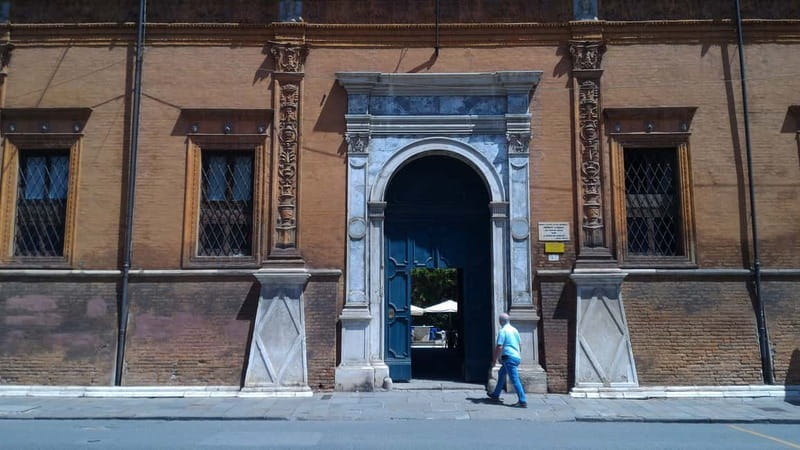
The Este family is not treated as an abstract dynasty. The tour includes the story of Lucrezia Borgia living in Castello Estense, which brings the court closer to everyday imagination.
You can picture the castle not merely as a fortified landmark, but as a place tied to family alliances, public image, and personal lives. The story of Lucrezia Borgia gives the opening castle stop a stronger connection to the people who occupied it.
Do not expect this two-hour walk to provide a full biography or a detailed castle tour. Instead, the story works as one part of a larger explanation of Ferrara under Este rule. That balance is sensible for an outdoor city walk, since the route has several other periods and communities to cover.
The tour’s strongest guides appear to be those who can connect these individual stories to the buildings around you. Elisabetta Concetta Gulino is the named experience provider, and the high 4.7 rating from 70 ratings supports the idea that clear historical explanation is a major part of the experience. One specific rating praises Elisabetta’s explanation of how different architectural styles reflect the city’s past, especially during the Jewish ghetto section.
Medieval business lanes and Ferrara’s Jewish ghetto
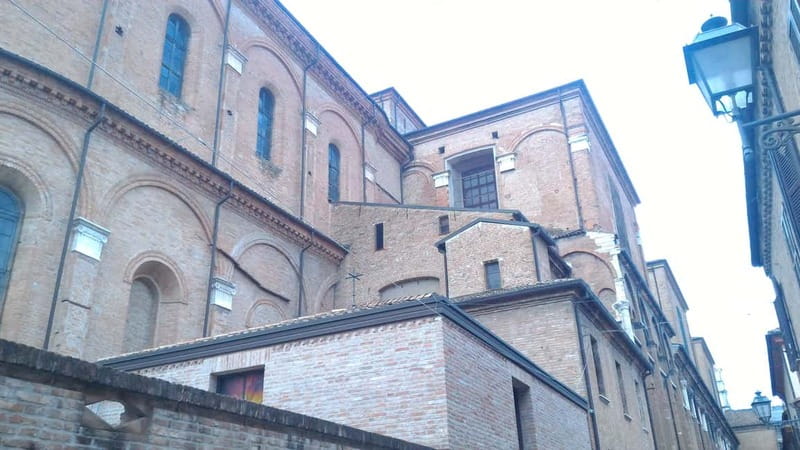
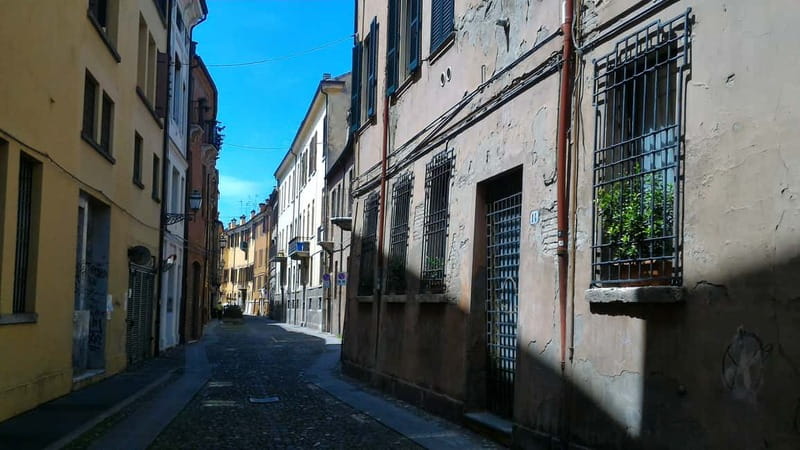
Near the end, the route turns into the medieval business lanes and historic Jewish ghetto. This is a valuable shift in scale. The castle and cathedral show power from above, while the narrow lanes suggest the commercial and residential life that made the city function.
The former business streets are especially helpful because they connect Jewish heritage with work and urban routine. You are not only hearing about a community in religious terms. You are walking through the part of the city where commerce and daily activity mattered.
The ghetto section is likely to be the emotional center of the tour. One of the strongest written assessments specifically singles it out as a favorite part, while another praises the guide’s command of the subject. I would give this section your full attention and avoid rushing to the final stop.
The route ends in front of the intricate 15th-century Italian Synagogue at Via Giuseppe Mazzini 95. The synagogue provides a clear final image for the Jewish heritage portion of the walk. It also leaves you in a useful central location for further time in Ferrara.
The supplied meeting details also say the activity ends back at the meeting point, while the route information names Via Giuseppe Mazzini 95 as the finish. Because those details do not perfectly match, confirm the exact end point when you book or meet your guide. Either way, the stated route finishes around the synagogue and central historic streets.
What the two-hour format does well
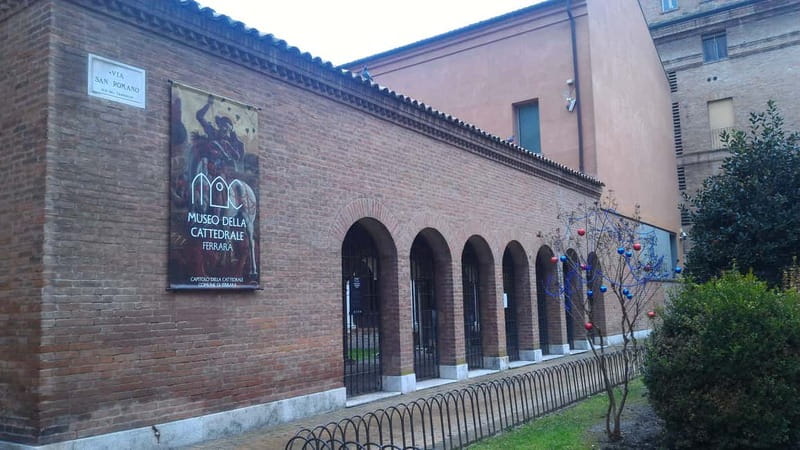
Two hours is a good length for a first look at Ferrara. You can cover the city’s main symbolic places without giving up an entire morning or afternoon. The private-group setup also means the pace can be better suited to your party than a large fixed group.
The limitation is simple: Ferrara has more to see than this route can include in 120 minutes. You will not have time for long interior visits, extensive shopping, or a leisurely stop at every monument. Think of the walk as a carefully connected introduction.
The route is outdoors, so weather and footwear matter. Wear comfortable shoes and comfortable clothes. The tour is listed as wheelchair accessible, but a private group should still discuss any specific mobility needs with the provider before the start, especially since the experience uses historic streets and public spaces.
The included headsets are helpful if your group spreads out slightly. The paper map is useful afterward, particularly if the tour gives you ideas for returning to the castle, cathedral, Jewish quarter, or other central sights.
Is $169.93 good value for up to six people?
The listed price is $169.93 per group of up to six, not $169.93 per person. For six people, that works out to about $28.32 each. For two people, the per-person cost rises to about $84.97, so the value depends heavily on your group size.
For a full private group, the price is attractive because you receive a dedicated guide, headsets, a city map, and a route that combines several parts of Ferrara’s story. The private format is also useful for families or friends who want to ask questions without waiting for a large group.
For one or two people, the price is harder to justify if you only want a brief orientation. It becomes more reasonable if you value the Jewish heritage focus, need one of the four listed languages, or want a guide who can connect architecture, literature, politics, and social history in one walk.
The strong point is not the number of stops alone. It is the way the route links them. You move from Este authority to civic buildings, from public squares to commercial lanes, and finally to Jewish Ferrara. That structure gives your two hours a clear purpose.
Who should book this Ferrara walk?
I would choose this tour if you want an efficient introduction before exploring Ferrara on your own. It suits first-time visitors, history-minded couples, families with older children, and small groups who prefer a private guide to a large scheduled outing.
It is also a good match if Jewish heritage is a key reason for visiting Ferrara. The ghetto, former business lanes, Finzi-Continis garden route, and synagogue receive real attention rather than appearing as a quick footnote.
You may want another kind of experience if your priority is entering museums or spending a long time inside Castello Estense. The supplied details describe an outdoor walking tour, not a ticketed interior tour, so book it for context and streetside interpretation.
The tour also works well for people who enjoy architecture across several periods. You’ll see medieval buildings, Renaissance spaces, an 18th-century square, and 20th-century rationalist design within one compact route.
Should you book it?
Book this walk if you want Ferrara explained through its buildings, communities, and individual characters rather than reduced to a few postcard sights. The private price is strongest for groups of four to six, and the Jewish ghetto section gives the tour a clear identity beyond the usual castle-and-cathedral circuit.
I would be cautious only if you need extensive interior access or dislike walking outdoors. Otherwise, the combination of Castello Estense, Este family stories, Savonarola, Grand Tour writers, the Finzi-Continis connection, medieval business lanes, and the synagogue makes this a well-focused way to meet Ferrara in two hours.
FAQ
Where does the walking tour start?
Meet your guide at the water well next to the tourist information office, IAT, inside the courtyard of Castello Estense. The listed starting location is L.go Castello 1, at the Caffetteria del Castello Estense.
Where does the tour finish?
The route information gives Via Giuseppe Mazzini 95 in Ferrara as the finish, in front of the 15th-century Italian Synagogue. The meeting details also state that the activity ends back at the meeting point, so confirm the exact end arrangement with the provider.
How long does the tour last?
The guided walking tour lasts two hours. Starting times depend on availability when you book.
What languages are available?
The live guide can conduct the tour in English, Italian, Spanish, or German.
Is the tour private and accessible?
Yes. It is a private group experience for up to six people, and it is listed as wheelchair accessible.
What should I bring?
Bring comfortable shoes and comfortable clothes. The tour is an outdoor walking experience, and headsets plus a paper city map are provided.
More Jewish Heritage Tours in Italy
- Padua: Jewish Heritage Museum and Synagogue Tour
★ 4.9 · 109 reviews - Lecce: Jewish History Walking Tour
★ 4.7 · 67 reviews - Budapest Jewish Heritage Memorial Walking Tour & Synagogue Entry
★ 5.0 · 568 reviews - Budapest: Jewish Heritage Guided Tour with Synagogue Ticket
★ 4.8 · 533 reviews
Just added around Italy
- Guided Cultural Tour of the Godfather Film in Messina★ 5.0 · 31 reviews
- Guided tour of the Riace Bronzes and the Archaeological Museum of Reggio Calabria★ 5.0 · 44 reviews
- SU NURAXI BARUMINI Unesco World Heritage Site★ 5.0 · 129 reviews
- Brescia the Unexpected: History, Local Stories & a drink★ 5.0 · 31 reviews
- Bolognese Cooking Class with Margherita in the Historic Center★ 5.0 · 26 reviews
- Tower and Power, Virtual tour in Medieval Bologna★ 4.5 · 54 reviews
- Bologna historical art walking tour with hidden gems and tastings★ 5.0 · 108 reviews
- Best of Bologna in one day : Food, architecture, art and history★ 5.0 · 27 reviews
Italy History Tours, compared.
Pompeii: Entry Ticket and Guided Tour with an Archaeologist
Read our review →
Colosseum: Underground and Ancient Rome Tour
Read our review →
Pompeii: Small Group Tour with an Archaeologist
Read our review →Pompeii Small Group Tour with an Archaeologist
Read our review →
Rome: Colosseum with Arena, Roman Forum and Palatine Guided Tour
Read our review →
Venice: St. Mark’s Basilica Guided Tour & VR History Intro
Read our review →
Colosseum with Arena, Roman Forum and Palatine Hill Guided Tour
Read our review →
Herculaneum: Skip-the-Line Guided Tour with Archaeologist
Read our review →Browse the lists this tour appears in