
Review · JAPAN
Osaka: Dark Side of Osaka Night Walking Tour
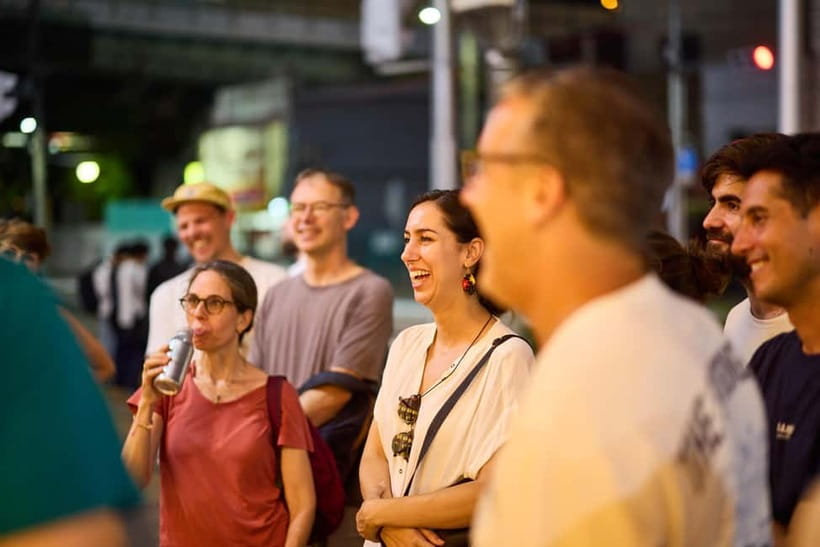
Osaka’s less-polished side is the point here. This two-hour night walk moves through Shinsekai, Nishinari, and Tobita Shinchi, areas shaped by working-class life, entertainment, poverty, tourism, and Japan’s tightly controlled adult industry. You see streets that most visitors skip, then hear the history and present-day context that make them easier to understand.
I like the contrast between the old amusement streets of Shinsekai and the quieter, more discreet world of Tobita Shinchi. I also like that the guides, including Jay, Rico, and Matt, bring personal observations and modern social context instead of handing you a string of dates.
The main caution is simple: some subjects and sights may be confronting. This is not a family outing or a gentle introduction to Osaka. The walk is in English, lasts two hours, and is not suitable for children under 18 or wheelchair users.
Key points to know before you book
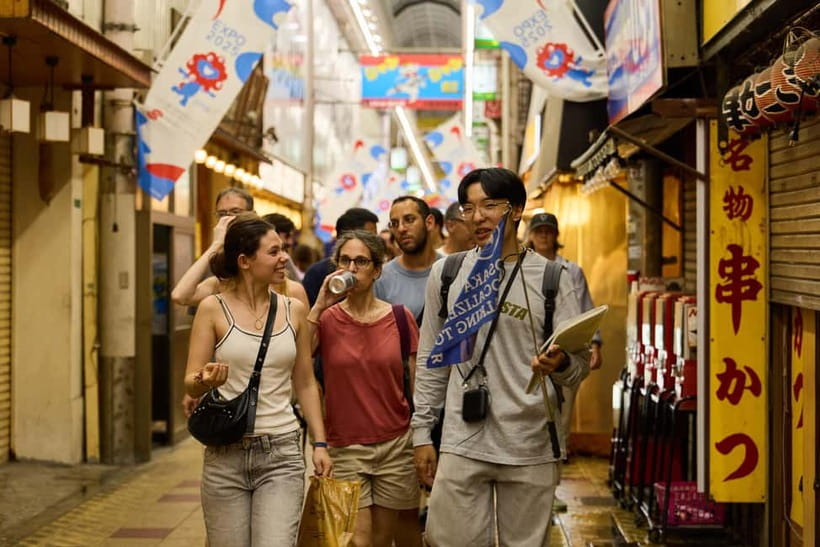
- A candid look at Osaka: Learn about working-class districts, day labor, poverty, and the adult entertainment trade.
- Shinsekai after dark: See Tsutenkaku Tower, retro eateries, and the old streets around Jyanjyan Yokocho.
- Tobita Shinchi is handled with discretion: You pass through Osaka’s largest red-light district while learning about its history and strict local customs.
- Strong guide-led experience: Jay, Rico, and Matt have all led tours praised for clear explanations, personal insight, and thoughtful handling of sensitive topics.
- Good value at $25: Two hours with a live English-speaking guide costs little compared with a private guide or a full evening activity.
- Bring practical gear: Wear comfortable shoes and prepare for rain, heat, or cold. Food and drinks are not included.
Why this Osaka night walk feels different
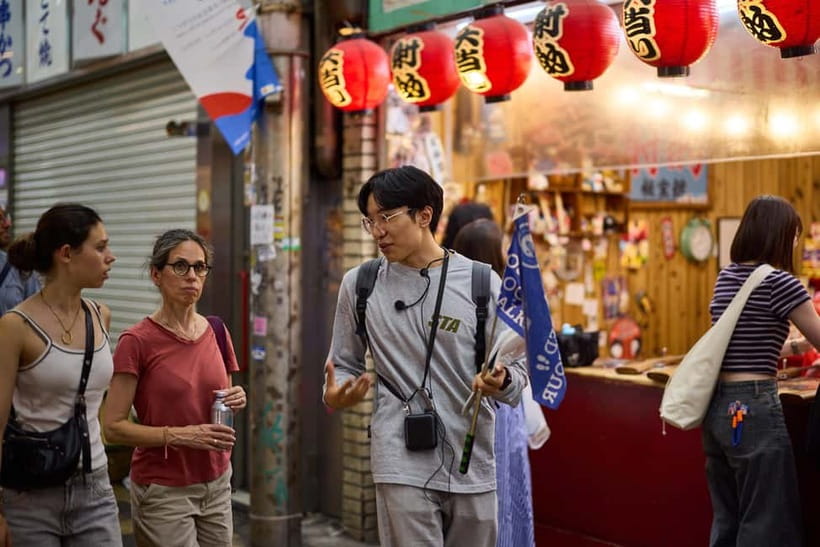
Many Osaka tours stay with food, neon signs, shopping arcades, and famous temples. This one asks you to look at how a city treats people and places that sit outside the tourist picture.
The route takes you into the southern part of Osaka, where the mood can change from bright and theatrical to quiet and serious within a few blocks. Your guide explains how these districts developed, who lived and worked there, and how attitudes toward them have changed.
That context matters. Without a guide, you may see old buildings, unusual signs, cheap hotels, and adult entertainment venues without knowing what they mean. With a guide, the walk becomes a lesson in modern Japanese society, urban change, and the gap between Osaka’s cheerful public image and the harder realities underneath it.
The experience also avoids treating the area as a curiosity show. The strongest feedback points to guides who speak respectfully about poverty, labor, and the people connected to these neighborhoods. That tone is important. You are looking at real communities, not a film set.
More History Walking Tours in Japan
- Tokyo: Imperial Palace and Shogun Historical Walking Tour
★ 5.0 · 2,251 reviews - Kyoto Gion: 2-Hour Geisha Culture & History Walking Tour
★ 5.0 · 1,186 reviews - Tokyo Castle & Imperial PalaceーShogun Walking Tour
★ 4.7 · 1,068 reviews
Meeting under the giant penguin
The tour begins beneath the giant penguin at MEGA Don Quijote Shinsekai. Your guide holds a sign marked GetYourGuide, which gives you a clear visual marker in a busy area.
This is a useful starting point because you are already near Shinsekai’s main sights. You do not need hotel pickup, and the tour does not include transportation. Plan to arrive with enough time to find the store and the penguin without rushing.
The meeting area is public and easy to identify, but Osaka’s nighttime streets can feel crowded and visually noisy. Keep the meeting instructions handy on your phone. Once the group gathers, the walk begins on foot and continues through the surrounding districts.
Shinsekai and the idea of a New World
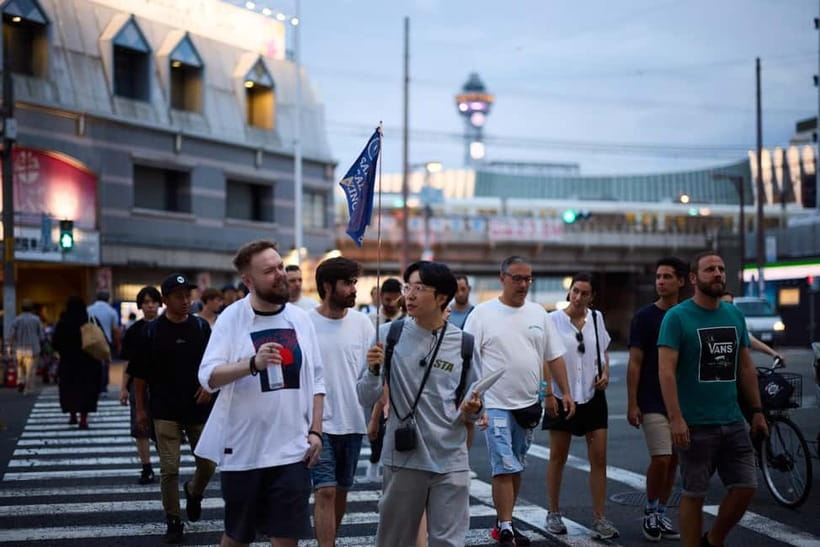
The first major stop is Shinsekai, whose name means New World. The district was created in 1912 as a modern entertainment area with strong Western inspiration.
Its southern section was modeled after Paris, while the northern section drew on New York’s Coney Island. That combination sounds grand, and the present-day streets show the faded remains of that ambition. Shinsekai now feels quirky, nostalgic, and unmistakably Osaka rather than like a polished copy of either city.
Your guide helps you read the district beyond its bright signs and old eateries. The original promise of modern entertainment has changed, but the area still attracts people with its low-key atmosphere, unusual architecture, and local food culture.
This is one of the more accessible parts of the walk. You get the colorful Osaka scenes many people hope to see, but with more background than a quick photograph provides. Tsutenkaku Tower gives the neighborhood its familiar landmark and helps you understand how the area works as both a tourist stop and a local district.
The tour includes roughly half an hour of guided time in this early part of the route. The exact order and timing can vary, but you should expect steady walking with frequent stops for explanation rather than a long visit inside an attraction.
Jyanjyan Yokocho and old Osaka atmosphere
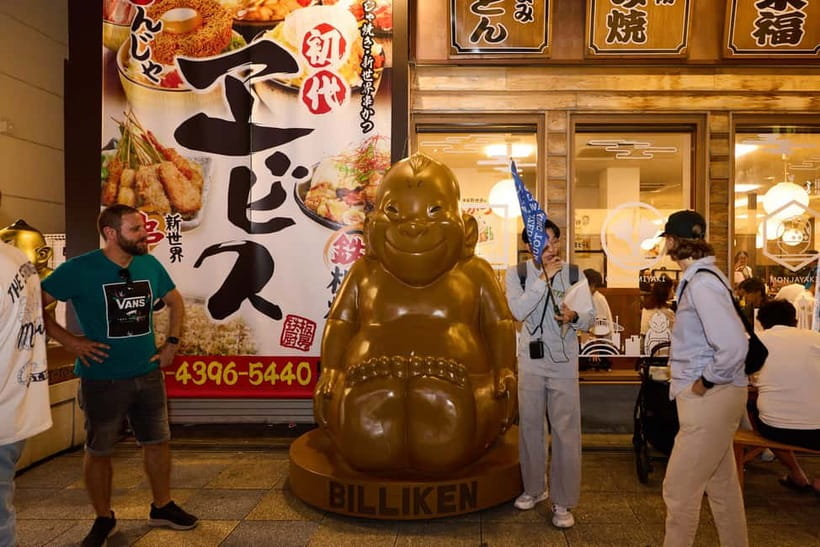
Near Tsutenkaku is Jyanjyan Yokocho, a narrow shopping and dining street with an old-fashioned feel. Its small eateries, bars, and shops recall mid-20th-century Osaka.
This is where the tour’s social history connects with everyday life. You are not simply hearing about a past era. You are walking through a place where the food, street layout, signs, and low-rise buildings still carry traces of it.
The alley is also a useful reminder that Osaka’s character is not limited to grand landmarks. The street feels informal and close to the ground. You may finish the tour nearby and choose to eat in Shinsekai, but food and drinks are not part of the tour price.
If you want a meal during the walk, do not assume there will be a scheduled restaurant stop. The experience is built around walking and discussion. Save your appetite for afterward, when you can explore the area at your own pace.
More Dark History and Haunted Tours in Japan:
- Normandy D-Day Sites & Cemetery Day Trip from Paris with Lunch
★ 5.0 · 6,877 reviews - Prague: Ghosts, Legends, Medieval Underground & Dungeon Tour
★ 4.3 · 5,104 reviews - Savannah History and Haunts Candlelit Ghost Walking Tour
★ 5.0 · 3,235 reviews - Normandy D-Day Small-Group Day Trip with Omaha Beach, Cemetery & Cider Tasting
★ 5.0 · 2,786 reviews
Nishinari and the social story behind the streets

From Shinsekai, the walk continues into Nishinari, a southern Osaka district with a long connection to working-class life and day labor.
This is the part of the tour that gives the experience its weight. Nishinari has often been associated with poverty, temporary work, and people living at the edge of mainstream society. In recent years, budget visitors and urban explorers have also become interested in the area, bringing new attention to a district once largely ignored by tourists.
Your guide explains that change without reducing Nishinari to a single label. The neighborhood has a past, but it is not frozen in time. You may hear about labor, housing, social attitudes, and the difference between what outsiders expect and what daily life looks like on the ground.
A good guide matters most here. Feedback about Jay, Rico, and Matt repeatedly points to clear historical explanations, friendly conversation, and respectful treatment of difficult subjects. One particularly useful detail from the tour is the explanation of a torii painted on a wall as a sign asking people not to urinate there. Small observations like this help you understand how residents manage public space.
Nishinari can feel rougher and less comfortable than central Osaka. That is not a flaw in the route, but it is a reason to book with the right expectations. You are not visiting a theme park version of Japan. You are walking through a real neighborhood with real social problems.
Tobita Shinchi and Osaka’s discreet adult district
The final major section is Tobita Shinchi, Osaka’s most famous and largest red-light district. Its history goes back more than a century, and the area is known for a distinctive architectural style and tightly regulated environment.
The guide does not simply point out venues. The value is in learning how this district fits into Osaka’s urban story and how tradition, discretion, and regulation shape what you see.
Tobita Shinchi is likely to be the most sensitive part of the evening. You may see activity that makes you uncomfortable, and the guide may discuss subjects that are not suitable for children. Keep your behavior quiet and respectful. Do not treat workers, residents, or buildings as entertainment.
Photography deserves particular care. The supplied information does not set out a formal photography policy, so follow your guide’s instructions and avoid photographing people or private activity. A respectful attitude is more important than getting a dramatic picture.
This stop can be valuable precisely because it challenges simple ideas about Japan. The country is often presented through temples, order, technology, and clean public spaces. Tobita Shinchi shows another part of urban life, one managed through custom and discretion rather than open display.
Finishing at Tsutenkaku Tower
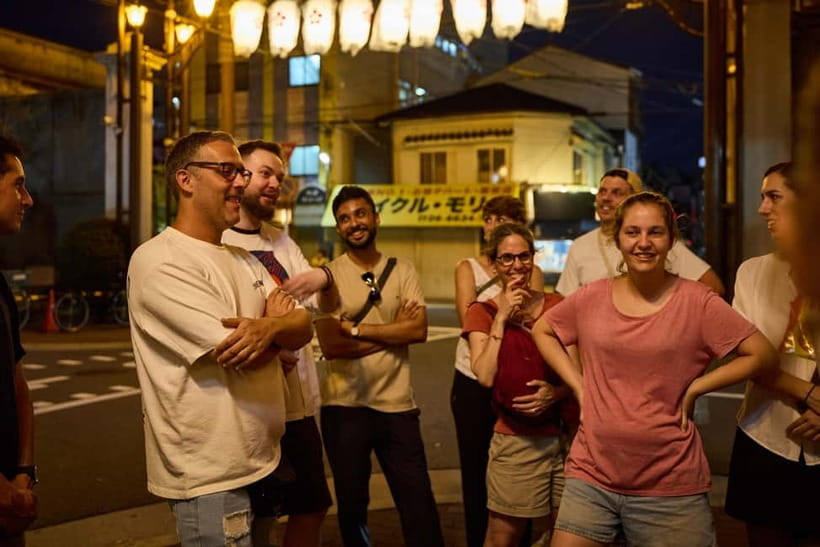
The tour finishes at Tsutenkaku, bringing you back to one of Shinsekai’s most recognizable sights.
Ending here works well. After the more serious discussion in Nishinari and Tobita Shinchi, the tower and surrounding streets return you to Osaka’s public face, with signs, restaurants, and evening activity nearby.
You are not left at a distant transport point, and you can continue eating or exploring after the guide says goodbye. Some people may prefer to finish quietly and head back to their hotel. Others will want to try local food in Shinsekai.
The full walk lasts two hours. That is long enough to cover several districts without turning into an exhausting historical lecture. The pace has been described as comfortable, with time for questions. Still, you are on your feet for the whole route, so good walking shoes matter.
The guides make or break the experience
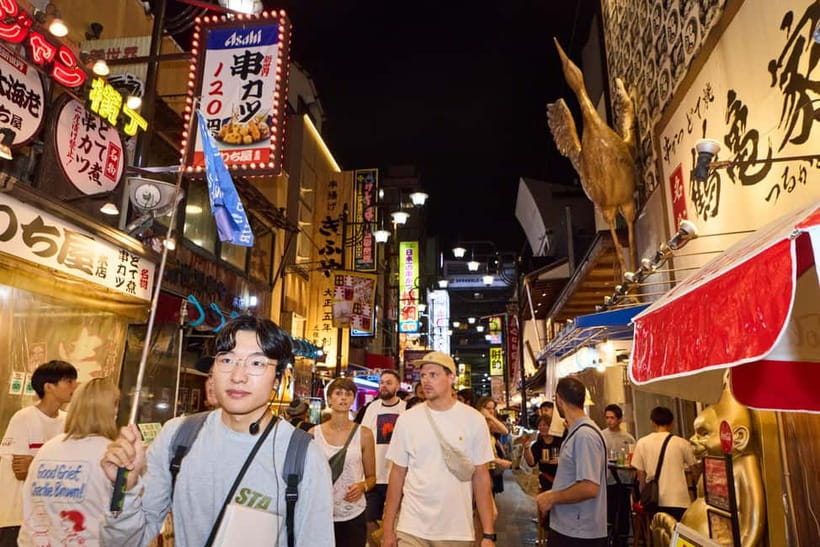
The guide is the main reason to choose this tour over walking the same streets alone.
Jay has been praised for a warm, engaging approach and for answering questions carefully. Rico has been described as especially strong on Osaka’s history, modern society, and useful restaurant recommendations. Matt has been noted for his respectful handling of people and circumstances connected with the tour.
Those names do not guarantee who will lead your walk. The guide may vary by date. What you can reasonably expect is an English-speaking guide whose job is to explain the area, answer questions, and keep the discussion balanced.
English fluency may matter more here than on a simple sightseeing walk. The subjects are complex, and the tour includes historical and social explanations. One useful caution is that a guide who speaks quickly may be harder to follow if English is not your strongest language.
The small-group feel reported on some departures also helps, since you can ask about details that catch your attention. Group size is not specified as a fixed feature, so do not book expecting a guaranteed number.
What $25 gets you
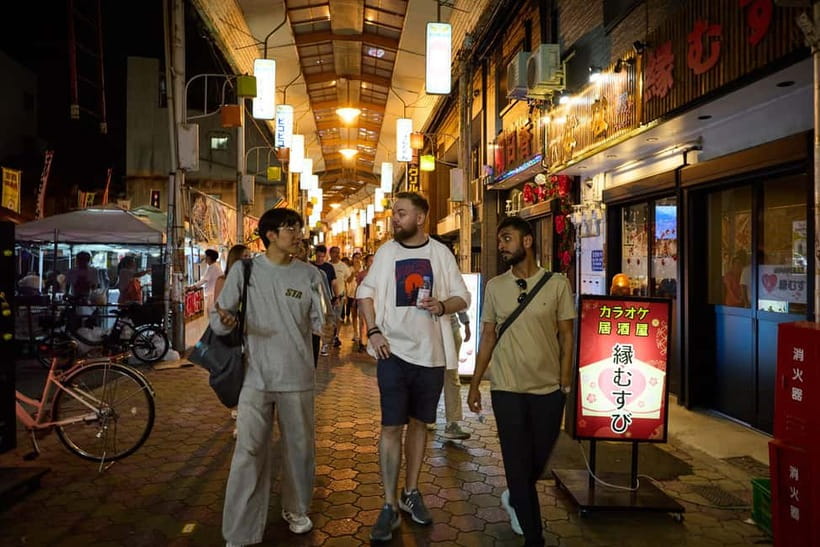
At $25 per person, this is a strong-value experience if you want context rather than a long list of landmarks.
You get two hours with a live English-speaking guide and a route through four distinct parts of southern Osaka. A self-guided walk would cost less, of course, but you would need to research the history, identify the social boundaries of each area, and decide how to behave around sensitive sites.
The price does not include food, drinks, hotel pickup, or drop-off. That keeps the cost low, but it also means you should budget for your own meal and transportation before or after the walk.
The tour is especially good value for a first visit to Osaka when you want something beyond Dotonbori and the usual food stops. It adds social context without taking an entire day from your schedule.
Who should book this walk
I would recommend it to adults who are curious about urban history and willing to look at uncomfortable subjects with care.
It suits you if you:
- Want to understand Osaka’s working-class districts
- Prefer local social history to a standard landmark tour
- Enjoy asking questions and discussing modern Japan
- Are comfortable walking through an adult entertainment district
- Want a short evening activity at a reasonable price
- Can follow an English-language explanation
I would skip it if you want a light, family-friendly evening. Children under 18 are not allowed, and the material may be too direct for anyone who prefers temples, food, and cheerful street scenes.
It is also not suitable for wheelchair users. The route includes walking through narrow urban areas, and the supplied information does not describe wheelchair access.
Practical advice for a smoother evening
Wear comfortable walking shoes. The distance is manageable, but hard pavement and a two-hour walk can wear you down if you arrive in sandals or uncomfortable footwear.
Check the weather before leaving. The walk operates outdoors, so bring protection from rain, sun, heat, or cold. A rainy evening does not necessarily ruin the experience, but you will be more comfortable with suitable clothing.
Do not plan on smoking during the tour, and do not bring alcohol for the walk. Respect local customs, keep your voice down in residential areas, and listen closely when the guide explains how to behave around Tobita Shinchi.
You can cancel up to 24 hours before the activity for a full refund, and the reserve-now, pay-later option lets you hold a place without paying immediately. Availability and starting times vary, so check the schedule when you choose your date.
Should you book the Dark Side of Osaka Night Walking Tour?
Book it if you want to understand Osaka through the parts that do not appear in a standard sightseeing brochure. The mix of Shinsekai’s retro streets, Nishinari’s working-class history, Jyanjyan Yokocho, and Tobita Shinchi gives you a fuller picture of the city.
The best reason to go is the guide-led context. Jay, Rico, and Matt have each been praised for making sensitive material clear, human, and respectful. At $25, that explanation is worth far more than wandering through these districts without knowing what you are seeing.
Skip it if you want a relaxed food walk, dislike adult themes, or are traveling with children. For the right adult audience, this is a short, direct, and memorable way to see an Osaka that many visitors never encounter.
FAQ
Where does the Osaka night walking tour start?
It starts under the giant penguin at MEGA Don Quijote Shinsekai. The guide will hold a sign marked GetYourGuide.
Where does the tour finish?
The walk finishes at Tsutenkaku Tower in Shinsekai.
How long does the activity last?
The walking tour lasts two hours. Starting times depend on availability.
Is the tour offered in English?
Yes. The tour includes a live English-speaking guide.
Is food included?
No. Food and drinks are not included. You may find places to eat around Shinsekai after the tour.
Can children or wheelchair users join?
Children under 18 are not allowed, and the experience is not suitable for wheelchair users.
More Evening Trips in Japan
- Charleston Harbor History Day-Time or Sunset Boat Cruise
★ 4.5 · 2,788 reviews - Dubai Evening Heritage Safari by Vintage G Class Al Marmoom Oasis
★ 5.0 · 1,500 reviews - Charleston: Daytime or Sunset Historic Harbor Cruise
★ 4.5 · 1,352 reviews - Buda Castle District Dark History, Legends and Vampire Night Tour
★ 4.5 · 1,240 reviews
Just added around Japan
- Private sake pairing@ancient underground★ 5.0 · 27 reviews
- Tokyo: Asakusa & Sensoji ー Oldest Temple Walking Tour (2hrs)★ 5.0 · 213 reviews
- [30 minutes] Rickshaw tour around Asakusa [History, sightseeing, Tokyo Skytree]★ 5.0 · 38 reviews
- Tokyo: Customized Private Historical Guided Photoshoot Tour★ 5.0 · 25 reviews
- Tokyo: Edo Castle & East Garden of the Imperial Palace Tour★ 4.7 · 112 reviews
- Tokyo: Imperial Palace, the history of Japan (ENGLISH GUIDE)★ 5.0 · 77 reviews
- Osaka: Osaka Castle & Historical Museum Guided Tour★ 4.8 · 28 reviews
- Osaka: Castle History Walking Tour / Castle Tower Admission★ 4.9 · 230 reviews
Japan History Tours, compared.
Kyoto: Fushimi Inari, Kinkakuji, Bamboo Grove 1 Day Bus Tour
Read our review →
World Heritage Shirakawa-go and Experience Tours from Kanazawa
Read our review →
Tokyo: Imperial Palace and Shogun Historical Walking Tour
Read our review →
World Heritage Kyoto & Nara Uji Authentic Matcha Experience
Read our review →
Kyoto Gion: 2-Hour Geisha Culture & History Walking Tour
Read our review →
Tokyo Castle & Imperial PalaceーShogun Walking Tour
Read our review →
Kanazawa: World Heritage Shirakawa-go Morning Guided Tour
Read our review →
Tokyo: Imperial Palace Japanese History Walking Tour
Read our review →Browse the lists this tour appears in