
Review · CROATIA
Pula: Historic Walking Tour with Local Guide & City Views
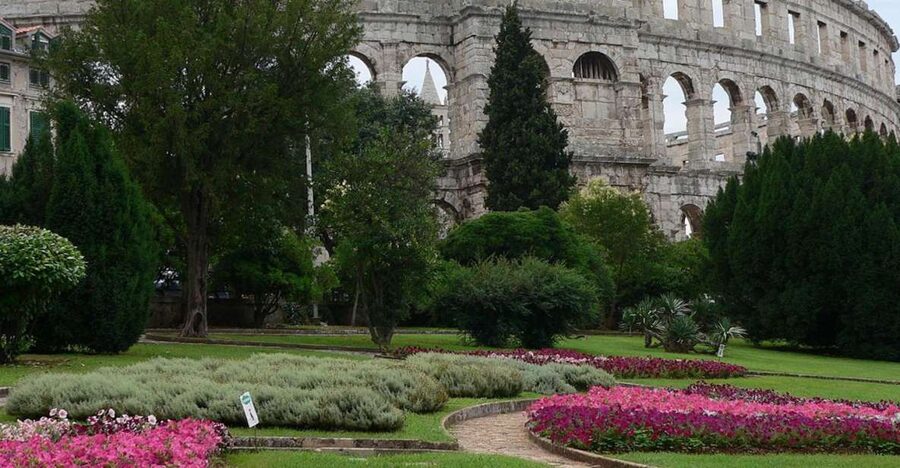
Pula’s Roman amphitheatre is more than a quick photo stop. This walking tour uses the Arena as your starting point, then follows the city’s old streets to Roman gates, the farmers market, and the Forum. I like the way it connects grand monuments with everyday Pula, including local food and the story behind the goat on Istria’s flag.
I also like the personal format. Marina can shape the conversation around local life, culture, nature, or food instead of delivering the same speech to every group. The main consideration is that the tour is offered in German, and entrance fees are not included if you choose to enter the amphitheatre.
Key points at a glance
- Start beneath the wooden roof at Pula’s Arena: The meeting point is directly at the entrance to the Roman amphitheatre.
- See three surviving Roman gates: The Twin, Hercules, and Sergii gates each offer a different glimpse of ancient Pula.
- Connect Roman Pula with daily life: The farmers market brings local produce and Istrian food into the story.
- Hear alternative facts and local explanations: The route covers the Roman past, Venetian influence, regional symbols, and city life.
- Choose a private group: Private bookings are available, useful if you want a quieter pace or a more focused conversation.
- Plan for 90 minutes to two hours: The exact length depends on the route and discussion.
Meeting Pula at the Roman Arena
The tour begins at the entrance to Pula’s amphitheatre, under the wooden roof. This is an easy place to find because the Arena is the city’s main attraction and one of its clearest landmarks.
Your guide, Marina, has worked as a licensed guide in Istria for more than 18 years and specializes in German-speaking groups. She begins with the building itself: why the Romans built it, how it was used, and why its role went beyond gladiator contests.
That last point matters. Many short city walks treat the amphitheatre as a grand stone backdrop and move on after a few basic facts. Here, the Arena is the first clue to Pula’s long public life. It was a place for spectacle and large gatherings, and its purpose gives you a better sense of the city’s Roman importance.
You can also ask to visit the interior. The tour price covers the walking guide, but entrance fees are separate. One practical tip is to decide early if you want to go inside, since that choice affects both timing and cost. If you are content with the exterior, you still get the building’s scale and setting without paying an additional admission fee.
Recent tour feedback describes the Arena visit as optional, with one group choosing to enter. That flexibility is useful for repeat visitors, families, or anyone working within a fixed budget.
More History Walking Tours in Croatia
- Dubrovnik Old Town History Walking Tour
★ 5.0 · 1,684 reviews - Dubrovnik: Ancient City Walls & Wars Walking Tour
★ 5.0 · 1,270 reviews - Zagreb: City and WWII Tunnels Walking Tour
★ 4.9 · 1,230 reviews
Following the old streets beyond the Arena
From the amphitheatre, the route leads toward older parts of Pula. This is where the walk becomes more than a monument checklist. You move through streets shaped by several cultures and periods, with the guide explaining how the city changed over time.
Pula still has three Roman city gates: the Twin Gate, Hercules Gate, and Sergii Gate. Each one has preserved details that help you picture the ancient city’s entrances and defenses.
The Twin Gate is named for its paired openings. It is a small but useful reminder that Roman remains often survive as fragments within an active city rather than as a separate archaeological park.
The Hercules Gate carries carved details associated with the ancient period. Its name and decoration give Marina a chance to explain how Roman identity appeared in public architecture.
The Sergii Gate, also known as the Golden Gate, is especially valuable for understanding how Roman monuments could also honor powerful local families. The preserved stonework gives the guide something specific to point out, rather than asking you to imagine the past from empty foundations.
You should expect to walk on historic streets, with stops for explanation rather than a long series of formal presentations. That makes the experience easier to follow, but it also means the quality of the tour depends on your questions and interests. If you want detail about architecture, ask for it. If you would rather hear about modern life, food, or local customs, say so.
The tour is described as personalized, and the guide can focus on subjects such as culture, nature, food, or the local way of life. This is a better fit for curious visitors who enjoy conversation than for anyone seeking a strict, fast-moving lecture.
The farmers market and the taste of Istria
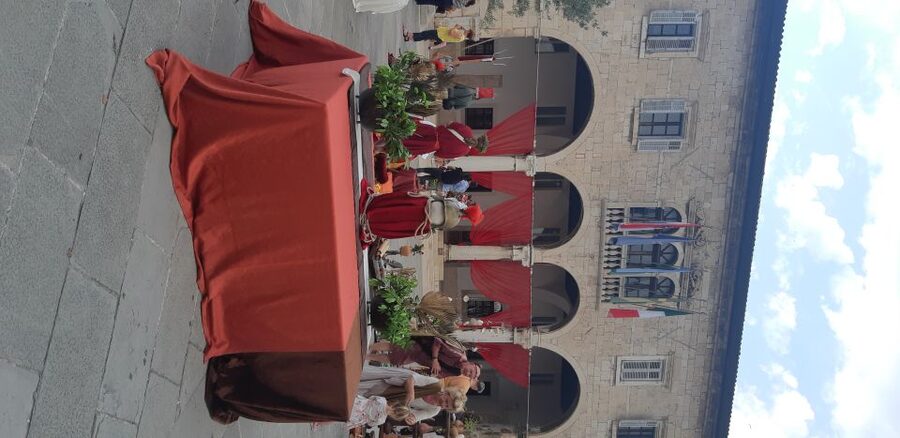
One of the most useful stops is Pula’s farmers market. This is where local people buy and sell products from Istrian soil, giving you a look at the city’s food culture without leaving the center.
Marina is also a passionate cook, so food is not treated as an afterthought. You can ask about local ingredients, cooking, and the connection between the market and Istrian life. The activity details do not promise tastings, so you should not book this expecting a food tour or included samples. Think of the market as a place for context, conversation, and practical ideas for what to look for during the rest of your stay.
I like this part because it balances the Roman monuments. The Arena and gates show Pula’s public past, while the market shows how the city works today. A guide who can explain both gives you a more useful introduction than one who only recites dates and names.
The market can also help you make better choices later. If you plan to shop for local products or eat Istrian food during your trip, you can use this stop to ask what is native to the region and what is simply sold there. The available information does not promise restaurant recommendations, but the guide is open to questions about local food.
From Roman marketplace to Forum Square
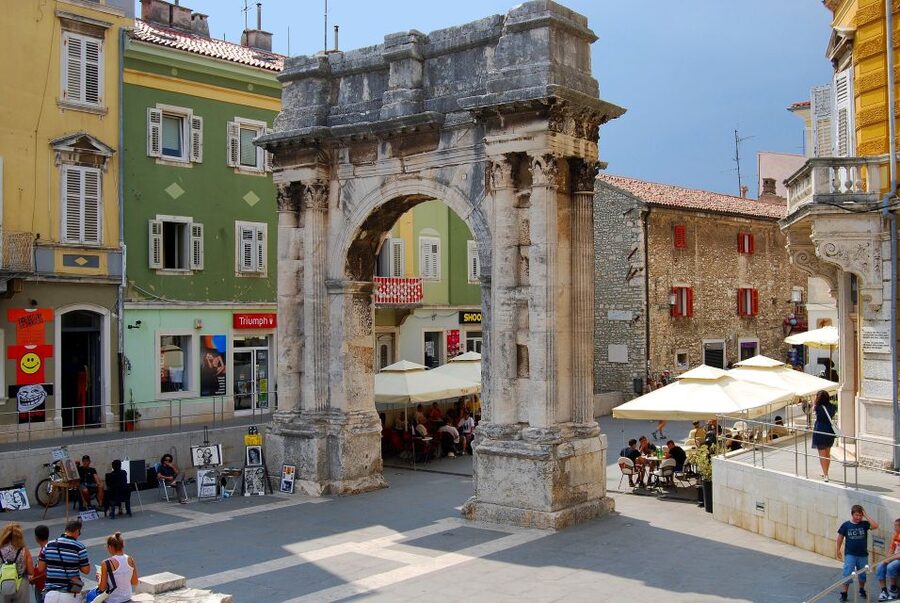
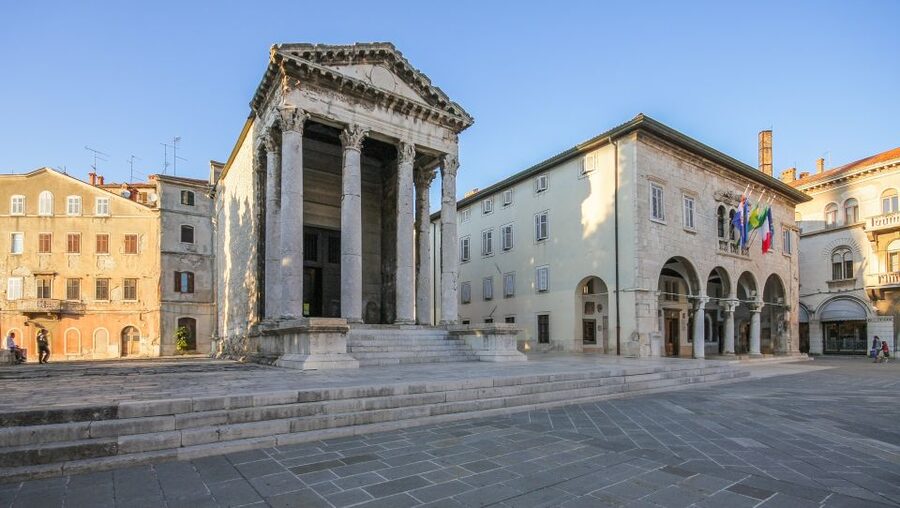
The walk continues to Forum Square, the heart of ancient Pula. In Roman times, the Forum served as the city’s central public area and marketplace. Today, it brings several layers of Pula together in one view.
Here you see remains of the Temple of Augustus. The temple gives the guide a clear way to explain Roman religion, public buildings, and the importance of the Forum in city life.
You also see the Venetian city hall. Its presence beside Roman remains shows how later rulers reused and reshaped central spaces rather than building an entirely separate city somewhere else.
This is one of the tour’s strongest interpretive moments. You are not simply looking at Roman stones and Venetian architecture in isolation. You are seeing how different periods occupy the same square, with each one leaving behind a different idea of power and public life.
The guide also explains why a goat appears on the regional flag. That small detail may be more memorable than another date, especially because it connects local identity with a symbol you can continue to notice around Istria. It is the kind of alternative fact that makes a walking tour feel personal and gives you a story to carry beyond Pula.
Same city, a different century:
- Zagreb: City & History Walking Tour & WW2 Tunnels
★ 4.9 · 1,202 reviews - Walking Tour of Split with a ‘Magister’ of History
★ 5.0 · 1,122 reviews - Dubrovnik Combo: Old Town & Ancient City Walls
★ 5.0 · 1,019 reviews - Split Walking Tour with Professor of History
★ 5.0 · 926 reviews
What Marina’s guiding style adds
Marina’s long experience in Istria matters most in the way she can adjust the tour. A group interested in Roman architecture can stay with the gates, Arena, and Forum. A food-minded group can spend more time discussing the market and local cooking. A visitor who wants everyday context can ask about life in Pula, local culture, or nature.
The tour is also suitable for questions. Several recent comments praise the detailed explanations, the time given to answers, and the fact that the walk remained engaging rather than dry. One group of seven, including a friendly young child, found the format enjoyable, which suggests that the route can work for a small family group when the pace is handled well.
Another recent booking described the walk as informative and entertaining, with a choice about entering the Arena. That combination is worth noting. The tour gives you information, but it does not appear to depend on a rigid script or force every group into the same add-on.
The supplied details identify Marina as the guide, while one recent comment refers to Veronika. If having a particular guide matters to you, confirm the name when booking. The more important point is that the experience is presented as a local, German-language tour rather than a large multilingual group outing.
German-language guiding and group size
The tour is conducted in German. That makes it a natural choice for German-speaking visitors who want explanations in their strongest language, especially when discussing names, Roman terms, regional history, or local food.
If you do not speak German, this is not the right choice. No other tour language is listed, so you should not assume that English commentary is available.
A private group option is available. That can be worth considering if you are traveling with family or friends and want to control the pace. It also gives you more room to guide the conversation toward subjects that matter to your group.
The standard duration is listed as 90 minutes to two hours, while the included walking tour is described as 1.5 hours. Treat that as a useful planning range rather than a promise of a precise finish time. A group that asks many questions or enters the Arena may take longer than a group focused on exterior sights.
The tour is wheelchair accessible. The available details do not describe every surface or any particular access arrangements inside the amphitheatre, so anyone needing specific support should confirm those points before booking.
Is $29 a fair price?
At $29 per person, this is a reasonable price for a guided introduction to Pula, especially if you value a private group option and a guide who can discuss more than the major monuments.
The value comes from the connections. You see the Arena, three Roman gates, the market, the Forum, the Temple of Augustus, and the Venetian city hall in one walk. You also get local explanations about food, regional identity, and the goat on the flag. That is a stronger use of 90 minutes than simply walking between photo stops on your own.
Still, the price does not include entrance fees. If you want to enter the amphitheatre, add that cost to your budget. For visitors who only want exterior views, the tour is easier to price and may feel especially good value.
You should also compare the price with your group size. For a private group, $29 per person can make sense because you are paying for attention and flexibility. For a solo visitor or couple, the value depends more on how much you want guided interpretation rather than independent sightseeing.
The high rating of 4.8 from 214 reviews supports the idea that the basic experience is dependable, but I would focus less on the number and more on the repeated strengths: clear explanations, an entertaining pace, time for questions, and useful local tips.
Who will enjoy this Pula walk?
I would choose this tour if you want a compact first look at Pula with a local guide who can move between ancient remains and present-day life.
It suits:
- German-speaking visitors who prefer a full German-language tour
- First-time visitors who want help understanding the city’s Roman remains
- Couples and families looking for a short walking activity
- Small groups that want a private option
- Food-minded visitors who want market and cooking context
- History fans who prefer stories and details over a list of dates
It may be less suitable if you want a dedicated food tasting, a long archaeological lecture, or a tour in English. It is also not ideal if you want every admission included in the quoted price.
Families should appreciate the relatively short length and the ability to ask questions or adjust the focus. The feedback from a group with a young child suggests the format can work well for families, though the usual demands of a historic walking route still apply.
Booking details worth knowing
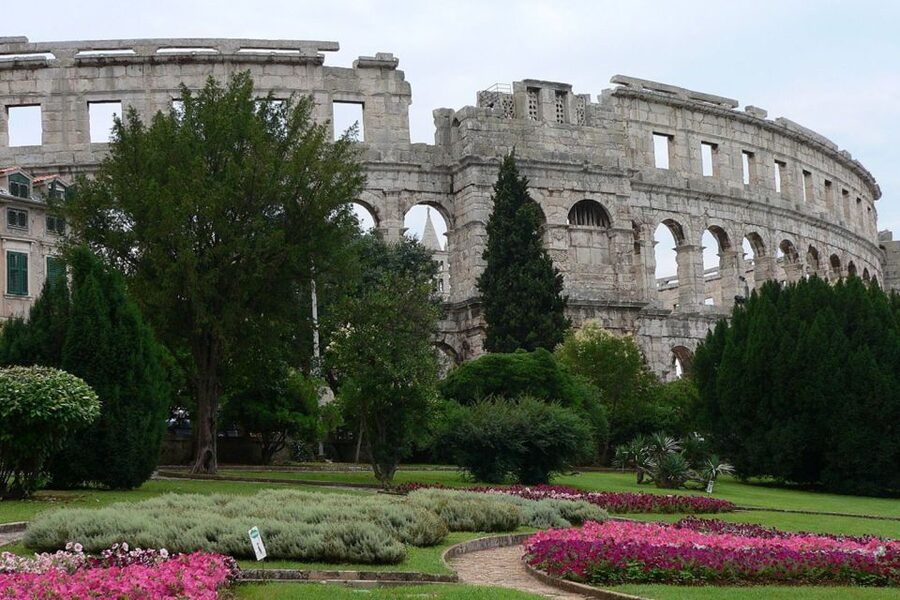
You meet at the entrance to the Arena, under the wooden roof. The tour lasts 90 minutes to two hours, with starting times shown according to availability.
You can cancel up to 24 hours before the tour for a full refund. A reserve-now, pay-later option is also available, so you do not have to pay at the time of booking.
The tour is wheelchair accessible, and private groups can be arranged. Entrance fees are not included, so decide in advance if you want to visit the inside of the amphitheatre.
Should you book this tour?
Book it if you want Pula explained by someone rooted in Istria, rather than simply photographed. The best parts are the links between the Arena, Roman gates, market, Forum, Venetian city hall, and local food. You get a clear route, plenty of subjects for questions, and a useful introduction in German.
Skip it if you need English, want a dedicated tasting tour, or prefer to explore every monument at your own pace. For German-speaking visitors, especially those booking a private group or visiting Pula for the first time, $29 is a fair price for a focused walk with local context.
FAQ
Where does the Pula walking tour begin?
The meeting point is at the entrance to Pula’s Arena, under the wooden roof.
How long does the tour last?
The tour lasts between 90 minutes and two hours. The included walking tour is also described as 1.5 hours.
What language is the tour conducted in?
The live tour guide speaks German. German is the only language listed for this activity.
Is the tour private?
A private group option is available. The activity details do not specify that every booking is automatically private.
Is the tour wheelchair accessible?
Yes, the activity is listed as wheelchair accessible.
Is entrance to the amphitheatre included?
No. Entrance fees are not included in the walking tour price.
Can I choose to enter the Arena?
Yes. The tour can include a choice about visiting the Arena, but you will need to pay any applicable entrance fee separately.
What places does the walking tour visit?
The route includes Pula’s Roman amphitheatre, the Twin Gate, Hercules Gate, Sergii Gate, the farmers market, Forum Square, the Temple of Augustus, and the Venetian city hall.
Can the guide focus on a particular subject?
Yes. The guide can focus on interests such as local lifestyle, culture, nature, or food.
Can I cancel for a full refund?
Yes. You can cancel up to 24 hours in advance for a full refund.
Just added around Croatia
- Split: Local History and Culture 90-Minute Walking Tour★ 5.0 · 194 reviews
- Split: Walking tour of Split with a ‘Magister’ of History★ 5.0 · 110 reviews
- Split: Historical & Gastro Treasures Tour with Green Market★ 4.9 · 144 reviews
- Split: Historical Tour of Salona, Klis Fortress and Trogir★ 4.1 · 108 reviews
- Split: Private Walking Tour in the Historical Town Center★ 5.0 · 25 reviews
- Šibenik: Medieval Night Walking Tour★ 5.0 · 27 reviews
- Šibenik: Croatia in a Day, Vistas, History, Olive Oil, Wine★ 5.0 · 30 reviews
- Dubrovnik: Red History Museum Regular Ticket★ 4.6 · 134 reviews
Croatia History Tours, compared.
Dubrovnik: Ancient City Walls & Wars Walking Tour
Read our review →
Zagreb: City & History Walking Tour & WW2 Tunnels
Read our review →
Walking Tour of Split with a ‘Magister’ of History
Read our review →
Dubrovnik Combo: Old Town & Ancient City Walls
Read our review →
Browse the lists this tour appears in