
Review · DUBLIN
2-Hour Historical Walking Tour from Dublin
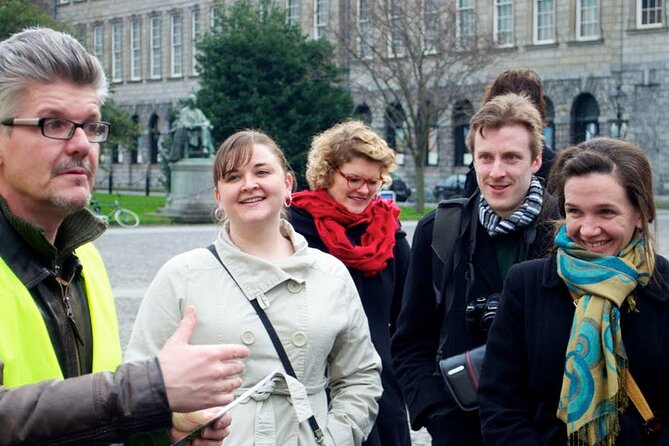
Dublin’s story comes at you fast on this compact walk, from the Viking settlement at Wood Quay to the British administration at Dublin Castle and the Civil War at the Four Courts. The guides, including Eoin, Jody, John, and others, are history postgraduates who bring plenty of detail and personality.
I like the low price of $22.98, especially for a two-hour orientation that covers major landmarks without taking up your whole day. I also like the route’s range: you get Trinity College, Temple Bar, a medieval cathedral, Georgian government buildings, and the sites of modern Irish political struggle.
The main caution is that this is a serious history lesson, not a light stroll with a few amusing facts. Some guides cover politics and events in considerable detail, so children and people looking only for Dublin folklore may find the pace or subject matter demanding.
Key points to know before you book
- The tour begins at the Grattan Monument: Meet at College Green, opposite Trinity College’s front gate, rather than waiting at the gate itself.
- You cover eight major sites: Trinity College, the Bank of Ireland, Temple Bar, Wood Quay, the Four Courts, Christ Church Cathedral, City Hall, and Dublin Castle.
- History is the main event: Guides are history postgraduates, and the tour reaches from ancient Ireland through the Viking period, British rule, independence, the Civil War, and recent politics.
- The group can include up to 25 people: That keeps the cost down, though you may prefer a smaller group if you want constant access to the guide.
- The Book of Kells costs extra: The tour explains its importance, but admission to see it is not included.
- Plan for weather and shoes: Dublin weather can be cold, wet, and windy, and the walk lasts about two hours, sometimes longer.
Why this is a useful first look at Dublin
This tour works best as an opening chapter to your time in Dublin. It gives you a map in your head and explains why the city’s monuments are tied to religion, colonial rule, rebellion, law, and national identity.
You are not simply walking from one attractive building to another. Trinity College leads into questions about education and Protestant power. The Bank of Ireland opens the story of the old Irish Parliament. The Four Courts brings in the bitter split over the 1921 Treaty and the Civil War that followed.
That is the appeal. You see central Dublin while learning how different groups shaped it. The route links Vikings, medieval churchmen, British officials, Catholic campaigners, revolutionaries, and modern Ireland.
The walk is also an efficient use of time. At around two hours, it leaves most of the day open for the Book of Kells, the Guinness Storehouse, museums, or a second look at any site that catches your interest. Many people book it near the start of a Dublin stay, and that timing makes sense.
More History Walking Tours in Ireland
- Historical 2-Hour Guided Walking Tour of Dublin
★ 4.7 · 865 reviews - Dublin’s Haunted History Walking Tour
★ 4.3 · 345 reviews - Deliciously Dublin: The Artisan Donut Walking & History Tour
★ 5.0 · 329 reviews
Starting at Trinity College and the Book of Kells
The meeting point is the Henry Grattan Monument on College Green, opposite the front gate of Trinity College. This detail matters. Do not wait directly at the college gates, since the tour’s stated meeting place is at the monument across from them.
The group enters the Trinity campus and spends about 20 minutes discussing Ireland’s oldest university, founded in 1592. Trinity is more than a handsome college courtyard. Its foundation reflects the religious and political divisions of Ireland, and its place in the city helps explain the social order that shaped Dublin for centuries.
The Book of Kells is the star object here. This eighth-century manuscript contains the four Gospels in Latin and is one of Ireland’s best-known cultural treasures. The guide explains its place in Irish history, but admission to see the Book of Kells is not part of the walking tour.
That arrangement is good for budget-minded visitors. You can decide later if you want to pay separately for the exhibition, rather than having that cost folded into the tour price. If the manuscript is a priority, leave time in your schedule to visit it on your own.
The Bank of Ireland and the politics of Georgian Dublin
The next stop is the Bank of Ireland, a grand neoclassical building that began life as Ireland’s Parliament in 1729. The Parliament was abolished by the Act of Union in 1800, an event that shifted political power to London and left a lasting mark on Irish history.
This is where the tour moves beyond architecture. The building represents Protestant Ascendancy, the period when political and economic power rested heavily with the Protestant ruling class. A guide with a strong history background can explain why a formal government building tells a less formal story about who had rights, influence, and access.
You may not spend long here, about 10 minutes, but the stop gives useful context for the rest of the walk. Dublin’s elegant Georgian center was not created in a political vacuum. Its buildings reflect wealth, authority, and a divided society.
Temple Bar, beyond the pub signs
Temple Bar is now one of Dublin’s most familiar districts, but the guide puts its modern identity into perspective. The narrow-street area was once marked for demolition before being repurposed as Dublin’s Cultural Quarter in the 1990s.
That change is worth hearing about because Temple Bar can feel like a ready-made tourist district. The tour helps you see it as an example of urban policy and changing ideas about what should happen to old city neighborhoods.
The stop lasts about 10 minutes. Do not expect a long pub crawl or a detailed food tour. This is a historical explanation of the area’s transformation, not an introduction to every bar and restaurant. Still, it can make your later visit more interesting, especially if you return after dark and notice how different the district feels from the rest of central Dublin.
More History Walking Tours in Dublin:
- Walking Tour of Dublin’s Viking/Medieval Quarter with a Viking
★ 5.0 · 171 reviews - Dublin: Macabre History Walking Tour
★ 4.9 · 95 reviews - Dublin Private Medieval Walking Tour
★ 5.0 · 69 reviews - Dublin: LGBT Pride Walking Tour with Queer History
★ 5.0 · 24 reviews
Wood Quay and the Viking city
At the Wood Quay Amphitheatre, the focus turns to the Viking settlement founded around AD 840. Extensive archaeological excavation took place here in the 1980s, uncovering evidence of the early city.
This stop helps correct the common idea that Dublin’s story begins with medieval castles or later British rule. The city’s name itself comes from the Dubh Linn, or Black Pool, a feature associated with the settlement around the castle area.
The discussion here is brief, around 10 minutes, but it connects geography with history. Dublin grew because of its river, port, and strategic position. You start to see the city not as a collection of separate attractions, but as a place shaped by water, trade, defense, and power.
The Four Courts and the beginning of the Civil War
The Four Courts is one of the strongest stops for anyone wanting to understand modern Irish history. It is Ireland’s legal headquarters and the place where the Civil War began in June 1922.
The conflict split those who supported the Treaty of December 1921 from those who opposed it. That Treaty ended the War of Independence from 1919 to 1921 but created new divisions over the shape and future of the Irish state.
A 20-minute stop gives the guide room to explain the dispute rather than simply naming it. This is one reason the tour can feel dense. Irish political history includes overlapping rebellions, treaties, religious divisions, and competing ideas of independence. If you want a quick list of dates, you may find the detail heavy. If you want to understand why Irish history remains politically charged, this is valuable time.
The physical walk is not difficult, but it is still a full two hours on city streets. Wear comfortable shoes and dress for rain, wind, or cold. A January morning can be especially brisk, and weather is the one part of the experience no guide can control.
Christ Church Cathedral and Strongbow’s arrival
Christ Church Cathedral is Dublin’s oldest cathedral, founded in 1030. The present stone building was rebuilt in the 1170s by Strongbow, the Anglo-Norman leader linked to the original English invasion of that period.
That makes the cathedral a useful place to discuss how medieval religious buildings were tied to conquest and political authority. The stop is only about 10 minutes, so it is more of an outdoor historical explanation than a full cathedral visit.
The tour’s stated end point is Christ Church Cathedral, although the listed route also includes City Hall and Dublin Castle. Because the route information places those stops after Christ Church, check the day’s exact walking order with your guide if you need to meet someone or reserve another activity immediately afterward.
City Hall and Daniel O’Connell
At City Hall, the story shifts toward Catholic emancipation and political representation. Inside is a statue of Daniel O’Connell, Dublin’s first Catholic Lord Mayor, elected in 1840.
O’Connell led the successful campaign for Catholic Emancipation in 1829, ending anti-Catholic laws that had restricted Catholics for generations. He is known as The Liberator, a title that makes more sense once you understand the barriers he challenged.
The guide may discuss the statue and its setting rather than conduct a long indoor visit. This is another short stop, but it adds an important personal story to the larger political account. Instead of hearing only about laws and institutions, you meet one of the figures who helped change them.
Dublin Castle and the Dubh Linn
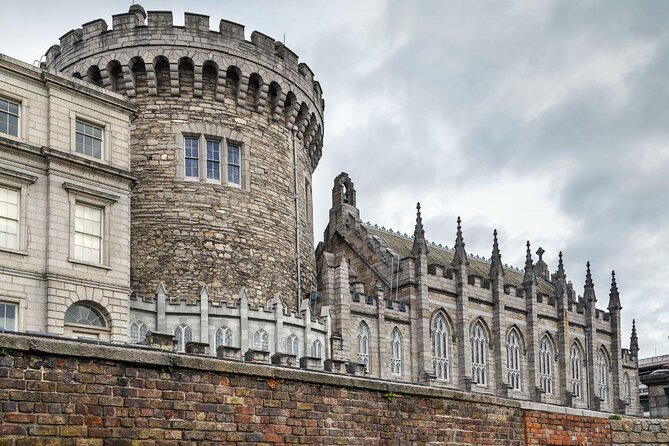
Dublin Castle brings several threads together. King John had it built in 1204, and it remained the center of British administration in Ireland until 1922.
The site also connects directly to Dublin’s name through the Dubh Linn, or Black Pool. That combination makes the castle an especially useful final landmark: it links the city’s early geography with centuries of foreign administration and the creation of the modern Irish state.
The stop lasts about 10 minutes. This is not a full Dublin Castle admission tour, so you should not book it expecting access to every room or exhibit. You get the historical framework, then you can return later if the castle deserves more of your time.
How much history fits into two hours
The guides are all history postgraduates, and that shapes the experience. Jody is described as an animated storyteller with strong knowledge of Irish history, while Eoin has been praised for making a huge span of time easy to follow. John, Daragh, Caolan, Colm, and Owen are also among the guides associated with the tour.
The presentation style can vary, but the common thread is clear: expect facts, political context, stories, and humor. One guide reportedly began with 5,000 years of Dublin history in five minutes, then added detail at each stop. That approach can help you organize a lot of information, but you need to pay attention.
The tour sometimes runs beyond the advertised two hours. A few extra minutes may be welcome, especially if the guide is answering questions, but leave some flexibility in your schedule. Do not book a timed attraction immediately afterward unless you have a generous gap.
Group size, price, and overall value
At $22.98 per person, this is a strong value if you want historical context rather than entry to paid attractions. The group can reach 25 people, which is small enough for a guide to address the group clearly but not intimate.
The price does not include the Book of Kells, and the tour does not function as a full admission visit to every landmark. You are paying for the guide’s expertise, the route, and the organized explanation of Dublin’s past.
That is a fair trade for many people. A private guide would cost much more, while a self-guided walk would leave you to connect Trinity, Wood Quay, the Four Courts, and Dublin Castle on your own. The group format keeps the price low and gives you a chance to ask questions, though you may need to move closer to the guide in a crowded street.
The tour is offered in English, uses a mobile ticket, and can be booked as far as about three weeks ahead by many people. Free cancellation is available up to 24 hours before the start time. Changes or cancellations inside that window are not accepted for a refund.
Who will enjoy this walk most
You should book this if you like history, politics, city architecture, and the stories behind famous places. It is especially useful for a first day in Dublin, when you want an orientation before exploring on your own.
It suits adults and older children who can follow a detailed explanation. One young teenager enjoyed the historical detail, but the tour may not hold the attention of younger children. The subject matter is not built around games or quick entertainment.
You should think twice if you want a relaxed cultural stroll with only short explanations. The politics can be dense, and one guide may cover more detail than you expect. The strongest guides balance facts with jokes, songs, personal stories, and clear storytelling, but the tour’s basic character remains academic and historical.
The walk requires moderate physical fitness. Service animals are allowed, and the route is near public transportation, but the tour is still outdoors and involves steady walking over roughly two hours.
Should you book the Dublin Historical Walking Tour?
Book it if you want to understand Dublin rather than simply photograph it. For about $23, you get a brisk route through the city center and a useful explanation of how Viking settlement, medieval conquest, Protestant rule, Catholic emancipation, independence, and the Civil War fit together.
Skip it if your priority is entering attractions, spending time inside the Book of Kells exhibition, or keeping the history light. For everyone else, take it early in your stay, wear good shoes, bring rain protection, and keep the rest of the day flexible. It gives you the context to make later visits to Trinity, Christ Church, City Hall, and Dublin Castle far more meaningful.
FAQ
Where does the tour begin?
It begins at the Henry Grattan Monument on College Green, opposite the front gate of Trinity College Dublin.
Where does the tour end?
The stated end point is Christ Church Cathedral, on Christchurch Place in Dublin.
How long does the tour last?
The tour is planned for about two hours, though it may sometimes run longer.
What language is the tour offered in?
The tour is offered in English.
How much does the tour cost?
The listed price is $22.98 per person.
How large can the group be?
The maximum group size is 25 people.
Is entry to the Book of Kells included?
No. The tour explains the importance of the Book of Kells, but admission is not included.
Which places does the walk visit?
The route includes Trinity College Dublin, the Bank of Ireland, Temple Bar, Wood Quay Amphitheatre, the Four Courts, Christ Church Cathedral, City Hall, and Dublin Castle.
What type of guide leads the tour?
The guides are history postgraduates. Named guides associated with the experience include Jody, Eoin, John, Daragh, Caolan, Colm, and Owen.
Can I cancel for a full refund?
Yes. You can cancel at least 24 hours before the experience start time for a full refund. Cancellations or changes made less than 24 hours beforehand are not accepted for a refund.
More Two-Hour Tours in Dublin
- Berlin’s Best: 2 Hour Walking Tour Third Reich and the Cold War
★ 5.0 · 5,486 reviews - 2-Hour Gettysburg Battlefield Guided History Bus Tour with a National Park Guide
★ 4.5 · 2,201 reviews - Kyoto Gion: 2-Hour Geisha Culture & History Walking Tour
★ 5.0 · 1,186 reviews - 2 Hour LoDo Historic Walking Tour in Denver
★ 5.0 · 1,106 reviews
Just added around Dublin
- Wicklow Historic Gaol: 1-Hour Tour★ 4.4 · 56 reviews
- Dublin: LGBT Pride Walking Tour with Queer History★ 5.0 · 24 reviews
- Dublin: Macabre History Walking Tour★ 4.9 · 95 reviews
- Dublin Private Highlights & History of 1916 Easter Rising Tour★ 5.0 · 154 reviews
- Dublin Private Medieval Walking Tour★ 5.0 · 69 reviews
- Dublin Historical Centre Private Food Tour with 8 Food Tastings★ 5.0 · 152 reviews
- The History of Dublin With Locals: 1916 Easter Rising PRIVATE Tour★ 5.0 · 73 reviews
- Walking Tour of Dublin’s Viking/Medieval Quarter with a Viking★ 5.0 · 171 reviews
Dublin History Tours, compared.

Dublin Historical Centre Food Tour with 8 Food Tastings & Drinks
Read our review →
Historical 2-Hour Guided Walking Tour of Dublin
Read our review →
Celtic Boyne Valley & Ancient Sites Day Tour From Dublin
Read our review →
From Dublin: Celtic Boyne Valley and Ancient Sites Tour
Read our review →
Dublin to Cork, Blarney Castle & Cóbh Heritage Centre by train
Read our review →
Dublin: Jeanie Johnston Tall Ship Irish Famine History Tour
Read our review →

Deliciously Dublin: The Artisan Donut Walking & History Tour
Read our review →Browse the lists this tour appears in