
Review · POMPEII
Explore Pompeii with an Archaeologist
Pompeii is easier to understand when someone helps you read the streets, houses, paintings, and public buildings as parts of one city. This two-hour walk takes you from the forum to villas, baths, shops, and the theatre, with an archaeologist explaining what you are seeing rather than leaving you to decode the ruins alone. The guide-led storytelling is the main reason to book.
I like the skip-the-line admission and the useful route through many headline sights. I also like the small-group limit of 20, which gives you a fair chance to ask questions. The main drawback is time: two hours can introduce Pompeii, but it cannot show you everything, and crowds may make some rooms hard to hear or enter.
Key points before you book
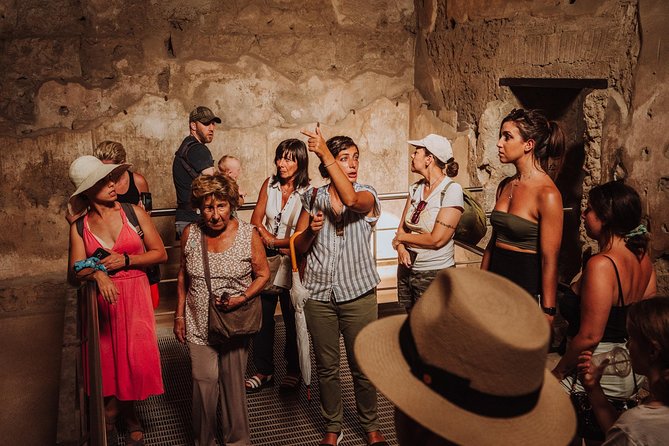
- A fast introduction to Pompeii: You visit the forum, basilica, Lupanar, villas, baths, shops, and theatre in about two hours.
- Archaeologist-led explanations: Guides including Mario Celentano, Teresa, Alexandra, Rosanna, Ilaria, and Sergio have been praised for clear stories and patient answers.
- Small group, up to 20 people: This is more personal than a large coach tour, though it is not a private visit.
- Expect serious walking: Pompeii has uneven ancient paving and very little shade. Comfortable shoes, water, and a hat matter.
- Admission is included: Transportation, food, and drinks are not included.
- You can keep exploring afterward: The tour ends at Piazza Esedra, and you can continue through the site on your own if you have time.
Entering Pompeii through Porta Marina Superiore
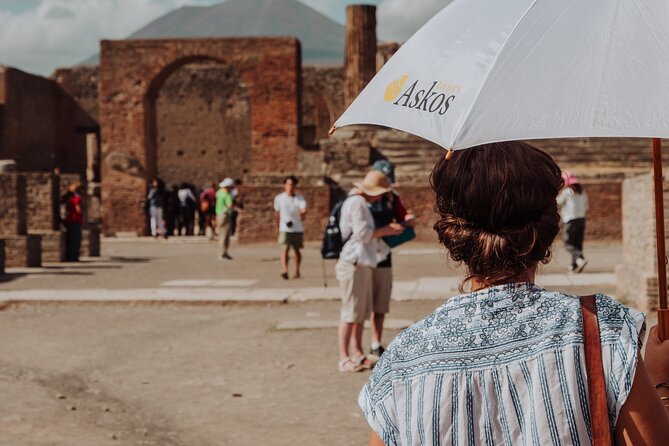
You meet the guide at the archaeological park’s Porta Marina Superiore entrance. Look for the Askos Tours sign, which should make the meeting point easier to spot among the arrivals.
The tour includes admission and is designed to reduce the usual wait at the entrance. That is useful at Pompeii, where time spent in an entry line is time lost inside a huge archaeological site. The meeting address is Via Villa dei Misteri, 2, in Pompeii, and the walk finishes at Piazza Esedra.
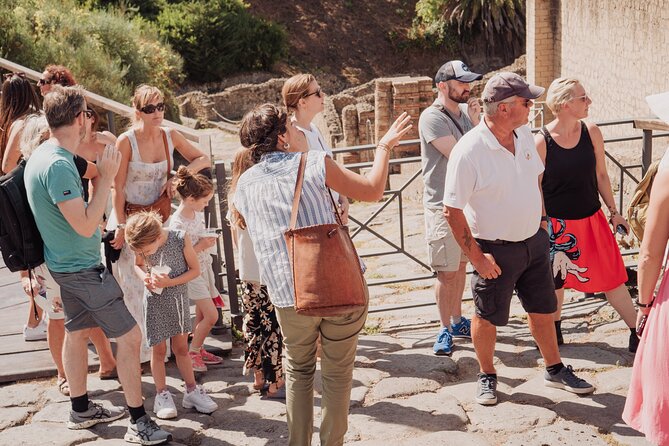
Your guide leads the group on foot. There is no transportation during the visit, and you should expect ancient stone streets, uneven surfaces, and plenty of walking. One especially practical point from the experience: the amount of walking is easy to underestimate. Even a two-hour route can feel like a workout in warm weather.
For groups of 16 or more, headsets are provided. These can help when the guide is speaking from the edge of a busy street or when the group spreads out. Still, sound is not always perfect. Crowds inside smaller rooms can make it harder to hear, so staying close to the guide is wise.
More Ancient History Tours in Italy
- Pompeii: Entry Ticket and Guided Tour with an Archaeologist
★ 4.8 · 19,459 reviews - Pompeii: Small Group Tour with an Archaeologist
★ 4.8 · 12,264 reviews - Pompeii Small Group Tour with an Archaeologist
★ 5.0 · 6,593 reviews
The forum and basilica explain how Pompeii worked
The first major stop is the Forum, Pompeii’s main square. This is the right place to begin because it gives you the city’s public center before you move into private homes and commercial streets.
Your guide can point out how the open square related to civic, religious, and commercial life. Without explanation, the forum can look like a broad field of columns and broken walls. With a clear guide, the remaining buildings begin to form a picture of daily public life.
The Basilica follows. Despite its name, this was the city courthouse and an important public building. The stop helps you see that Pompeii was not only a collection of houses preserved by disaster. It was a functioning city with courts, markets, religious spaces, entertainment, baths, and busy streets.
Ten minutes at each listed stop is a quick pace. That is useful if you want to cover a lot of ground, but it does not leave much time for quiet contemplation or detailed photography. If one building catches your attention, note its name and return later.
The Lupanar and forum granaries
The Lupanar, Pompeii’s famous brothel, is one of the most talked-about stops. Its small rooms and surviving wall paintings offer a direct, sometimes blunt look at commercial sex in the ancient city.
This is a place where context matters. A guide can explain what the rooms may have been used for and separate the evidence from the more sensational stories often attached to Pompeii. The space can also be crowded, and you may need to wait briefly to see the interior.
The Granaries of the Forum are less flashy but useful. They held objects and food-related materials recovered from the city. The stop adds an everyday side to Pompeii, moving the tour beyond dramatic ruins and grand villas.
I like this contrast. The Lupanar attracts attention, while the granaries help you think about storage, trade, and supplies. Together, they show both the human and practical sides of the city.
House of Menander and House of the Faun
The House of Menander is one of Pompeii’s important residences. Its name comes from the ancient Greek playwright Menander, whose work is connected with the decoration found there. A guide can help you notice how a wealthy Roman home was arranged and what its art suggests about taste and status.
The House of the Faun is even larger and more famous. It takes its name from the bronze statue of a dancing faun, and it is linked with the celebrated Alexander Mosaic. Even when every room is not open, the scale of the property gives you a sense of how much wealth some Pompeii residents controlled.
These houses are a good test of the tour’s pace. Ten minutes is enough for a focused explanation and a look at key features. It is not enough to study every courtyard, mosaic, wall painting, and architectural detail.
I suggest listening for the guide’s main points, then taking a mental note of which house you want to revisit. The tour gives you a framework. Your later walk can fill in the detail.
More Ancient History Tours in Pompeii
- Discover the Ancient Ruins of Pompeii: Day Trip from Rome
★ 3.5 · 2,247 reviews - Pompeii and Herculaneum Small Group Tour with an Archaeologist
★ 5.0 · 1,350 reviews - Skip the Line Guided Tour of Pompeii led by an Archaeologist
★ 5.0 · 703 reviews - Pompeii: Tour with Archaeologist Guide & Skip-the-Line Entry
★ 4.5 · 623 reviews
The Stabian Baths show Pompeii’s social side
The Stabian Baths, or Terme Stabiane, bring the tour into a public setting built around washing, exercise, and social contact. The ancient baths were not simply places to get clean. They were part of city life.
The surviving rooms and layout make more sense when your guide explains how different spaces were used. You can begin to picture a routine that involved moving through rooms with different temperatures and meeting other people along the way.
This stop also gives you a break from the grand houses. Pompeii’s story is stronger when you see both private luxury and shared public facilities. The baths show that public amenities mattered across the city, even though access and experience would have varied by status.
The site can be hot, especially under the summer sun. Bring a refillable water bottle. Water is available from fountains, and a hat or small umbrella can make the walk more comfortable.
Via dell’Abbondanza reveals ordinary street life
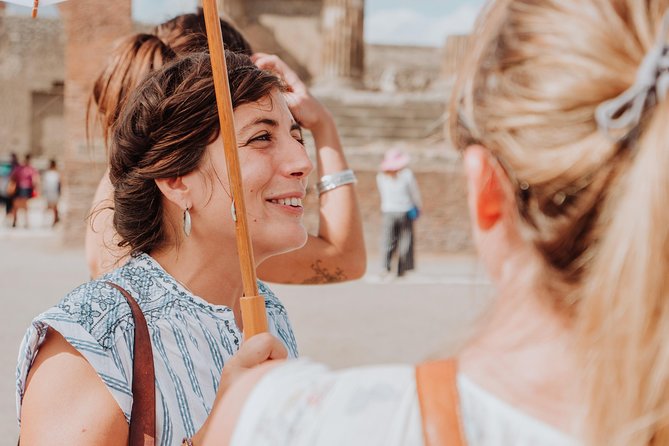
Via dell’Abbondanza is one of Pompeii’s main streets and one of the most useful places to understand movement through the city. You will walk along the ancient route while the guide points out buildings, street details, and the way commercial and residential areas met.
This is where Pompeii starts to feel less like a museum collection and more like a neighborhood. You can imagine people moving between homes, shops, baths, public buildings, and entertainment venues.
The itinerary lists this stop as free admission, though the Pompeii entry ticket is included for the overall park visit. The street itself is also where uneven paving becomes especially noticeable. Watch your footing instead of trying to walk and photograph at the same time.
The guide’s pace matters here. Mario has been praised for checking whether the group was moving too fast or too slowly, while Jolanta was noted for making streets and buildings feel connected to human stories. That kind of attention can make a long walk feel more manageable.
Thermopolium VI brings ancient fast food into view
Thermopolium VI was a food shop, a place where prepared food and drink could be sold to people on the move. The counter is one of Pompeii’s memorable features because it connects the site with an activity you still recognize today: grabbing something to eat away from home.
This stop adds useful variety. After forums, villas, and baths, a food counter brings the focus back to ordinary habits and small businesses. It helps you see that Pompeii was not just a city of monuments. It was a place where people bought meals, ran shops, and carried on with daily work.
Your guide may spend only a short time here because the route includes many stops. If food, trade, or ordinary life interests you most, ask a question while the group is gathered. The best guides on this tour have been praised for answering questions beyond a fixed script.
The Teatro Grande closes the route with spectacle
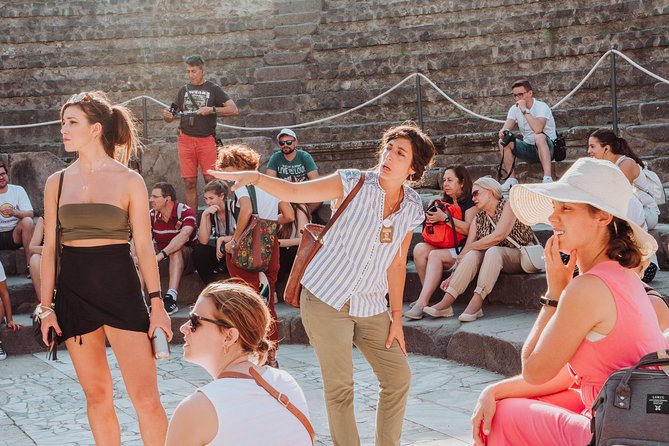
The Teatro Grande is the tour’s theatre stop. Its size and layout show how entertainment formed part of public life. The building gives you a change of scale after the narrow streets and domestic spaces.
A theatre is also a good final stop because it brings together architecture, performance, and the social life of the city. You can look at the seating and stage area while imagining the movement of a large audience.
The route ends at Piazza Esedra rather than returning you to the starting entrance. That can be convenient if you want to continue elsewhere in Pompeii, but it is worth paying attention to the end point if you have a train, meeting, or arranged ride afterward.
The official route also lists the House of the Vettii. Depending on the day’s access and pacing, the guide uses the stop to show another wealthy residence and its decorations. Pompeii can have changing access to individual buildings, so do not assume every room will be open exactly as expected.
What two hours can and cannot do
The route is broad rather than slow. You cover 12 listed stops, with roughly 10 minutes assigned to each. That is a smart format for a first visit, especially if you want orientation before exploring by yourself.
You will see many of Pompeii’s best-known types of sites:
- Public government and civic spaces
- Wealthy private houses
- A brothel
- Ancient baths
- A food shop
- A main commercial street
- A theatre
- Storage buildings and forum facilities
You will not see every excavated street or spend long periods inside each house. One important limitation is that this route does not promise a visit to active excavation areas. If newly uncovered sections are your main interest, you may want extra time beyond the tour.
Crowds can also affect the experience, even outside the busiest months. Lines may form inside popular rooms, and the number of people around you can make it difficult to hear through a headset. A private guide would offer more control, but this group tour costs far less and still provides a useful structure.
The guides make the largest difference
The experience depends heavily on the individual guide. The strongest reports describe guides who explain clearly, answer questions, adjust their pace, and add humor without turning the visit into a performance.
Mario Celentano is praised for patience, fun facts, and strong English. Another account describes him as a storyteller who regularly checked the group’s pace. Teresa is noted for her passion for archaeology and for answering questions throughout the visit.
Alexandra is described as direct, detailed, and especially good at keeping a younger visitor interested. Rosanna is praised for making difficult material easy to follow while adding humor. Ilaria, Julia, Diego, Sergio, Antonio, Rafaela, and Jolanta are also named as guides who made the ruins easier to understand.
There is one clear warning to keep in mind. One poor experience involved a slow delivery, limited interaction, and weak answers to questions. That does not appear to reflect the overall pattern, but it points to a real issue with group tours: you cannot choose the exact guide or teaching style in advance.
Is $35.67 a fair price?
At $35.67 per person, the value is strongest if you want admission, a live guide, and a focused introduction without paying for a private visit. The included Pompeii ticket removes one extra cost, and skip-the-line access can save useful time.
You are paying for a two-hour orientation, not an all-day exploration. If you arrive without much background, the guide’s explanations can make the ticket price worthwhile because you are less likely to walk past important buildings without understanding them.
The price is less attractive if you already know Pompeii well or prefer to set your own pace. You may feel rushed at the villas and want to linger longer than the schedule allows. In that case, you can still use the tour as a starting point and remain inside the park afterward to explore.
For the best value, plan a few extra hours after the guided portion if your schedule permits. The tour gives you names, locations, and context. Your own time afterward lets you return to the places that interested you most.
Who should book this Pompeii walk?
I would choose this tour if you are visiting Pompeii for the first time, have about two hours for a structured visit, and want a guide who can explain the site in English. It also suits families, since the route covers varied sights and several guides have been praised for making the material accessible to children.
It is a good fit for anyone arriving by train or public transportation, since the meeting point is near public transit. You should be comfortable walking on uneven ground and standing outdoors in the sun.
You may want a private tour instead if you need a very slow pace, have a strong interest in a narrow topic, or want to spend long periods inside individual houses. You should also arrive with realistic expectations. Pompeii is enormous, and no two-hour route can cover it all.
Free cancellation is available if you cancel at least 24 hours before the start time. Changes or cancellations inside that window are not accepted for a refund. If you are under 18, bring a passport or ID to qualify for free admission. Service animals are allowed, while other dogs must weigh no more than 10 kilograms, be no taller than 40 centimeters, remain leashed, and be carried inside buildings.
Should you book Explore Pompeii with an Archaeologist?
Yes, if you want a reasonably priced first look at Pompeii with the major sights arranged in a sensible route. The guide is the real value, especially when you get someone like Mario, Teresa, Alexandra, Rosanna, or another guide who welcomes questions and explains the evidence clearly.
Book it as an introduction, not as your entire Pompeii visit. Wear sturdy shoes, carry water, protect yourself from the sun, stay close enough to hear, and leave extra time to wander after the tour. If you want a slower and more personal experience, pay more for a private guide. For most first-time visitors who want structure and useful context, this two-hour walk is a practical choice.
FAQ
How long does the Pompeii tour last?
The tour lasts approximately two hours.
Where do I meet the guide?
You meet at the Porta Marina Superiore entrance to the Pompeii archaeological site, at Via Villa dei Misteri, 2. The guide will hold an Askos Tours sign.
Where does the tour finish?
The tour ends at Piazza Esedra in Pompeii.
Is Pompeii admission included?
Yes. The Pompeii admission fee is included in the tour price.
Is transportation included?
No. Transportation, food, and drinks are not included.
What is the maximum group size?
The group can include up to 20 travelers per guide. Headsets are provided for groups of 16 or more.
Can children and dogs enter Pompeii?
Most travelers can participate, and children under 18 are advised to bring a passport or ID for free admission. Only dogs weighing no more than 10 kilograms and standing no taller than 40 centimeters are permitted, and they must follow the stated leash and carrying rules inside buildings.
More Archaeological Site Tours in Pompeii
- Pompeii Private Tour with an Archaeologist and Skip The Line – 3 hours
★ 5.0 · 564 reviews - Pompeii Skip-the-line Tour with Archaeologist Guide
★ 5.0 · 559 reviews - Pompeii 3hours Villa of Mysteries tour with an Archaeologist
★ 4.8 · 486 reviews - Pompeii Private Tour with an Archaeologist and Skip The Line
★ 5.0 · 391 reviews
Just added around Pompeii
- Pompeii and Herculaneum: Guided Tour with an Archaeologist★ 5.0 · 164 reviews
- Pompeii Guided Tour with Archaeologist★ 4.6 · 27 reviews
- Pompeii: Guided Tour with Archaeologist with max. 12 People★ 5.0 · 155 reviews
- Pompeii Small Group Tour – Tickets Included★ 4.7 · 72 reviews
- Pompeii: 2-Hour Guided Tour with an Archaeologist★ 4.9 · 151 reviews
- PompeiI Exclusive Tour with your Archaeologist in a Small Group★ 4.5 · 363 reviews
- Pompeii Private Tour with an Archaeologist Guide★ 5.0 · 184 reviews
- Pompeii Private Tour with an Archaeologist and Skip The Line★ 5.0 · 391 reviews
Pompeii History Tours, compared.
Pompeii: Entry Ticket and Guided Tour with an Archaeologist
Read our review →
Pompeii: Small Group Tour with an Archaeologist
Read our review →Pompeii Small Group Tour with an Archaeologist
Read our review →
Discover the Ancient Ruins of Pompeii: Day Trip from Rome
Read our review →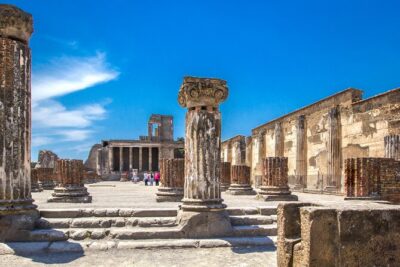
Pompeii and Herculaneum Small Group Tour with an Archaeologist
Read our review →
Skip the Line Guided Tour of Pompeii led by an Archaeologist
Read our review →
Pompeii: Tour with Archaeologist Guide & Skip-the-Line Entry
Read our review →
Pompeii Private Tour with an Archaeologist and Skip The Line – 3 hours
Read our review →Browse the lists this tour appears in