Review · POMPEII
Pompeii Private Tour with an Archaeologist and Skip The Line – 3 hours
Pompeii makes much more sense with someone who can read the ruins for you. This private three-hour walk moves from the theaters and Forum to baths, homes, shops, temples, and the city’s main street, turning broken walls into a picture of daily Roman life. The archaeologist guide is the real draw, with guides such as Luisa, Amadeo, Eliana, Mariagrazia, and Roberto praised for clear explanations and lively stories.
I like the private format because you can ask questions without holding up a group, and I like the route’s broad sweep through Pompeii’s public and private life. The main catch is important: the $302.32 price does not include the adult entrance ticket, which costs $19 per person. Skip-the-line help is available only if arranged in advance, so do not leave ticket planning until you reach the gate.
Key points at a glance
- A three-hour private walk: Your group has the guide to itself, making it easier to ask questions and adjust the pace.
- A wide look at Pompeii: The route includes theaters, baths, the Forum, temples, markets, homes, a brothel, a laundry, and a fast-food counter.
- Archaeological context: Guides explain architecture, Roman daily life, the eruption, and ongoing excavation work.
- Tickets cost extra: Adult admission is listed at $19 per person. The operator provides a link for advance purchase.
- Porta Marina meeting point: Begin at Hortus Pompei near Porta Marina Superiore and Piazza Esedra.
- Bring steady footing: Expect plenty of walking, steps, and slippery surfaces. Shade and water stops can matter on hot days.
Why a private archaeologist changes Pompeii
Pompeii is not a tidy museum arranged room by room. It is a large ancient city with streets, homes, public buildings, shops, temples, and open areas spread across a rough archaeological site. Without a plan, you can see plenty and still miss how the pieces fit together.
A private guide gives the visit a clear shape. Instead of simply looking at walls, you can ask why a building was placed where it was, how a bath complex worked, or what a painted sign tells you about commerce. The strongest guides on this tour, including Luisa, Amadeo, Eliana, and Roberto, are praised for combining facts with stories about ordinary life.
That personal attention matters most in a private group. If you care about architecture, Roman engineering, food, religion, theater, or the eruption of Mount Vesuvius, you can steer the conversation. If one person in your group needs more time, guides have shown patience and adjusted the pace.
The three-hour limit is both a strength and a limit. It gives you enough time for a well-planned introduction to Pompeii, but not enough to see every open building. I would treat this as a focused first visit, not a complete survey of the park.
More Ancient History Tours in Italy
- Pompeii: Entry Ticket and Guided Tour with an Archaeologist
★ 4.8 · 19,459 reviews - Pompeii: Small Group Tour with an Archaeologist
★ 4.8 · 12,264 reviews - Pompeii Small Group Tour with an Archaeologist
★ 5.0 · 6,593 reviews
Starting at Porta Marina Superiore
The tour begins at Hortus Pompei, Restaurant & Garden Bar, at Via Villa dei Misteri near Piazza Porta Marina Superiore and Piazza Esedra. The route enters through Porta Marina Superiore and is described as ending at Porta Marina Inferiore, although the meeting information also says the activity ends back at the meeting point. Confirm the exact finish with the operator before booking onward transport.
Starting near Porta Marina gives the guide a useful place to set the scene. You are entering one of the main access areas to Pompeii, then moving into a city where the scale becomes clear through its streets and public buildings.
The first stop inside the archaeological park is brief, but it helps you get oriented. Have your ticket ready and wear shoes with a firm grip. Pompeii’s ancient paving stones are uneven, and the walking surface can be hard on ankles and knees.
Theaters and the gladiator barracks
The Odeon, or Small Theater, is an early stop. The scheduled visit is short, but the building introduces Pompeii’s entertainment culture in a more intimate setting than the larger theater nearby. Your guide can explain how the two venues differed and why theater mattered in Roman civic life.
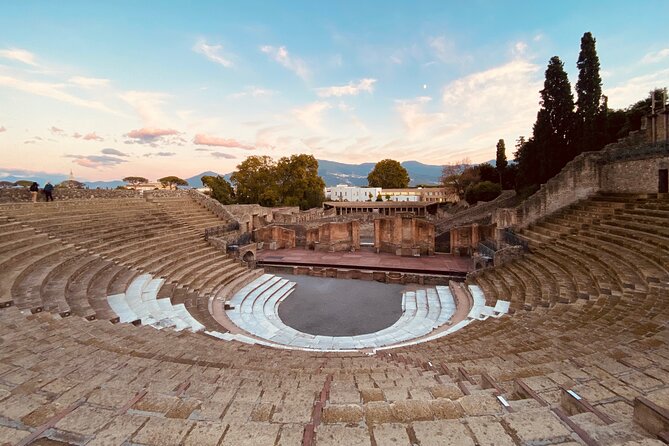
The Teatro Grande, or Large Theater, receives more time. With its broad seating area and stage structure, it gives you a stronger sense of public performance and crowd movement. This is one of the places where an archaeologist’s explanation helps. A partly ruined theater can look abstract until you understand where the audience sat, where performers appeared, and how the building related to the rest of the city.
The Quadriporticus of the Theaters follows as the gladiators’ barracks. Its covered colonnade and surrounding rooms connect the entertainment district with the people who performed in the arena. The stop is especially useful if you want to understand Pompeii as a working city, not only as a collection of elegant houses.
These early stops also help break up the walking. You move between open courtyards, streets, and buildings rather than spending three hours inside a single type of ruin.
Pompeii’s main street, granary, and baths
The main street gives the tour its everyday rhythm. Here, your attention shifts from grand public architecture to movement, trade, and street design. Look down as you walk. Raised stepping stones and worn paving help explain how people crossed streets and how carts moved through the city.
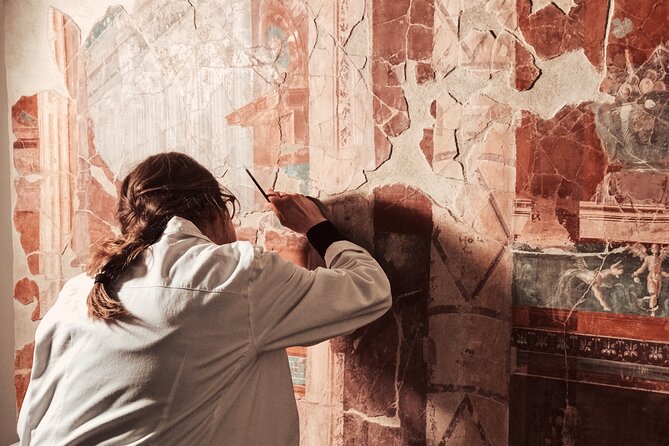
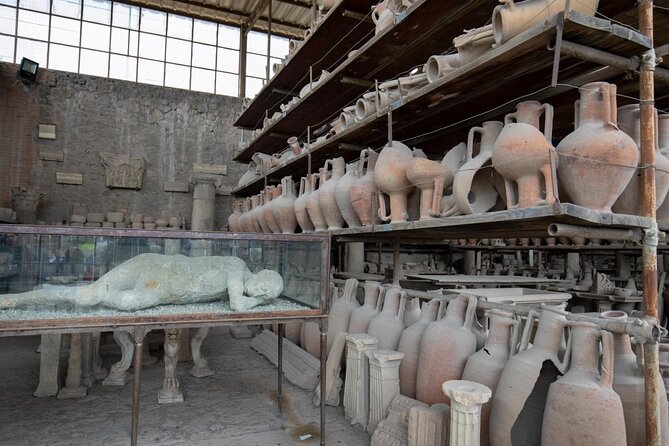
The Granai del Foro, or archaeological deposit, offers a less polished but important side of Pompeii. This area relates to stored archaeological material and the continuing work of excavation and preservation. It reminds you that Pompeii is not a finished display. Archaeologists still study, protect, and interpret what has been uncovered.
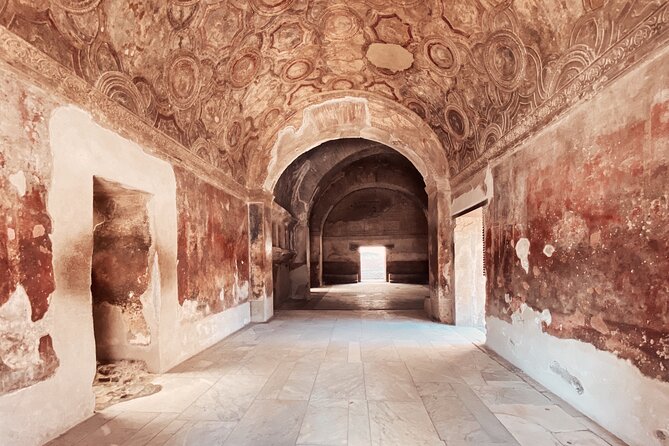
The Stabian Baths are among the most useful stops for understanding Roman social life. These were not simply places to wash. A bath complex involved exercise, changing rooms, heated spaces, and social contact. The guide can help you read the sequence of spaces and explain how Roman engineering controlled heat and water.
The baths also show why a guide can be worth the cost. Many rooms look like bare stone chambers when you first see them. With the right explanation, you start noticing construction details, room functions, and the difference between public architecture and private homes.
More Ancient History Tours in Pompeii
- Discover the Ancient Ruins of Pompeii: Day Trip from Rome
★ 3.5 · 2,247 reviews - Pompeii and Herculaneum Small Group Tour with an Archaeologist
★ 5.0 · 1,350 reviews - Skip the Line Guided Tour of Pompeii led by an Archaeologist
★ 5.0 · 703 reviews - Pompeii: Tour with Archaeologist Guide & Skip-the-Line Entry
★ 4.5 · 623 reviews
The Forum, Basilica, and temples
The Forum was Pompeii’s main civic and religious center. It is a major stop on the route, and it deserves the full attention given to it. Here, your guide can connect politics, trade, worship, and public ceremonies in one place.
The Basilica, described as the court of justice, shows Pompeii’s legal and administrative side. Its scale and position help explain how public business was conducted. I find this kind of stop valuable because it keeps the tour from becoming only a parade of decorative houses.
The Temple of Jupiter adds the religious dimension. Its location near the Forum makes clear how closely civic authority and worship were linked in Roman cities. You will see more than one temple during the walk, and the guide can help distinguish their roles rather than letting them blur together.
The Temple of Venus is another major religious landmark. The route does not list a separate time allocation for this stop, so expect the guide to include it as part of the broader walk. Open areas can be hot, and there may be little shade, so carry water and consider a morning start.
Shops, markets, and Pompeii’s working life
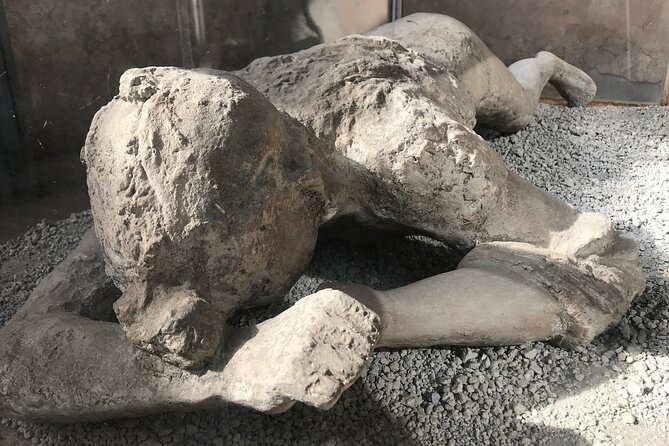
The Lupanar, Pompeii’s brothel, is one of the most talked-about stops. Its small rooms and surviving imagery offer evidence of a commercial activity that is easy to sanitize or sensationalize. A good guide keeps the explanation grounded in Roman society, urban commerce, and the limits of what the evidence can tell us.
The Macellum was the meat and fish market. This stop shifts the focus to food supply and daily shopping. It helps you picture Pompeii as a city where residents bought ingredients, met other people, and depended on organized marketplaces.
The Edificio di Eumachia, associated with the wool market, adds another layer of commerce. Together, the Macellum and Eumachia building show that trade was not an afterthought. It shaped the city’s public spaces and supported a large range of work.
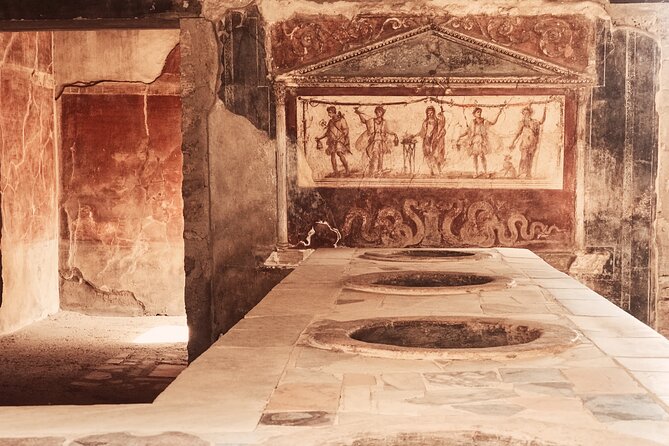
The Thermopolium of Vetuzio Placido is one of the most relatable stops. This takeaway shop and fast-food counter gives you a direct link to eating habits and quick meals. The remains of the counter make it easier to imagine how people bought prepared food rather than cooking every meal at home.
The Fullonica di Stephanus, a laundry, completes the picture of local services. Clothing care required labor, water, space, and organization. Seeing a laundry beside food shops and markets makes Pompeii feel less like a stage set and more like a functioning neighborhood.
Houses, mosaics, and domestic Pompeii
The Casa del Poeta Tragico is a short stop with a famous Cave Canem mosaic. The Latin warning, meaning beware of the dog, is one of Pompeii’s most memorable details. It offers a small but vivid glimpse of how homeowners decorated entrances and signaled private space.
Casa del Menandro receives the longest scheduled visit, at about 20 minutes. This is where the tour turns more fully toward domestic life, frescoes, mosaics, and the design of elite homes. Your guide can explain how rooms related to one another and how decoration communicated status.
Pompeii’s houses are easy to misread if you rush through them. Empty rooms can seem repetitive, but their courtyards, wall paintings, floors, and sightlines reveal how Roman families received visitors and organized home life. The guide’s architectural training is especially useful here.
You should also expect some areas to be closed or changed as excavation and conservation work continues. One guide may redirect you to another open building or adjust the route. That flexibility is a benefit of booking a private walk, though it also means the exact experience can vary by date.
What the three hours feel like
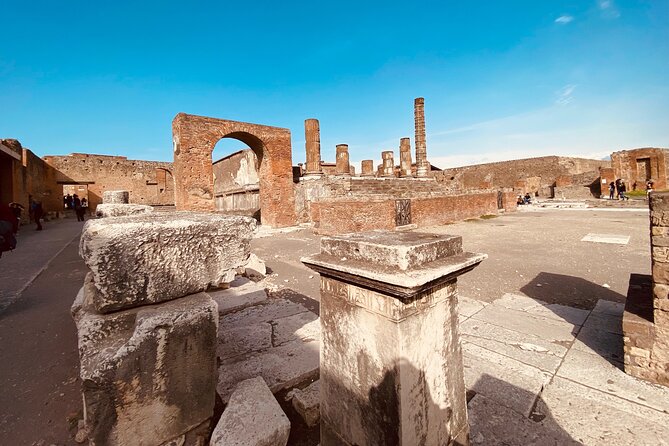
This is a walking tour, not a shuttle ride. The route covers many parts of the park and includes uneven paving, steps, and slippery surfaces. One account specifically notes that good balance is helpful, while guides have also adapted the pace for people with mobility limitations.
Tell the guide about physical concerns at the start. Mariagrazia, Roberto, Luisa, and others have been praised for adjusting pace, finding shade, helping with steeper steps, and making sensible route choices. That does not remove the physical demands, but it can make the visit more manageable.
Three hours can pass quickly. The itinerary includes many stops, with some visits lasting only five minutes and others lasting 15 to 20 minutes. That structure gives you variety, but it also means you cannot linger everywhere. If one house or temple matters especially to you, say so early.
The tour is offered in English and is private, so only your group participates. The booking information says the price is for a group of up to one, which is an unusual presentation. Check the final group and pricing details carefully if you are booking for more than one person.
Price, tickets, and skip-the-line value
The listed price is $302.32 per group, with adult Pompeii admission not included. At $19 per adult, the entrance cost can add up quickly for a larger party. The tour provides a link for buying tickets in advance, and skip-the-line assistance is available only on request in advance.
This is not the cheapest way to see Pompeii. You are paying for a private specialist rather than a basic entry ticket or a large shared group. The value improves if your group wants detailed explanations, has different interests, or prefers to move at its own pace.
The ticket issue deserves care. One person arrived expecting admission to be included and had to work through an Italian-language website outside the site. That problem is avoidable: confirm the ticket plan before the tour date, buy the required entrance tickets in advance, and ask specifically how skip-the-line entry will work.
The free cancellation policy allows a full refund when you cancel at least 24 hours before the start time. Changes made inside that window are not accepted, and poor weather can lead to a new date or full refund. The experience is near public transportation, and service animals are allowed.
Which guide might suit your group
Guide assignments can vary, but several names appear repeatedly in the experience: Luisa, Amadeo or Amadeu, Eliana, Mariagrazia, Roberto, Maria, and Luciana. The strongest common thread is personal attention, clear storytelling, and an ability to answer questions.
Luisa is a good fit if you want a warm, story-led visit with attention to comfort and family groups. Amadeo is praised for humor, patience, and architectural explanation. Eliana is associated with archaeology, current excavation, and strong enthusiasm for the site.
If your group has mobility concerns, mention them before the tour. If you are traveling with teenagers, ask for a guide who is comfortable using stories and everyday examples. If you are especially interested in buildings and construction, make that clear when arranging the booking.
Should you book this Pompeii tour?
I would book it if Pompeii is a major part of your Italy trip and you want to understand what you are seeing rather than simply walk among ruins. The private archaeologist format is especially useful for first-time visitors, curious families, history fans, and anyone who wants freedom to ask questions.
I would hesitate if your main goal is the lowest possible price, if you want a full-day exploration, or if you dislike uneven walking. You also need to budget for the separate entrance ticket and handle advance ticket arrangements carefully.
Book this tour for expert guidance and a well-shaped three-hour introduction. Before paying, confirm the guide language, entrance ticket process, meeting point, final route, and whether a preferred guide can be requested. Get those details right, and Pompeii becomes far easier to read.
FAQ
How long is the Pompeii private tour?
The tour lasts approximately three hours.
Where does the tour start?
The meeting point is Hortus Pompei, Restaurant & Garden Bar, at Via Villa dei Misteri near Piazza Porta Marina Superiore and Piazza Esedra in Pompeii.
Where does the route begin inside Pompeii?
The route begins at Porta Marina Superiore.
Where does the tour end?
The route description says it ends at Porta Marina Inferiore. The meeting information also says the activity ends back at the meeting point, so confirm the exact finish with the operator.
Is the Pompeii entrance ticket included?
No. Adult admission is listed separately at $19 per person. Entrance is free for children under 18.
How does skip-the-line entry work?
Skip-the-line help is available only if requested in advance. The operator provides a link for buying entrance tickets ahead of time.
Is this a private tour?
Yes. Only your group participates in the activity.
Is the tour offered in English?
Yes. English is the listed tour language.
Can people with mobility concerns join?
Most people can participate, but the site includes extensive walking, steps, uneven surfaces, and slippery areas. Guides can adjust the pace and route, so tell the operator about mobility needs before the visit.
Can I cancel for a refund?
You can cancel at least 24 hours before the start time for a full refund. Cancellations or changes made less than 24 hours before the start time are not accepted for a refund. If poor weather causes cancellation, you will be offered another date or a full refund.
More Archaeological Site Tours in Pompeii
- Pompeii Skip-the-line Tour with Archaeologist Guide
★ 5.0 · 559 reviews - Explore Pompeii with an Archaeologist
★ 5.0 · 511 reviews - Pompeii 3hours Villa of Mysteries tour with an Archaeologist
★ 4.8 · 486 reviews - Pompeii and Herculaneum: Guided Tour with an Archaeologist
★ 5.0 · 164 reviews
More Private History Tours in Italy
- Pompeii Private Tour with an Archaeologist and Skip The Line
★ 5.0 · 391 reviews - PompeiI Exclusive Tour with your Archaeologist in a Small Group
★ 4.5 · 363 reviews - Pompeii Private Tour with an Archaeologist Guide
★ 5.0 · 184 reviews - Pompeii: Exclusive Tour with Archaeologist and Entry Tickets
★ 4.9 · 634 reviews
Just added around Pompeii
- Pompeii and Herculaneum: Guided Tour with an Archaeologist★ 5.0 · 164 reviews
- Pompeii Guided Tour with Archaeologist★ 4.6 · 27 reviews
- Pompeii: Guided Tour with Archaeologist with max. 12 People★ 5.0 · 155 reviews
- Pompeii Small Group Tour – Tickets Included★ 4.7 · 72 reviews
- Pompeii: 2-Hour Guided Tour with an Archaeologist★ 4.9 · 151 reviews
- PompeiI Exclusive Tour with your Archaeologist in a Small Group★ 4.5 · 363 reviews
- Pompeii Private Tour with an Archaeologist Guide★ 5.0 · 184 reviews
- Pompeii Private Tour with an Archaeologist and Skip The Line★ 5.0 · 391 reviews
Pompeii History Tours, compared.
Pompeii: Entry Ticket and Guided Tour with an Archaeologist
Read our review →
Pompeii: Small Group Tour with an Archaeologist
Read our review →Pompeii Small Group Tour with an Archaeologist
Read our review →
Discover the Ancient Ruins of Pompeii: Day Trip from Rome
Read our review →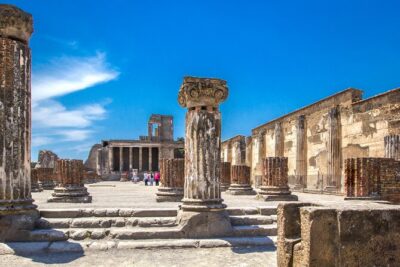
Pompeii and Herculaneum Small Group Tour with an Archaeologist
Read our review →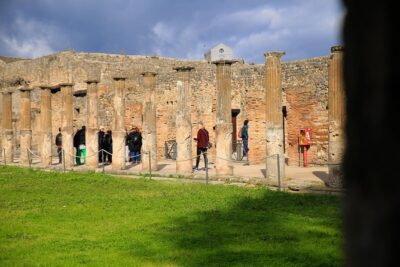
Skip the Line Guided Tour of Pompeii led by an Archaeologist
Read our review →
Pompeii: Tour with Archaeologist Guide & Skip-the-Line Entry
Read our review →