
Review · NUREMBERG
Nuremberg: WWII Tour, Courtroom 600 and 3rd Reich Sites
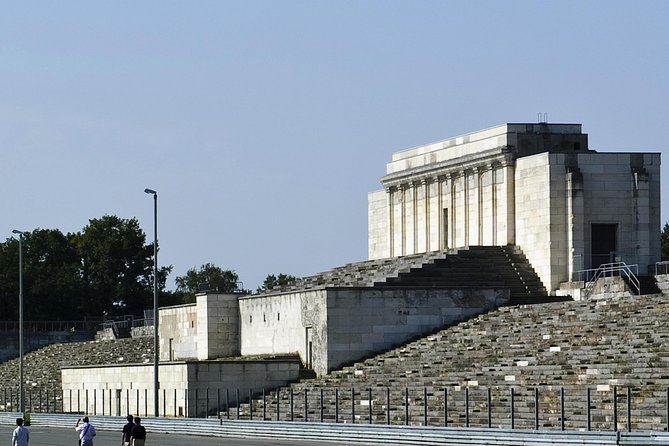
Nuremberg’s Nazi rally grounds are so vast that photographs alone cannot prepare you for them. This four-hour tour helps you read the scale and purpose of the Luitpold Arena, Great Road, Congress Hall, and Zeppelin Field, then brings you to Courtroom 600, where Nazi leaders faced the International Military Tribunal.
I like the small group, limited to eight, and the hotel pickup, which saves you the trouble of sorting out transport between scattered sites. I also like the guides’ use of period photographs, a simple but effective way to connect today’s bare spaces with the propaganda events once staged there. The main drawback is time: some visitors wanted longer at Zeppelin Field and Courtroom 600, and the final courtroom visit can feel rushed.
Key points at a glance
- Courtroom 600 closes on Tuesdays: Check the day before booking if this is the part you most want to see.
- A small group keeps the tour personal: The van carries no more than eight participants.
- The rally grounds require transport: These sites are spread across southeastern Nuremberg, so hotel pickup is useful.
- Guides bring visual context: Rob, Robson, Sheba, and other guides use photographs and detailed explanations to show how the sites once looked.
- The €147 price includes convenience: Hotel pickup, drop-off, transport, a guide, and the walking tour are covered, but the €7.50 Palace of Justice admission is not.
- Expect a serious historical visit: This is about propaganda, dictatorship, war, and the postwar trials, not light sightseeing.
Why Nuremberg’s Nazi sites are best seen together
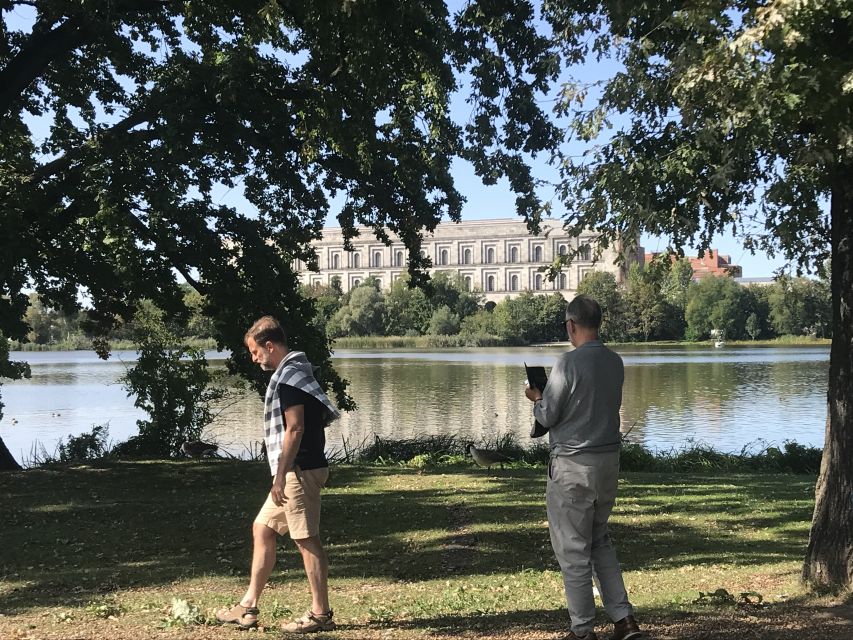
Nuremberg was chosen by the Nazi regime for its large party rallies and symbolic importance. The surviving structures were designed to impress through size, repetition, stone, and carefully staged movement. On foot, you can grasp the distance between the buildings and the huge open areas used for mass gatherings.
That scale is the point. A quick photograph of Congress Hall or Zeppelin Field may look like a grand old building or an empty parade ground. With a guide beside you, those places become easier to understand as tools of political theater. You learn how architecture and crowds were meant to create obedience and awe.
I find this kind of tour more useful than visiting the sites alone. The buildings do not explain themselves. Some are incomplete, some are damaged, and some are plain open ground. Period photographs help you compare what you see today with the ordered, highly controlled images the regime wanted to project.
The subject is grim, and the tour treats it seriously. You should be ready for discussion of Nazi ideology, mass propaganda, war crimes, and the trials that followed the war. It is a history tour with moral weight, not simply a collection of dramatic photo stops.
More WWII and D-Day Tours in Germany
- Berlin: Third Reich & Cold War Guided Walking Tour
★ 4.9 · 8,378 reviews - Munich: Third Reich & WWII Walking Tour
★ 4.6 · 6,181 reviews - Berlin’s Best: 2 Hour Walking Tour Third Reich and the Cold War
★ 5.0 · 5,486 reviews
Hotel pickup and the ride to southeastern Nuremberg
The tour begins with pickup outside your accommodation in Nuremberg. You then travel in a comfortable vehicle toward the rally grounds, with about an hour of transport included in the overall outing.
This arrangement is a real advantage because the major sites are not gathered in one compact old-town square. Instead, they occupy a broad area in southeastern Nuremberg. A private vehicle also lets the guide keep the group moving without asking you to manage several public transport connections.
The group is limited to eight people. That size matters here. At an open site such as Zeppelin Field, a guide can point out details and answer questions without trying to project across a large crowd. It also makes the ride and the walking portions feel less formal.
The vehicle is useful, but this remains a walking tour once you reach the individual sites. Wear comfortable shoes and expect time outside. The information supplied does not promise protection from sun, rain, or cold, so dress for the season.
Luitpoldhain and the Luitpold Arena
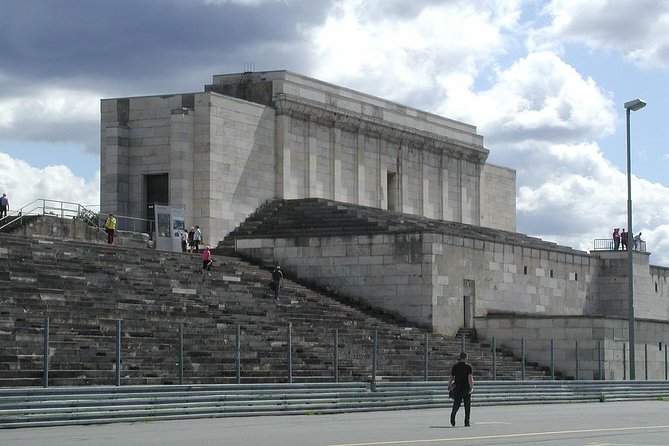
The first major stop is Luitpoldhain, also called the Luitpold Arena area. You spend about 30 minutes here with the guide.
This broad space was intended to provide an impressive setting for Nazi party rallies. Its size can be difficult to picture from a book or museum panel. Standing there gives you a better feel for the way the regime used open ground, disciplined formations, and monumental planning to make individuals feel small within a mass movement.
The value of the stop lies in the explanation. Much of what once created the spectacle is no longer present in its original form, so you need context to understand what the site meant. Guides such as Rob have been praised for being energetic, interactive, and good at linking the remaining structures with historical photographs.
You will not spend the whole morning at one location. The 30-minute visit is enough for an introduction and a focused explanation, but it will not satisfy someone who wants a slow photographic study of every surviving feature.
Great Road and the logic of Nazi scale
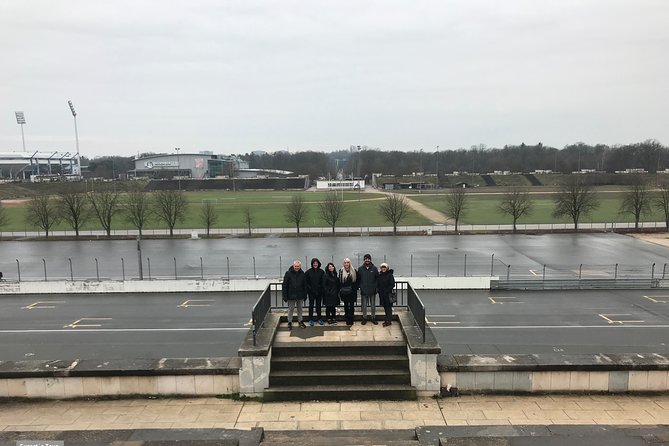
The tour continues to Große Straße, or Great Road, for another 30-minute guided visit. This huge planned avenue helped create a controlled route for marches and displays.
Here, look less for a single famous object and more for the way the space was planned. The width, length, and formal arrangement show how movement itself became part of the political message. The road was not just a practical route. It was part of the staging.
This stop works well after Luitpoldhain because you begin to see a pattern. Open fields, long axes, monumental buildings, and carefully framed views were all used to create a sense of order and power. Your guide can point out those relationships in a way that a standard city tour usually cannot.
The drawback is that these are exposed, spread-out spaces. If you prefer indoor museums and short walks, this part may feel demanding, especially in poor weather. If you want to understand how propaganda operated through architecture and public space, it is one of the tour’s strongest sections.
Same city, a different century:
- Leipzig: City History Canal Sightseeing Tour on a Motorboat
★ 4.7 · 7,671 reviews - Third Reich Berlin: Hitler and WWII Walking Tour
★ 5.0 · 3,301 reviews - Leipzig: 1.5-Hour Historical Walking Tour in German
★ 4.7 · 2,217 reviews - Nuremberg: Medieval Dungeons Guided Tour
★ 4.8 · 2,214 reviews
Congress Hall and an unfinished monument
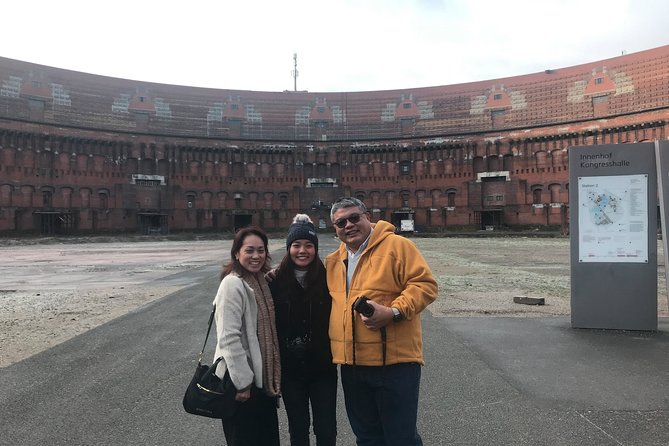
The Nuremberg Congress Hall receives about 30 minutes. You have time for a guided visit and photographs, although the schedule does not promise a long museum session inside.
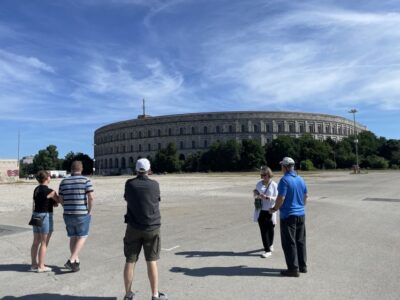
The building is enormous, and its unfinished condition adds to the impact. It was planned as the largest preserved National Socialist monumental building, and its size reveals the ambition behind the party’s plans for Nuremberg. The building was not meant to be modest or welcoming. It was meant to overwhelm.
Your guide helps explain the political purpose behind the architecture. That context is important because the structure can otherwise seem like an isolated shell. Look at its curved form and repeated masonry as part of a grand scheme, not simply as an old building.
The Documentation Center Nazi Party Rally Grounds Museum is also passed during the tour. The building’s modern design creates an architectural contrast with the monumental remains. Its sharp intervention into the older structure is an intentional visual comment, and the guide can explain why that contrast matters.
You should note the difference between passing the Documentation Center and having a full museum visit. The tour includes the site in its route, but the listed schedule gives it limited time compared with a dedicated museum visit. One visitor would have preferred more time at Zeppelin Field and less near the Documentation Center. If museum exhibits are your main interest, plan a separate visit.
Zeppelin Field and the most powerful open space
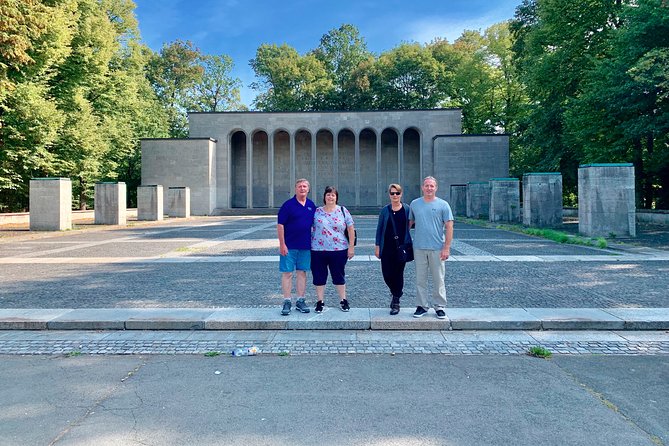
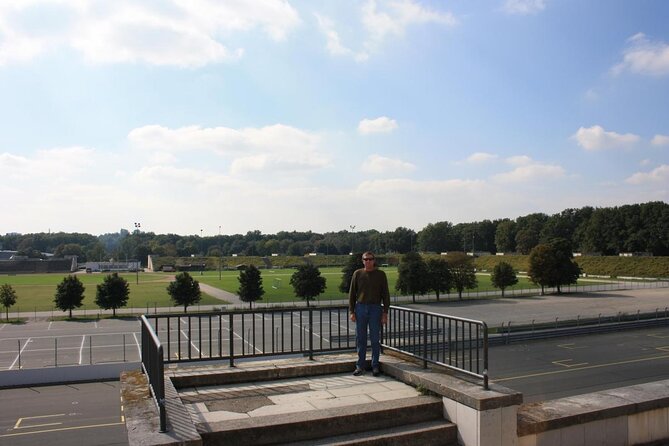
Zeppelin Field receives about 40 minutes, making it the longest outdoor stop in the published schedule. You get a guided visit and time for photographs.
This is where the grand scale of the rally grounds may feel most direct. The field was designed as a setting for mass Nazi rallies, with the reviewing stand and broad open area arranged to support ceremony, spectacle, and control. You can better understand how architecture, uniforms, flags, speeches, and crowds worked together.
The site is especially useful for visitors who want to connect physical place with political history. The guide may use photographs from the period to show the field in use, then help you compare that imagery with what remains today. That shift between past and present is one of the tour’s best teaching tools.
Time is still limited. A 40-minute stop allows a clear explanation and photographs, but not an unhurried examination of every section. If Zeppelin Field is your main reason for booking, make that clear to your guide early. The small group format makes such a request easier than it would be on a large coach excursion, though the overall schedule still has to be respected.
Courtroom 600 and the Palace of Justice
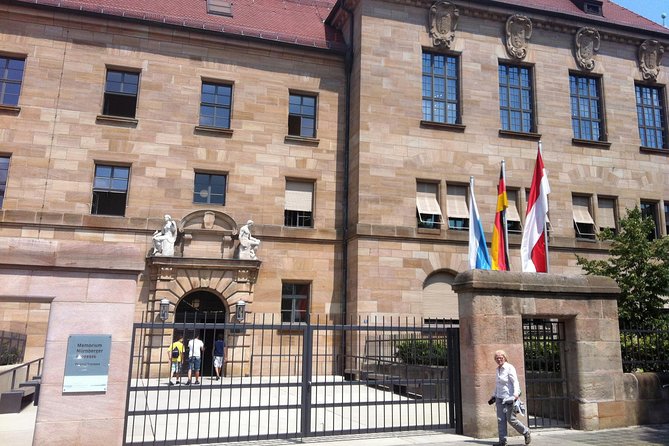
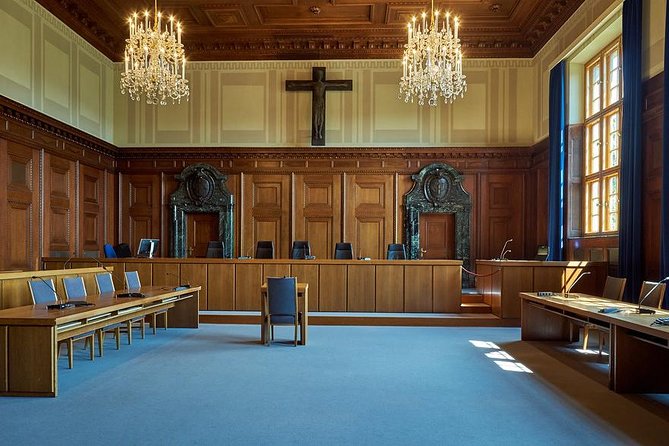
The final major stop is the Nuremberg Palace of Justice, where you have about 45 minutes for sightseeing and a self-guided visit. Courtroom 600 is the emotional center of the tour for many people. It was the courtroom used for the International Military Tribunal, where leading Nazi war criminals were tried after World War II.
Unlike the rally grounds, this stop places you inside a working justice building connected to the postwar reckoning. The subject shifts from how the Nazi regime displayed power to how the Allied powers attempted to establish legal responsibility for its crimes.
The admission charge is €7.50 per person and is not included in the $147 tour price. The tour information says you can skip the ticket line, but you still need to pay the entrance fee. Courtroom 600 and the Palace of Justice are closed on Tuesdays, so Tuesday is a poor choice if the courtroom is essential to your plans.
The visit is self-guided rather than a long live explanation from your tour guide. That gives you some freedom, but it also means you need to read and move through the exhibition efficiently. Several people wanted more time here, and one person noted that the group arrived with only about 45 minutes left in the tour. I would treat the courtroom as an important final stop, but not assume you will receive an extended museum visit.
The Palace of Justice also has a practical complication: the court remains part of a functioning legal setting. Access can therefore depend on opening arrangements. The supplied information confirms the Tuesday closure, but you should check current conditions when you book if your schedule is tight.
How the guides shape the experience
The strongest part of this tour is the guide-led interpretation. Rob is mentioned repeatedly by name, with praise for his energy, clear explanations, friendly manner, and safe driving. Robson is also identified as an attentive guide who explains details carefully, and Sheba is described as enthusiastic and well suited to the subject.
Guides can vary, so you should not assume one particular person will lead every departure. The available languages are English, Portuguese, Spanish, and Italian.
One practical point deserves attention: a few people found that a guide spoke quickly or had an accent that made parts of the explanation harder to follow. Another person asked the guide to slow down, and the guide adjusted. If you need a slower pace or clearer repetition, say so early. A small group makes that request easy and reasonable.
The use of old photographs is particularly helpful. Nuremberg’s surviving sites can look empty and disconnected from their original purpose. Photos give you a visual bridge, while the guide supplies the political and historical background.
Is $147 good value?
At $147 per person, this is not the cheapest way to see Nuremberg’s Nazi-era sites. The price makes more sense when you add up the convenience: pickup and drop-off at your accommodation, transport between scattered sites, a guide, and a small group capped at eight.
You also avoid the work of planning a route through Luitpoldhain, Große Straße, Congress Hall, Zeppelin Field, and the Palace of Justice. For a first visit, that efficiency has real value. You can focus on the subject instead of watching a map or checking connections.
The €7.50 Palace of Justice admission is extra, so include it in your budget. The price is easiest to justify if you want a guided overview in one morning or afternoon and value personal explanations. It is less attractive if you only want photographs, prefer to move slowly, or plan to spend several hours at the Documentation Center and Courtroom 600.
The free cancellation period of 24 hours and reserve-now, pay-later option give you some useful flexibility. Wheelchair access is also listed, though the tour still includes outdoor areas and walking, so confirm that the exact route suits your needs.
Who should book this tour?
I would choose this tour if you have limited time in Nuremberg and want the main Nazi-era sites connected in one thoughtful route. It suits history students, families with older children, and anyone who wants more context than a self-guided photo stop can provide.
It is also a good choice if you are staying outside the old town or would rather not organize transport. The hotel pickup and small van remove much of the practical fuss.
You may prefer a separate museum visit if you want long, quiet time with exhibits. You may also prefer independent sightseeing if you want to linger at Zeppelin Field or spend more time inside Courtroom 600. The tour gives you breadth and interpretation, not unlimited time at each stop.
Should you book it?
Book it if you want a serious, well-organized introduction to Nuremberg’s Nazi rally grounds and the postwar trials, especially if you appreciate a guide who uses photographs and explains the purpose behind the buildings.
Choose a day other than Tuesday, and allow for the extra €7.50 admission. If Courtroom 600 is your top priority, ask about the timing before you commit, since the final stop can feel short. For most first-time visitors with four hours to spare, the combination of transport, small-group attention, and strong historical explanation makes this a worthwhile, if tightly timed, introduction.
FAQ
How long does the tour last?
The tour lasts four hours, including hotel pickup and drop-off, transport, guided visits, and the Palace of Justice stop.
What is the price?
The listed price is $147 per person.
Is hotel pickup included?
Yes. Pickup and drop-off are included from outside your accommodation in Nuremberg.
How large is the group?
The tour is limited to eight participants.
Is Courtroom 600 included in the price?
The tour takes you to the Nuremberg Palace of Justice and Courtroom 600, but the €7.50 entrance fee is not included.
Is the Palace of Justice open every day?
No. The Palace of Justice and Courtroom 600 are closed on Tuesdays.
Which languages are available?
The live tour guide is available in English, Portuguese, Spanish, and Italian.
Is the tour wheelchair accessible?
Yes, the activity is listed as wheelchair accessible.
Can I cancel the booking?
Yes. You can cancel up to 24 hours in advance for a full refund. You can also reserve now and pay later.
Just added around Germany
- Berlin Food & Cultural Tour: Must-Try German & Berliner Classics★ 5.0 · 51 reviews
- Berlin Half-Day World War II Walking Tour★ 4.5 · 48 reviews
- Small-Group Historical Bike Tour in Berlin★ 4.5 · 103 reviews
- Historic center of Berlin – Tour in Italian★ 5.0 · 143 reviews
- Berlin Cold War & World War II Third Reich Walking Tour★ 4.5 · 30 reviews
- Private Tour: Jewish Heritage Walking Tour of Berlin★ 5.0 · 29 reviews
- Private Taxi Tour City East & West History and Architecture 3-4h★ 5.0 · 42 reviews
- Berlin Wall and Cold War Bike Tour in Small Groups★ 5.0 · 114 reviews
Nuremberg History Tours, compared.
Nuremberg: Historischer Kunstbunker WWII Art Bunker Tour
Read our review →
Nuremberg: 1.5-Hour Private Tour through Historical Old Town
Read our review →
“Rotes Bier” and “Blaue Zipfel”. A historical-culinary walk
Read our review →
Browse the lists this tour appears in