
Review · POMPEII
Pompeii: Entry Ticket and Guided Tour with an Archaeologist
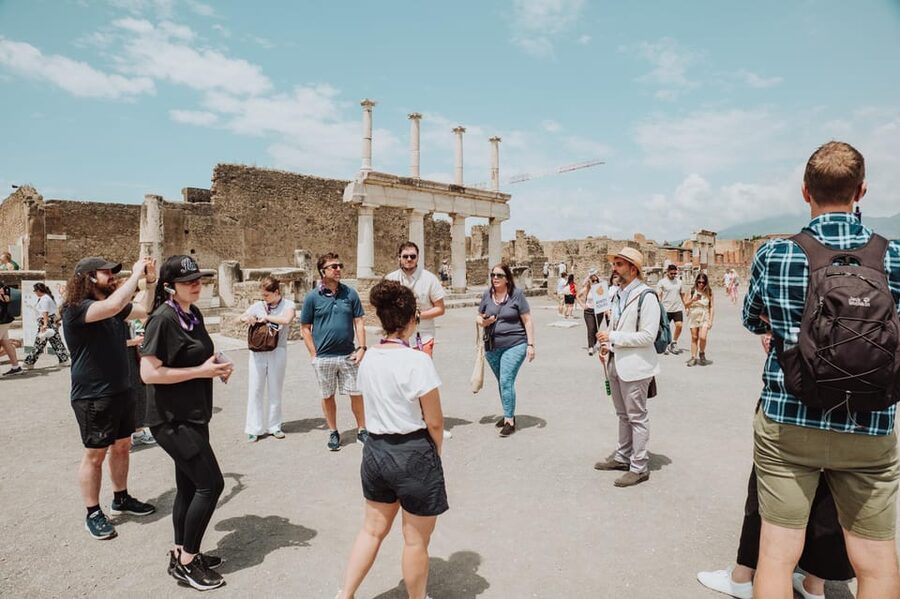
Pompeii makes the most sense when someone helps you read it. This two-hour walking tour with an archaeologist takes you from the Marina Gate and Forum to famous houses, shops, baths, and the plaster casts of victims. Instead of seeing a giant field of old stones, you get a picture of Roman daily life.
I like the small group of up to 20 people, and I like that the tour includes the entrance ticket and skip-the-line access. Guides such as Teresa, Anna, Alfredo, and Raffaella are praised for making the ruins easy to understand, often with humor and useful suggestions for seeing more afterward.
The main drawback is the site itself: Pompeii is enormous, and two hours only introduces it. The streets are uneven, you may need to manage steps, and the tour is not suitable for wheelchair users or people with major mobility limits.
Key points before you book
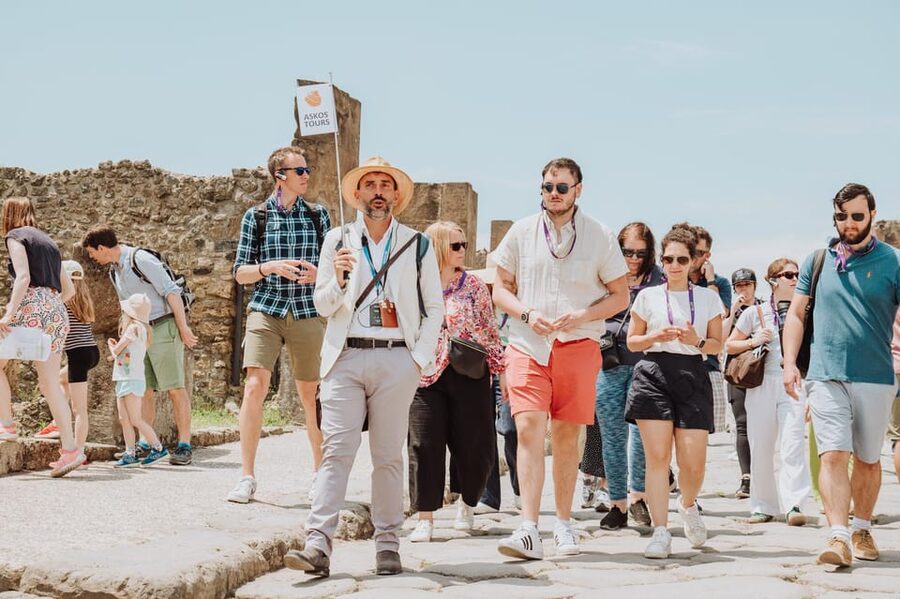
- An archaeologist leads the way: You get context about architecture, Roman society, religion, food, and ordinary life, not just names and dates.
- The route covers the essential sights: Expect the Forum, House of the Faun, Lupanar, House of Menander, Macellum, baths, theaters, and major streets.
- Small group format: Groups can include up to 20 people, with headsets supplied when there are 10 or more participants.
- Good value at $35: The price includes the Pompei Express entrance ticket and guided touring, which is useful at a site this large.
- You can stay and explore afterward: Guides provide suggestions for continuing through Pompeii on your own.
- Bring water and sturdy shoes: The paths are rough, the walking adds up, and shade and seating cannot be counted on throughout the site.
Why Pompeii is better with a guide
Pompeii is not a single monument with a tidy beginning and end. It is a full ancient city, with streets, homes, temples, businesses, public buildings, theaters, and baths spread across a vast area.
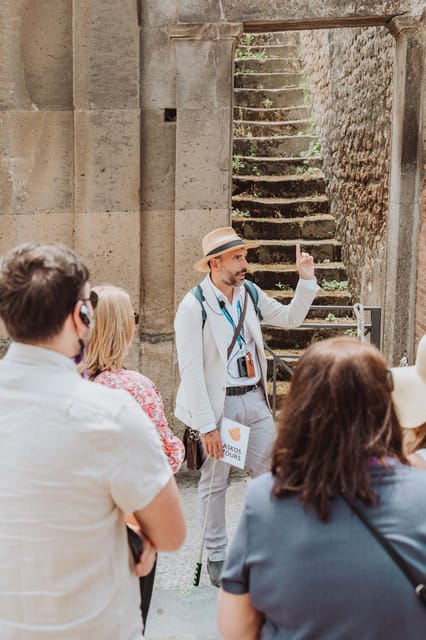
That scale creates the site’s magic, but also its main problem. Without context, a doorway can look like just another doorway, and a large open space can be hard to identify. A guide can point out how the city worked, where people worshiped, shopped, bathed, ate, and gathered.
The strongest part of this experience is the focus on ordinary life. Guides explain not only wealthy homes and grand public buildings, but also the practical details of Roman society. The Termopolium, for example, helps you picture food being served to people on the go. The streets and shops show that Pompeii was a living town, not simply a collection of villas.
The archaeologist-led approach also adds useful context. Guides have been praised for linking history, architecture, mythology, sociology, and daily customs in a way that remains understandable. The best guides, including Teresa, Anna, Sergio, Mario, Alfredo, and Raffaella, seem to combine facts with storytelling rather than delivering a long lecture.
More Ancient History Tours in Italy
- Pompeii: Small Group Tour with an Archaeologist
★ 4.8 · 12,264 reviews - Pompeii Small Group Tour with an Archaeologist
★ 5.0 · 6,593 reviews - Discover the Ancient Ruins of Pompeii: Day Trip from Rome
★ 3.5 · 2,247 reviews
Starting at the Marina Gate
The tour begins at one of three possible meeting locations along Via Villa dei Misteri, 2, depending on the option you reserve. Check your exact meeting point carefully before setting out, since the starting place may vary.
Porta Marina, or the Marina Gate, is an appropriate opening. It was one of the main entrances to Pompeii, and it gives you an immediate sense of the city’s defenses, roads, and connection with the outside world.
The guide generally spends about 10 minutes passing through this area. That may sound brief, but it helps establish the basic layout before you move deeper into the ruins. You begin to see Pompeii as a functioning city with movement, trade, religion, and public life.
Take a moment here to settle into the walking pace. You will be on your feet for most of the tour, and the ancient paving can be uneven. Comfortable shoes are not optional decoration. They are practical equipment.
The Temple of Apollo and Pompeii’s religious center
The route continues past the Temple of Apollo, another short stop of about 10 minutes. This temple stood near the city’s civic heart and helps explain the religious side of Pompeii.
A guide can make this stop more meaningful by explaining how Roman religion fitted into public life. Temples were not isolated attractions in the modern sense. They formed part of the city’s daily and political structure.
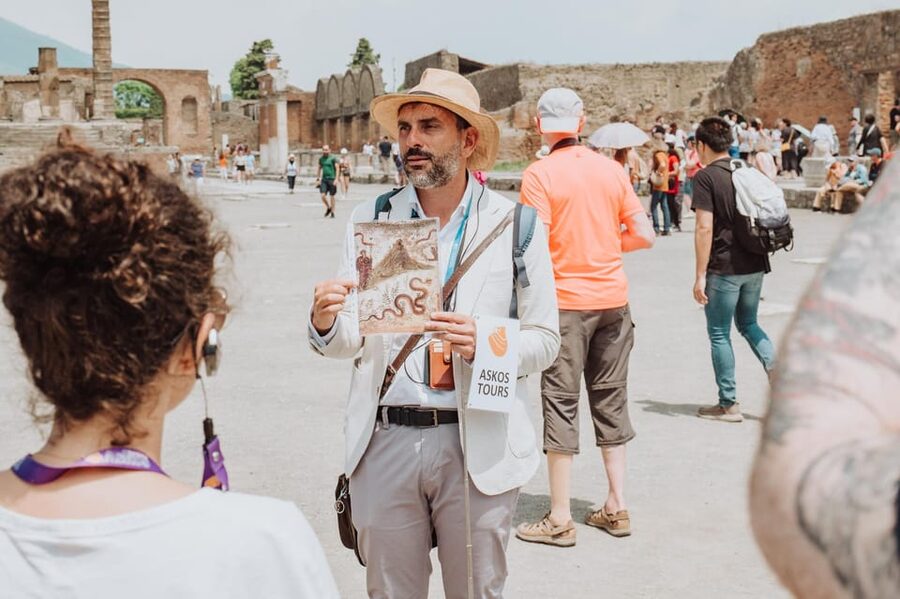
The tour then reaches the Foro Civile di Pompei, or the Forum. About 20 minutes are allowed here. This is one of the most important spaces on the route, since the Forum was the center of public activity.
The open area can be hard to read at first. Look beyond the broken columns and imagine the surrounding buildings as a working civic district. Your guide will help identify the major structures and explain how public, political, commercial, and religious functions overlapped.
This is also one of the better places to ask questions. The Forum can become crowded, and a headset helps you follow the explanation without needing to stand directly beside the guide.
The House of the Faun and elite Pompeii
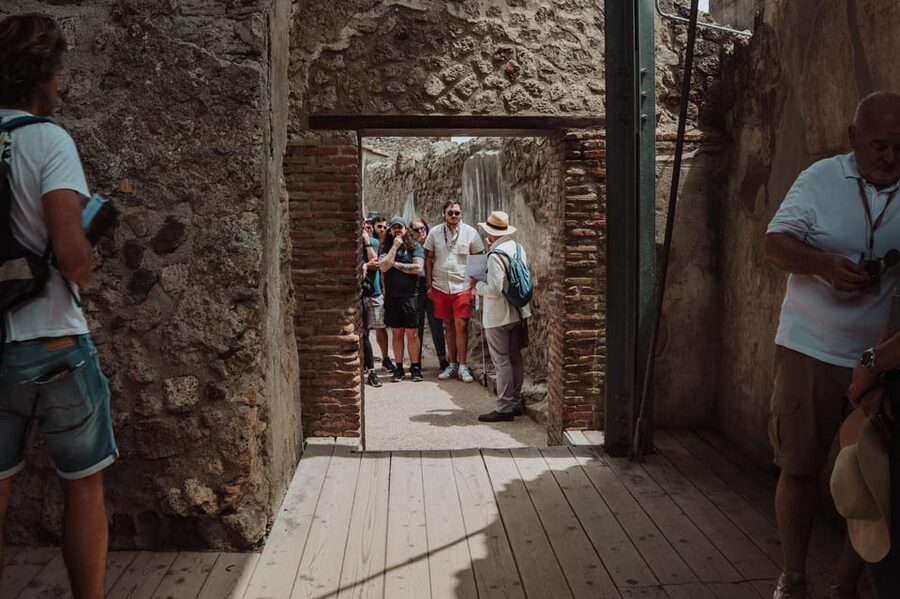
The House of the Faun receives about 20 minutes of guided attention. It is one of Pompeii’s celebrated residences and gives you a look at the scale and ambition of an elite Roman home.
The name comes from a faun statue, and the house is known for its grand layout and decorative details. Here, the value of a guide is especially clear. Large rooms, courtyards, thresholds, and mosaics can be visually striking, but an archaeologist can explain how the spaces worked and what they suggest about status and household life.
This is also a useful counterpoint to the public buildings. Pompeii was not socially equal, and the size and decoration of this house help show the difference between wealthy residents and people living and working in more modest conditions.
Give yourself time to look closely. You may notice small design choices that are easy to miss when moving through alone. At the same time, do not expect to study every room in detail. The tour has a set route, and Pompeii offers far more than can fit into two hours.
More Ancient History Tours in Pompeii
- Pompeii and Herculaneum Small Group Tour with an Archaeologist
★ 5.0 · 1,350 reviews - Skip the Line Guided Tour of Pompeii led by an Archaeologist
★ 5.0 · 703 reviews - Pompeii: Tour with Archaeologist Guide & Skip-the-Line Entry
★ 4.5 · 623 reviews - Pompeii Private Tour with an Archaeologist and Skip The Line – 3 hours
★ 5.0 · 564 reviews
The Lupanar and the less polished side of Roman life
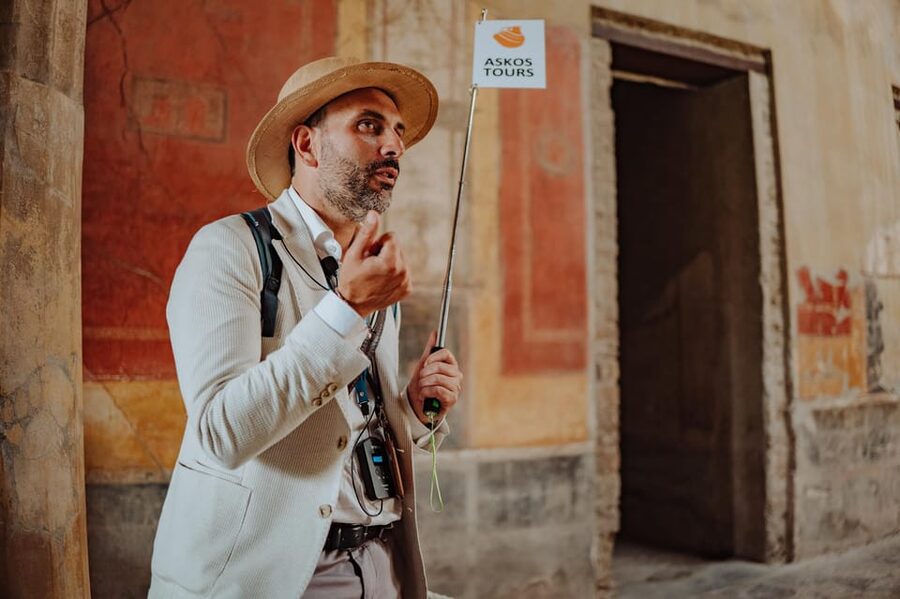
The Lupanar, Pompeii’s brothel, is another 20-minute guided stop. It is one of the site’s most famous buildings, partly because its purpose is unusually direct and partly because it offers a less formal view of Roman society.
The rooms are small, and the painted images and layout can prompt plenty of questions. A good guide adds needed context without turning the stop into a cheap joke. The point is not simply that Pompeii had a brothel. It is that the city’s surviving buildings reveal the range of work, services, and social habits that existed alongside temples and grand houses.
This stop may not suit every child or every family. Parents should use their own judgment, especially because the imagery and subject matter are adult in nature.
The House of Menander and private life
The House of Menander receives about 20 minutes. Like the House of the Faun, it helps you understand domestic architecture, but the emphasis here is on another wealthy home and its decorative and household features.
The name refers to Menander, a Greek playwright whose image is associated with the house. Your guide can connect the residence to education, entertainment, taste, and the influence of Greek culture in the Roman world.
I like this part of the route because it balances the more famous public sights. Pompeii becomes more than a story about the eruption. You see how people arranged their homes, displayed status, welcomed visitors, and shaped their private surroundings.
Guides are also good at drawing your attention to small clues about daily life. Details such as wall decoration, thresholds, household objects, and room placement can tell you more than a large ruined wall ever will.
Shops, food, and the Macellum
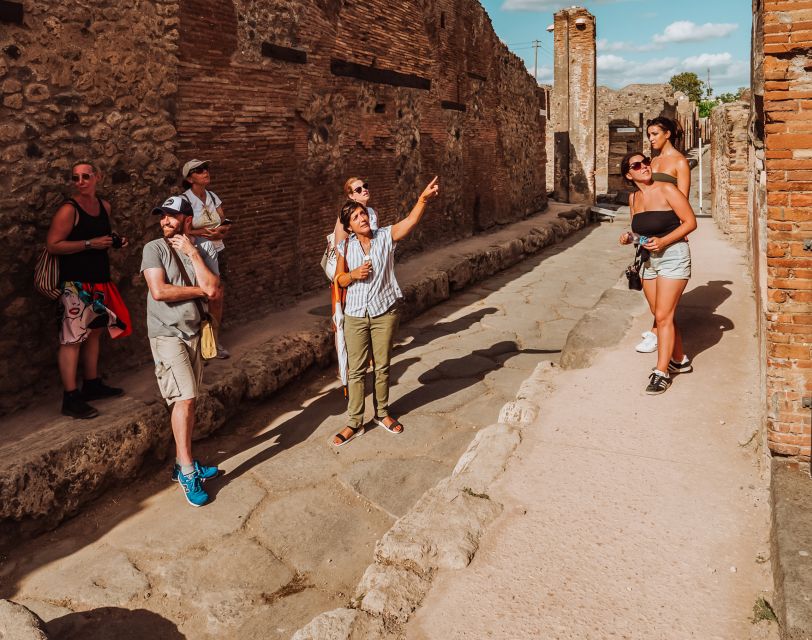
The Macellum of Pompeii is given about 10 minutes. This was a market area, and it brings the city’s commercial life into view.
Here you can think about Pompeii as a place where people bought food, met neighbors, worked, and moved through the day. The tour also highlights the Termopolium, an ancient food counter. It is one of the most vivid places for picturing a quick meal in the Roman city.
This is where the guide’s storytelling can make a real difference. A bare counter may not tell you much on its own. With explanation, it becomes part of a wider picture of shopping, cooking, serving, and eating.
The short time at the Macellum is enough for orientation, but not for a detailed study of every market feature. If food, trade, or working life interests you most, ask your guide what to return to after the formal tour.
The Forum Baths and the practical Roman city
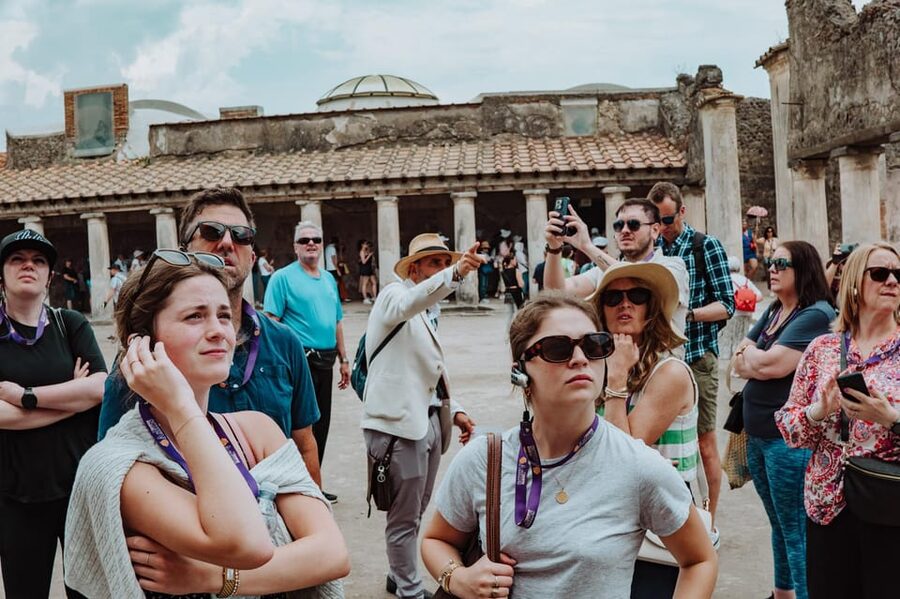
The Forum Baths are the final listed stop, with roughly 10 minutes of guided touring. Roman baths were much more than places to wash. They were social spaces and an important part of city life.
The baths also reveal the engineering behind Roman comfort. Your guide may point out the arrangement of rooms and explain how bath facilities fitted into the wider urban system. Even a short visit can help you understand why public baths mattered so much.
This stop completes the tour’s broad picture of Pompeii. You have seen religion at the Temple of Apollo, government and public life at the Forum, wealth in private homes, commerce at the market, adult services at the Lupanar, and everyday comfort at the baths.
The plaster casts and Pompeii’s human cost
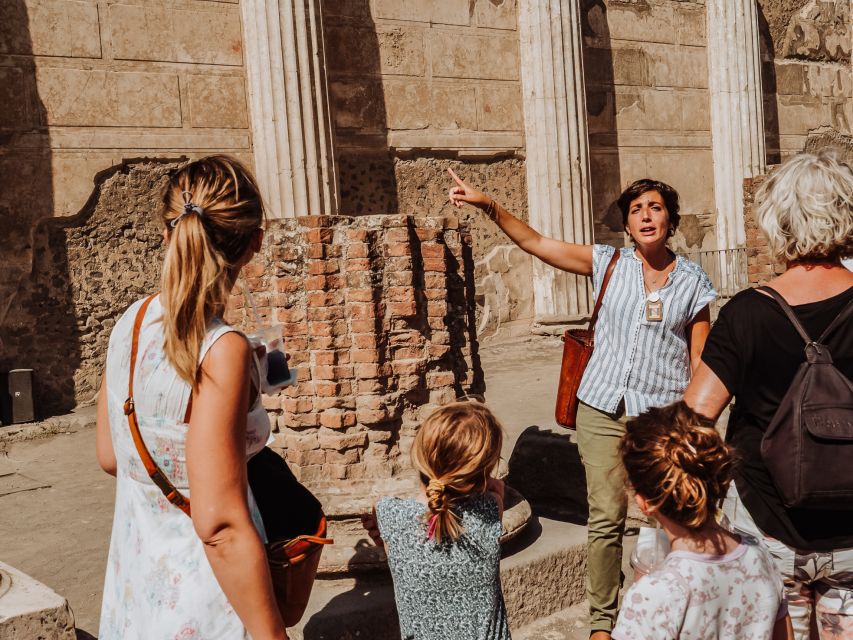
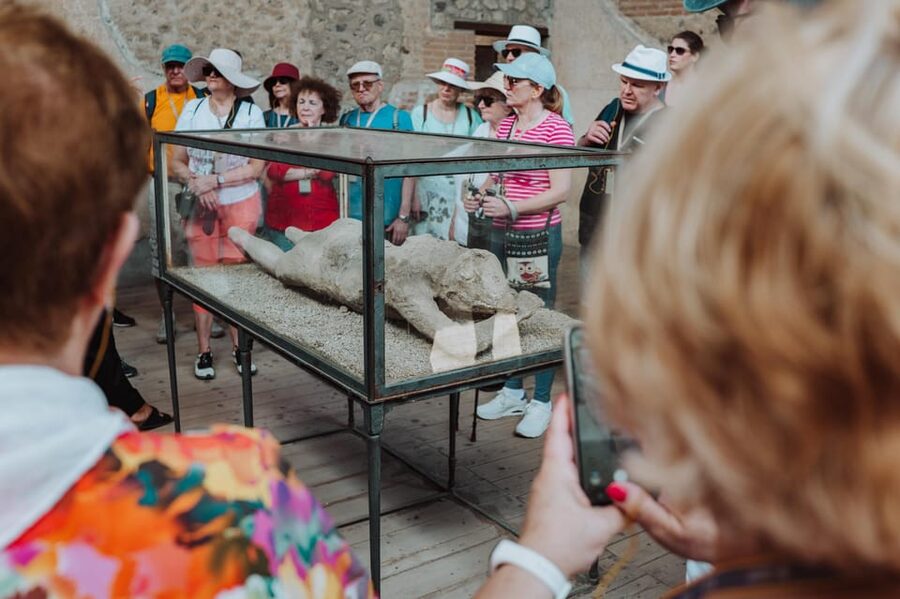
The route includes the famous plaster casts of victims, although the exact timing can vary as the guide moves through the site. These casts are among Pompeii’s most emotional sights.
They show the human cost of the eruption of Mount Vesuvius in 79 AD. The remains are not simply archaeological objects. They represent people caught in a disaster, and the sight can be upsetting, particularly for children.
A thoughtful guide helps place the casts in historical context without reducing them to spectacle. This is one reason I prefer a guided visit here. You can ask questions, understand what you are seeing, and take a quiet moment before continuing.
What the two-hour schedule really means
Two hours is long enough for a strong first look, but Pompeii cannot be fully covered in that time. The route is efficient and includes many of the best-known buildings, yet you will still leave with more to see.
Several people have found the tour itself lasted longer than expected, or stayed afterward for another two or more hours. That is possible if the schedule and site conditions allow, but you should treat the guided portion as the planned two-hour experience and any extra exploration as a bonus.
The best approach is to avoid scheduling something tight immediately afterward. You may want to continue alone, take photographs, revisit a house, or follow the guide’s suggestions.
The site can also become confusing after the tour. Pompeii’s streets form a large network, and it is easy to lose your bearings. Ask the guide where to go next before the group separates.
Group size, audio, and guide quality
The group can include up to 20 people. That is not a private tour, but it is small enough to keep the guide’s explanation focused.
Headsets are included for groups of 10 or more. They help in crowded areas, though they are not perfect for everyone. One practical complaint is that some people found themselves holding the earpiece close to the ear when surrounded by noise.
Guide quality is the heart of this experience. The strongest guide names in the feedback include Teresa, Anna Sorrento, Raffaella, Alfredo, Sergio, Giancarlo, Paolo, Mario, Amedeo, and Alexandra. Their praised qualities are consistent: clear English, humor, strong historical knowledge, enthusiasm, and the ability to explain ordinary life.
Language options include English, Spanish, French, Italian, Portuguese, and German. Check the language offered by your chosen departure time.
Is $35 a fair price?
At $35 per person, the tour is good value if you want structure and explanation. The entrance ticket is included, and skip-the-line access can save valuable time, especially when a long queue forms at the entrance.
You are also paying for more than access. You get an archaeologist guide, a planned route, explanations at major sites, and advice about what to see afterward. At a huge archaeological park, that guidance can prevent you from spending your limited time wandering past buildings without understanding their purpose.
The price is less compelling if you already have strong knowledge of Pompeii and prefer to explore alone. Even then, a guided introduction can be useful, followed by independent time.
Practical advice for a smoother visit
Wear shoes with firm soles. The ancient streets are uneven, and you may climb a few steps.
Bring water. One person found the site tiring and became dehydrated and hungry after extending the visit. Food and drinks are not included in the tour, so plan accordingly.
Allow extra time after the guided route if you want to see more. The contemporary city and the wider ruins both deserve attention, but do not assume the two-hour route covers every major corner.
Pompeii is not suitable for wheelchair users or people with significant mobility impairments. Mobility scooters are not allowed. Only dogs weighing no more than 10 kilograms and measuring no more than 40 centimeters in height are permitted, and they must follow the site’s leash and carrying rules. Children under 18 should bring a passport or ID to qualify for free admission.
The tour does not include hotel pickup, drop-off, transportation, food, or drinks. You need to arrange your own way to the meeting point.
Who should book this Pompeii tour?
I would book this tour if you are visiting Pompeii for the first time, have only a few hours, or want the ruins explained rather than simply photographed.
It is especially useful for history fans, families with older children, and anyone who wants to understand Roman homes, food, religion, and public life. The guides’ humor and storytelling also help keep a large archaeological site from becoming tiring.
I would choose another approach if you need a fully accessible route, want a private pace, or plan to spend the entire day studying individual buildings. In that case, a longer private or self-guided visit may fit better.
For most first visits, though, this is a sensible way to begin. You get the major sights, a strong historical framework, and enough practical advice to continue on your own. At $35, the combination of admission, skip-the-line access, and an archaeologist-led introduction makes the tour a solid choice.
FAQ
How long is the Pompeii guided tour?
The guided tour lasts two hours. You may be able to continue exploring the ruins independently afterward.
What is included in the price?
The price includes the Pompei Express entrance ticket, an archaeologist guide, a small group tour, and headsets for groups of 10 or more.
Which languages are available?
The live guide may conduct the tour in English, Spanish, French, Italian, Portuguese, or German. Check the selected departure option for the language offered.
Does the tour include transportation or hotel pickup?
No. Transportation, hotel pickup and drop-off, food, and drinks are not included.
Is the tour suitable for wheelchair users?
No. The activity is not suitable for wheelchair users or people with mobility impairments. Mobility scooters are also not allowed.
Can children and dogs enter Pompeii?
Unaccompanied minors are not allowed. Children under 18 are advised to bring a passport or ID to qualify for free admission. Dogs are permitted only if they weigh no more than 10 kilograms, are no taller than 40 centimeters, remain on a leash, and follow the site’s rules inside buildings.
More Archaeological Site Tours in Pompeii
- Pompeii Skip-the-line Tour with Archaeologist Guide
★ 5.0 · 559 reviews - Explore Pompeii with an Archaeologist
★ 5.0 · 511 reviews - Pompeii 3hours Villa of Mysteries tour with an Archaeologist
★ 4.8 · 486 reviews - Pompeii Private Tour with an Archaeologist and Skip The Line
★ 5.0 · 391 reviews
Just added around Pompeii
- Pompeii and Herculaneum: Guided Tour with an Archaeologist★ 5.0 · 164 reviews
- Pompeii Guided Tour with Archaeologist★ 4.6 · 27 reviews
- Pompeii: Guided Tour with Archaeologist with max. 12 People★ 5.0 · 155 reviews
- Pompeii Small Group Tour – Tickets Included★ 4.7 · 72 reviews
- Pompeii: 2-Hour Guided Tour with an Archaeologist★ 4.9 · 151 reviews
- Pompeii Private Tour with an Archaeologist Guide★ 5.0 · 184 reviews
- PompeiI Exclusive Tour with your Archaeologist in a Small Group★ 4.5 · 363 reviews
- Pompeii Private Tour with an Archaeologist and Skip The Line★ 5.0 · 391 reviews
Pompeii History Tours, compared.
Pompeii: Small Group Tour with an Archaeologist
Read our review →Pompeii Small Group Tour with an Archaeologist
Read our review →
Discover the Ancient Ruins of Pompeii: Day Trip from Rome
Read our review →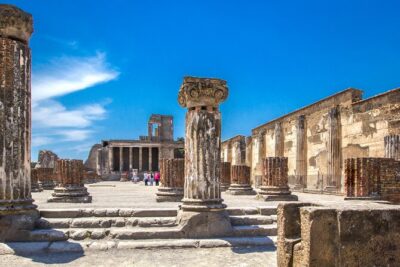
Pompeii and Herculaneum Small Group Tour with an Archaeologist
Read our review →
Skip the Line Guided Tour of Pompeii led by an Archaeologist
Read our review →
Pompeii: Tour with Archaeologist Guide & Skip-the-Line Entry
Read our review →
Pompeii Private Tour with an Archaeologist and Skip The Line – 3 hours
Read our review →
Pompeii Skip-the-line Tour with Archaeologist Guide
Read our review →Browse the lists this tour appears in