Review · POMPEII
Pompeii Small Group Tour with an Archaeologist
Pompeii makes far more sense with an archaeologist beside you. The site is huge, the streets can feel confusing, and a plain wall or broken column often needs a story before it becomes meaningful. This tour takes you from the Basilica and Forum to plaster casts, private houses, baths, the Lupanar, and the theaters in about two hours.
I especially like the focused route through major sights and the chance to hear about ordinary Roman life, not just emperors and monuments. Guides such as Alessandra, Paolo, Teresa, and Vincenzo have earned praise for clear storytelling, humor, and patience. The main drawback is the group limit of 20, which can feel larger than ideal at crowded rooms and narrow streets.
Key points to know before booking
- See Pompeii’s essential sights in two hours: The route includes the Forum, Granaries, House of Menander, Stabian Baths, Lupanar, House of the Faun, and both theaters.
- Learn from an archaeologist: The guide explains architecture, decoration, daily life, excavation, and the eruption rather than simply naming buildings.
- The tour ends inside the ruins: You can keep exploring on your own after the guided portion, but you must plan your route out.
- Expect uneven ground and little shade: Sturdy shoes, sun protection, and water matter, especially in summer.
- The $35.67 price offers solid value: You receive the Pompeii Express entrance ticket and guided context without paying for transportation or food.
- Arrive on time: Pompeii is very large, and joining late can be difficult or impossible once the group is inside.
Why an archaeologist changes Pompeii
Pompeii is not a compact monument you can understand in one quick circuit. It is an ancient city with streets, houses, shops, public buildings, theaters, baths, and open spaces spread across a broad archaeological park. You can walk past an elegant courtyard and miss why it matters, or see a plaster cast and fail to grasp the human cost of the eruption.
A trained guide gives you a framework. You learn how the Forum functioned, why the Basilica mattered to business and civic life, and how private homes revealed social rank. The best guides also connect the remains to people, showing how Romans ate, bathed, entertained themselves, worshipped, and moved through the city.
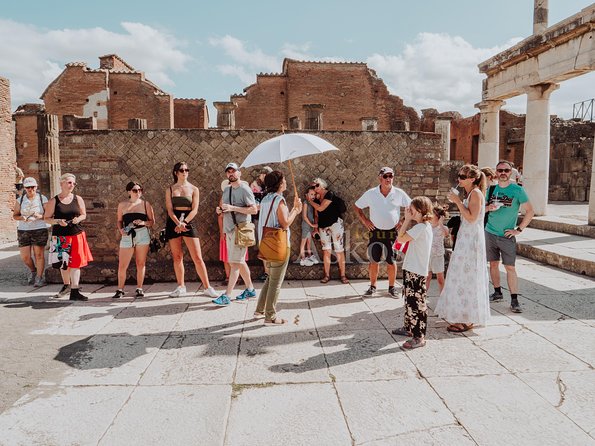
The tour is offered in English and is capped at 20 people per guide. That is small enough for a personal feel compared with a large coach group, though it is not an intimate private tour. For groups of 16 or more, headsets are supplied. They can help in busy areas, but one poor experience included a delay caused by headset trouble, so do not expect the technology to be perfect every time.
At $35.67 per person, the value is strong if you want orientation and interpretation. Your ticket, guide, and assistance are included. Transportation, food, and drinks are not, so you need to arrange your own way to Pompeii and bring water.
More Ancient History Tours in Italy
- Pompeii: Entry Ticket and Guided Tour with an Archaeologist
★ 4.8 · 19,459 reviews - Pompeii: Small Group Tour with an Archaeologist
★ 4.8 · 12,264 reviews - Discover the Ancient Ruins of Pompeii: Day Trip from Rome
★ 3.5 · 2,247 reviews
Meeting at Porta Marina Superiore
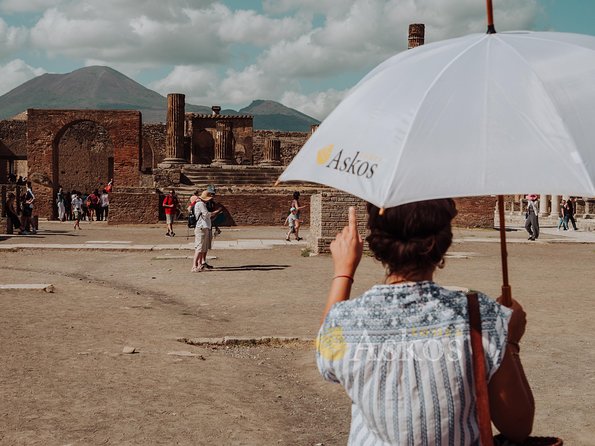
The meeting point is the main archaeological entrance at Porta Marina Superiore, at Via Villa dei Misteri 2. Look for the guide holding an Askos Tours sign. The official starting point matters because Pompeii has several entrances and the site itself is large enough to make a last-minute search stressful.
Build in time to arrive before the scheduled start. A late arrival can be a serious problem here. The guide may be far inside the ruins, phone reception can be poor, and the group cannot simply stop and wait for a late party. One delayed group missed the tour after arriving about 45 minutes late, even though entrance tickets were still provided.
The tour finishes inside Pompeii rather than returning you to the entrance. I consider this a benefit because you can stay and explore independently. It also means you should listen carefully when the guide explains the exits and plan how you will leave the park afterward. One useful improvement would be clearer directions at the end of the tour, so ask before separating from the group.
The Basilica and Forum set the scene
The Basilica is the first major stop. This was an open portico used for commerce and other civic activity, and it gives you an early lesson in how Pompeii worked as a city. The remains are not as visually complete as some houses, but the scale and position help you understand the public center.
From there, the group moves to the Forum, Pompeii’s main square. This is where the city’s political, religious, and commercial life came together. The guide can point out how the surrounding buildings related to the square, helping you read the ruins as an urban plan rather than a collection of stones.
The stops are fairly brief, about 10 to 15 minutes each. That pace is useful because you cover a lot of ground, but it also means you should not expect a long lecture at every building. Guides often choose particular details for a closer explanation. One visitor noted that each guide may select different highlight spots for a fuller explanation, which is a reminder that the tour is an introduction, not a complete study of every room.
The Granaries make the eruption personal
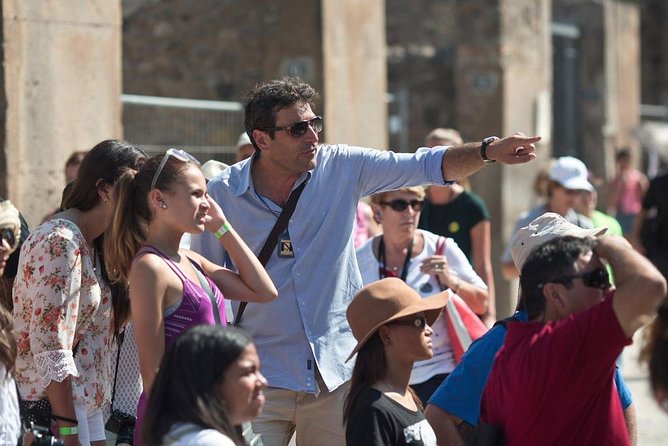
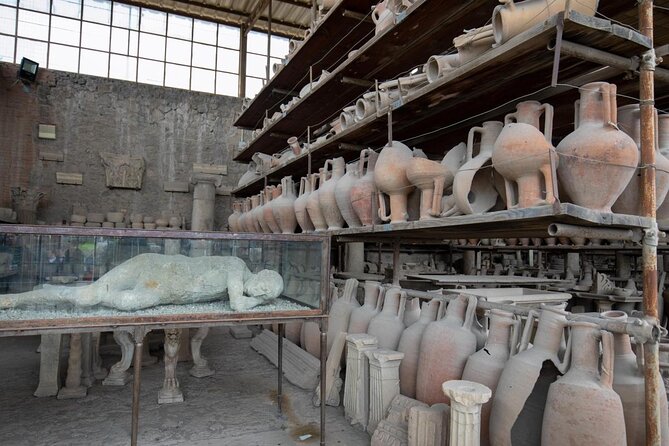
At the Granaries of the Forum, the tone changes. You will see marble tables, fountain pieces, and plaster casts of people affected by the eruption, along with casts of a dog and a tree. These objects make Pompeii’s final hours feel immediate in a way that grand architecture cannot.
This stop can be emotional. The casts are not simply curiosities. They represent people caught in a disaster, and a good guide helps you consider the human story without turning the moment into spectacle. The tour connects the eruption with the wider city, showing that Pompeii was a lived-in place before it became an archaeological site.
Take a moment here. The schedule allows about 15 minutes, but the importance of the stop is greater than the clock suggests. If this is the part of Pompeii you most want to absorb, you may prefer to return after the tour for a quieter look.
More Ancient History Tours in Pompeii
- Pompeii and Herculaneum Small Group Tour with an Archaeologist
★ 5.0 · 1,350 reviews - Skip the Line Guided Tour of Pompeii led by an Archaeologist
★ 5.0 · 703 reviews - Pompeii: Tour with Archaeologist Guide & Skip-the-Line Entry
★ 4.5 · 623 reviews - Pompeii Private Tour with an Archaeologist and Skip The Line – 3 hours
★ 5.0 · 564 reviews
Walking the main street and entering the houses

The route then follows an original paved street. This is one of Pompeii’s pleasures and one of its practical challenges. The stones are uneven, and the old road surfaces can be tiring underfoot. Wear sturdy walking shoes rather than smooth sandals, and bring water even when the day does not feel especially hot.
The House of Menander is one of the tour’s strongest stops. It was among the wealthiest and most impressive homes in Pompeii, with notable architecture, decoration, and contents. Here, the guide can explain how a Roman house was arranged and what its decoration said about the family who owned it.
You may see frescoes, mosaics, courtyards, and rooms designed for both family life and social display. The point is not simply that the house is beautiful. It shows how private wealth shaped daily life, and why a home in Pompeii could function as a stage for status.
The House of the Faun offers another look at elite domestic life. It was one of the largest private residences in the city, and its size helps balance the smaller rooms and narrower streets elsewhere on the route. These houses are a good reason to choose a guided visit. Without explanation, you may notice decoration but miss the social clues in the floor plan.
The Stabian Baths reveal everyday Roman life
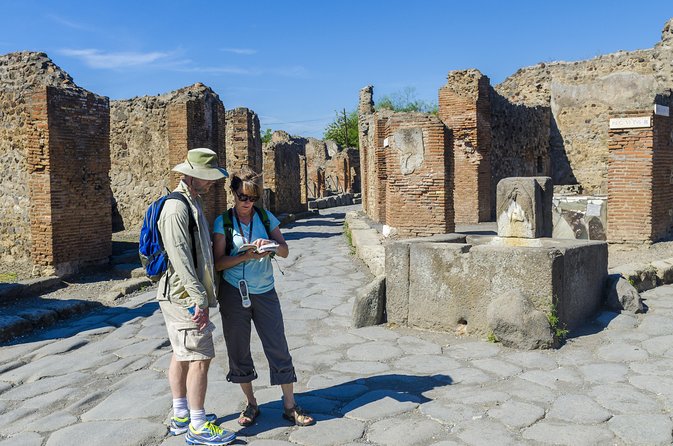
The Stabian Baths occupy a broad area between the Brothel Lane, the Holconius crossroads, and Via Stabiana. They are considered the oldest thermal complex in Pompeii, making them important both for their age and for what they reveal about public life.
Baths were not merely places to wash. They were social spaces, part of the city’s daily rhythm. The guide can help you picture how people used different rooms and why public bathing mattered so much in Roman culture.
The baths also show the difference between Pompeii’s grand public buildings and its practical systems. Heating, water, movement, and crowd control all had to work together. A short stop here gives you useful context before the tour moves to a very different kind of building.
The Lupanar requires a thoughtful visit
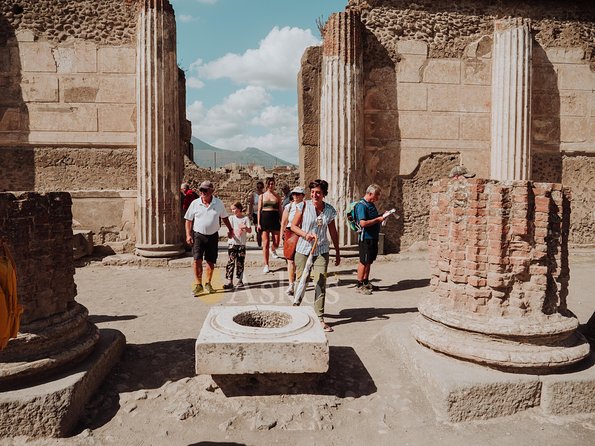
The Lupanar is Pompeii’s best-known brothel. Its small rooms and surviving paintings attract plenty of attention, but the site is worth more than a quick joke or a glance at the famous imagery. The guide can place it within the city’s social world and explain what the building may tell us about commercial sex in Roman Pompeii.
This is a busy stop, and space can be tight. If you are traveling with children or teenagers, the guide’s explanation helps keep the visit historical and respectful. Children must be accompanied by an adult, as with the rest of the tour.
Because the tour moves through several popular sights, you may need to wait for others to see the key details. A group of 20 is manageable, but narrow interiors can make it feel larger. If you strongly prefer quiet rooms and long pauses, a private tour may suit you better.
The Odeon and Teatro Grande finish the route
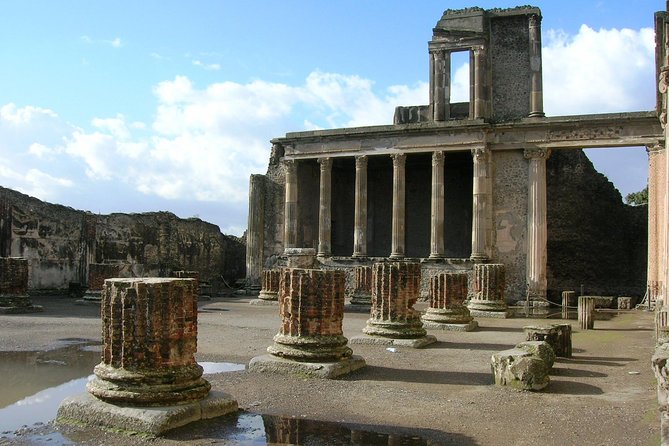
Near the end, you will see the Teatro Piccolo, also called the Odeon. This smaller theater helps show that Pompeii’s entertainment scene was not limited to one large venue. Its form and scale give you another example of how Roman public buildings were designed for different uses.
The final major stop is Teatro Grande, Pompeii’s largest and most important theater. It is a fitting finish because it brings together architecture, public life, and entertainment. Your guide can explain how the seating and stage area worked, while the setting gives you one last sense of Pompeii as an active city rather than a silent ruin.
The theater stop lasts about 10 minutes. That is enough for an overview, though not a full examination of every architectural feature. Once the guided tour ends, you can remain inside the ruins and continue at your own speed.
What the two-hour timing really means
Two hours is a good length for a first look, especially if you are visiting Pompeii as part of a larger day in the Naples area. It keeps the visit from becoming an exhausting all-day march and gives you a clear route through the essential buildings.
It is not enough to see every corner of the archaeological park. Pompeii is too large for that. Think of this tour as a guided foundation: you learn the layout, see major highlights, and receive enough context to choose what to explore next.
Several guides, including Alessandra, Paolo, Teresa, Amedeo, Antonio, Julia, and Vincenzo, have been praised for friendly delivery, humor, clear speech, and thoughtful pacing. One guide was especially noted for keeping teenagers interested, while another adjusted the pace to suit different walking abilities. Guide quality can vary on any shared tour, but the archaeological background is a meaningful advantage.
Practical advice for a smoother visit
Wear comfortable shoes with good grip. Pompeii has uneven paving, steps, ramps, and some slightly steep sections. The tour is not recommended for people with significant mobility limitations, and mobility scooters are not permitted. If you need a route suited to particular mobility needs, contact the operator about a private option.
There is little shade in many parts of the site. In summer, pack sunglasses, sunscreen, a hat, and a small bottle of water. The tour operates year-round, in rain or sun, so a wet-weather plan is sensible even though the provided information does not specify equipment or shelter.
Service animals are allowed. Other dogs must weigh no more than 10 kilograms and measure no more than 40 centimeters at the shoulder. They must be leashed, carried inside buildings, and cleaned up after.
For anyone under 18, bring an identity card or passport. Children must stay with an adult. The tour is available throughout the year, and confirmation is supplied when you book.
Cancellation is free up to 24 hours before the local start time. Within 24 hours, the payment is not refunded, and changes are not accepted. That policy makes punctual planning especially important.
Who should book this Pompeii tour?
I would choose this tour if you want a clear introduction to Pompeii without spending the whole day with a guide. It suits first-time visitors, families, and anyone who worries about missing the meaning behind the ruins. The route mixes public monuments, private houses, baths, a brothel, theaters, and the casts, so you get a broad picture of city life.
It is also a good choice if you plan to continue independently. After the two-hour walk, you can stay inside and see more of the site at your own pace. Ask the guide for exit directions and suggestions before the group disperses.
I would think twice if you need a slow, highly flexible visit or dislike walking on uneven ground. A maximum of 20 people is reasonable for the price, but it will not feel private. And if you arrive late, the size of Pompeii makes catching up with the group difficult.
At $35.67, the tour is a sensible buy for the structure, entrance ticket, and archaeological interpretation. Book it if you want Pompeii to feel like a city with people and routines, not just a field of ruins. Skip it only if you already know the site well and prefer to spend your entire visit exploring alone.
FAQ
How long does the Pompeii tour last?
The tour lasts approximately two hours.
Where does the tour meet?
Meet at the Porta Marina Superiore entrance to Pompeii Archaeological Park, at Via Villa dei Misteri 2. The guide will hold an Askos Tours sign.
Where does the tour finish?
The guided tour finishes inside the Pompeii ruins.
Is the Pompeii entrance ticket included?
Yes. The Pompeii Express entrance ticket is included.
Is transportation included?
No. Transportation, food, and drinks are not included.
How large is the group?
The maximum is 20 people per guide.
Are headsets provided?
Headsets are provided for groups of 16 or more.
Is the tour suitable for people with mobility limitations?
It is not recommended for people with mobility issues because the route includes steps, ramps, uneven ground, and some slightly steep sections. Mobility scooters are not allowed.
What happens if I cancel?
You receive a full refund if you cancel at least 24 hours before the experience starts. Cancellations or changes within 24 hours are not accepted and are not refunded.
More Small-Group History Tours in Pompeii
- PompeiI Exclusive Tour with your Archaeologist in a Small Group
★ 4.5 · 363 reviews - Pompeii Small Group Tour – Tickets Included
★ 4.7 · 72 reviews - London Small Group Tour of Historical Pubs
★ 5.0 · 10,422 reviews - Boston: Freedom Trail History Small Group Walking Tour
★ 5.0 · 6,450 reviews
More Archaeological Site Tours in Pompeii
- Pompeii Skip-the-line Tour with Archaeologist Guide
★ 5.0 · 559 reviews - Explore Pompeii with an Archaeologist
★ 5.0 · 511 reviews - Pompeii 3hours Villa of Mysteries tour with an Archaeologist
★ 4.8 · 486 reviews - Pompeii Private Tour with an Archaeologist and Skip The Line
★ 5.0 · 391 reviews
Just added around Pompeii
- Pompeii and Herculaneum: Guided Tour with an Archaeologist★ 5.0 · 164 reviews
- Pompeii Guided Tour with Archaeologist★ 4.6 · 27 reviews
- Pompeii: Guided Tour with Archaeologist with max. 12 People★ 5.0 · 155 reviews
- Pompeii Small Group Tour – Tickets Included★ 4.7 · 72 reviews
- Pompeii: 2-Hour Guided Tour with an Archaeologist★ 4.9 · 151 reviews
- PompeiI Exclusive Tour with your Archaeologist in a Small Group★ 4.5 · 363 reviews
- Pompeii Private Tour with an Archaeologist Guide★ 5.0 · 184 reviews
- Pompeii Private Tour with an Archaeologist and Skip The Line★ 5.0 · 391 reviews
Pompeii History Tours, compared.
Pompeii: Entry Ticket and Guided Tour with an Archaeologist
Read our review →
Pompeii: Small Group Tour with an Archaeologist
Read our review →
Discover the Ancient Ruins of Pompeii: Day Trip from Rome
Read our review →
Pompeii and Herculaneum Small Group Tour with an Archaeologist
Read our review →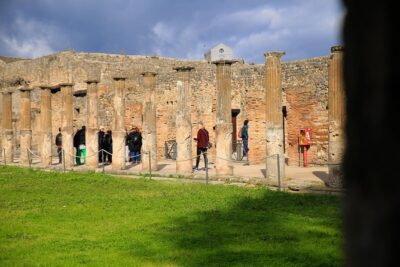
Skip the Line Guided Tour of Pompeii led by an Archaeologist
Read our review →
Pompeii: Tour with Archaeologist Guide & Skip-the-Line Entry
Read our review →
Pompeii Private Tour with an Archaeologist and Skip The Line – 3 hours
Read our review →