
Review · SPLIT
Split Walking Tour with Professor of History
Split’s old town is not a museum behind glass. It is a living city built inside and around a Roman emperor’s palace. This walking tour makes that unusual setting easier to understand, with a history professor as your guide and a route that connects Roman ruins, medieval lanes, Napoleon-era planning, and modern Croatian life.
I like two things here: the broad route, which gives you a useful first look at nearly every major corner of central Split, and the guides’ habit of adding practical advice about food, banks, shops, and onward plans. The main drawback is pacing. The advertised time is about 2 hours 20 minutes, but the walk can run close to three hours if your guide adds extra stories.
Key points to know before booking

- Diocletian’s Palace is still part of everyday Split, so you walk through working streets, squares, cafés, and shops rather than a sealed historic site.
- Mario and Anita are the named guides praised most often, with Mario especially noted for humor, local tips, and lively explanations.
- The route covers 11 places, from Riva Harbor and the palace substructures to Fruit’s Square and Prokurative.
- The maximum group size is 17 people, and a private upgrade is available if you want more individual attention.
- The cathedral and Temple of Jupiter are viewed from outside, so admission to those interiors is not part of the tour.
- The price is $24.19 per person, a fair fee for a long, expert-led introduction to Split’s historic center.
Why a professor changes the way you see Split
The key appeal is not simply the number of sights. It is the way the guide links them.
Split can feel confusing at first. Roman walls form the bones of the old town, later buildings fill the gaps, and narrow passages lead to squares that once served very different purposes. A guide who teaches history can explain why a Roman mausoleum became a Christian cathedral, why a palace basement matters, and how a street named for Napoleon’s marshal fits into the city’s story.
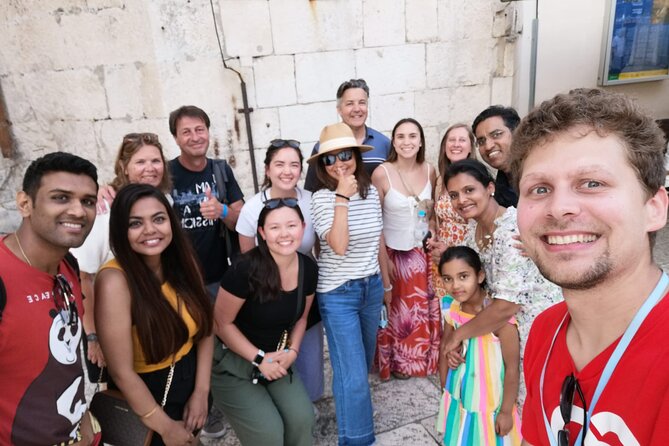
Mario receives especially strong praise for mixing serious history with humor and small facts that keep the walk moving. Anita is described as warm, attentive, and proud of her Croatian background. The tone appears to be educational without turning into a lecture, with questions, stories, and room for the group to respond.
That matters in Split. You can see the Peristyle in five minutes on your own, but you may miss the staging of imperial power, the later changes to the buildings, and the reason the palace remains such an unusual part of daily life.
More History Walking Tours in Croatia
- Dubrovnik Old Town History Walking Tour
★ 5.0 · 1,684 reviews - Dubrovnik: Ancient City Walls & Wars Walking Tour
★ 5.0 · 1,270 reviews - Zagreb: City and WWII Tunnels Walking Tour
★ 4.9 · 1,230 reviews
Starting at Riva Harbor beside the palace
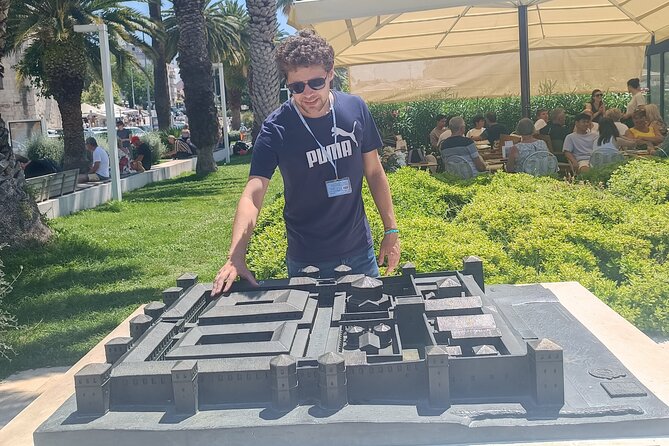
The meeting point is by the Brass Gate, also called Porta Aenea, at Obala Hrvatskog narodnog preporoda 22. The tour begins beside the model of Diocletian’s Palace on the Riva promenade.
Riva is Split’s social front porch. People come here for coffee, sunshine, conversation, and a slow look toward the harbor. Beginning here gives you useful context before you enter the old town. The palace was not an isolated fortress in the modern sense. It was tied to the sea, and the waterfront still shapes how the city works.
You spend about 15 minutes here. This is a good opening because it lets the guide explain the layout before the narrow streets begin. It also gives you a chance to locate yourself if you have just arrived by ferry or public transport.
The Riva can be busy, and standing in direct sun may be tiring during a hot afternoon. The guide’s ability to choose shade and keep the group moving becomes important here and at later stops.
Beneath Diocletian’s Palace
The palace substructures are one of the best-preserved ancient complexes of their kind. They also explain the shape of the streets above. In practical terms, the lower rooms supported and mirrored the imperial apartments that once stood overhead.
The tour spends about 15 minutes in this area. The admission fee is included, listed as free for the stop, so you do not need to make a separate payment for the guided visit.
The substructures are among the strongest parts of the walk because they make the palace feel like a real building rather than a collection of scattered ruins. Their preservation helped Split’s historic center receive UNESCO World Heritage status in 1979.
One limitation is that 15 minutes is enough for orientation, not a full archaeological visit. If the underground halls catch your interest, you may want to return later and spend more time exploring at your own pace.
Imperial power at the Peristyle and Vestibule
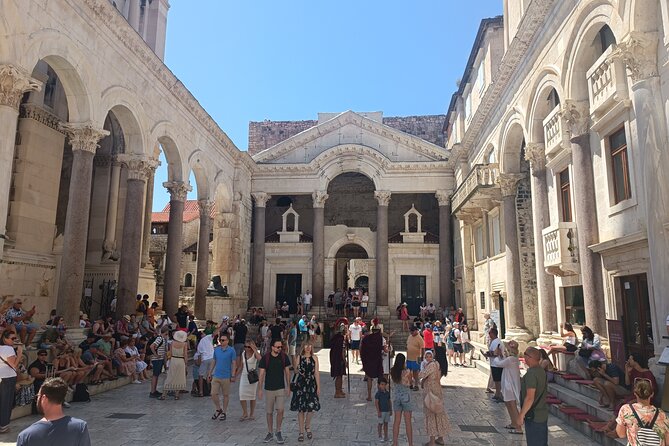
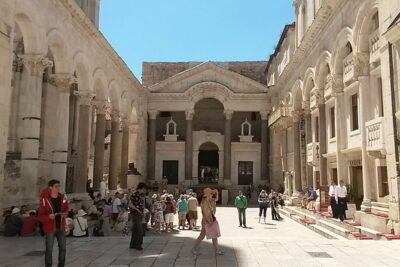
The Peristyle is the palace’s central ceremonial square. Here the guide explains how Emperor Diocletian presented himself as a divine ruler, associated with Jupiter. The space was designed for ceremony and submission, not casual public life.
The details help you read the architecture. The emperor appeared beneath the central architrave, while subjects approached in formal gestures of respect. A square that now serves as a photo stop once carried a heavy political message.
The visit lasts about 10 minutes. That may seem brief, but a good explanation can make the square far more interesting than its columns alone suggest.
Next comes the Vestibule, a circular hall that formed part of the route to the imperial apartments. It was built by the beginning of the fourth century and once had a dome. The room measures about 17 meters high and 12 meters across, giving you a strong sense of the scale intended for imperial visitors and selected audiences.
The Vestibule receives another 10 minutes. It is a compact stop, but it works well after the Peristyle because you move from public ceremony into the controlled approach to the emperor’s private world.
Same city, a different century:
- Zagreb: City & History Walking Tour & WW2 Tunnels
★ 4.9 · 1,202 reviews - Walking Tour of Split with a ‘Magister’ of History
★ 5.0 · 1,122 reviews - Dubrovnik Combo: Old Town & Ancient City Walls
★ 5.0 · 1,019 reviews - Split: History and Heritage Walking Tour
★ 4.9 · 650 reviews
Seeing Saint Domnius as Roman mausoleum and church
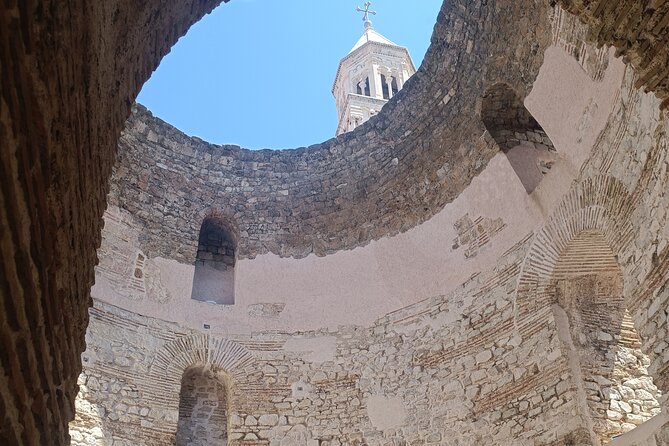
The Cathedral of Saint Domnius is viewed from outside. The entrance fee is not included, but the guide explains the building and can provide information if you want to visit inside afterward.
Its importance comes from the way several layers meet in one structure. The building began as a Roman mausoleum for Diocletian, then became a cathedral. That change tells you much about Split: old Roman structures were not simply abandoned. They were adapted, reused, and given new religious meaning.
The tour allows about 20 minutes here, one of the longer stops. Use it to ask about the building’s changing role and to decide if you want to pay for a separate interior visit later.
This arrangement is worth noting before you book. If you want a tour that includes every major interior, this is not that kind of outing. It is a city walk with explanations, and the cathedral is an outside stop.
Jupiter, a narrow lane, and the Golden Gate
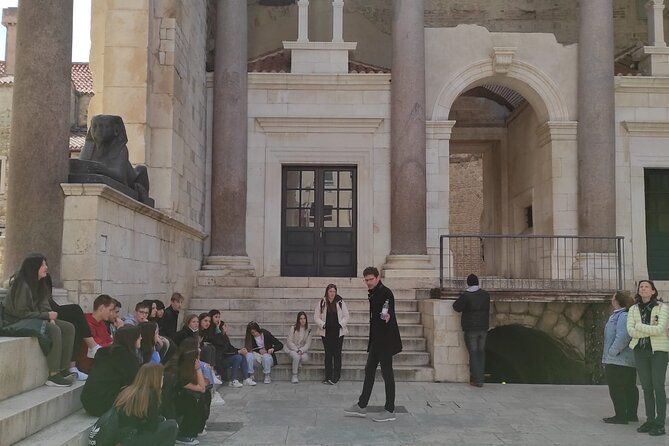
The Temple of Jupiter is another outside stop. Jupiter was the supreme Roman sky and thunder god, and the temple later became a baptistery dedicated to Saint John the Baptist.
The guide uses this place to show how religious buildings change meaning over time. You also pass through a very narrow lane called Let me pass street. Local people regard it as one of the narrowest streets in the world.
The route then heads toward the Golden Gate, the northern entrance to the palace. This was the main gate used by Diocletian to enter the complex and was decorated to signal its importance. During the Middle Ages it was sealed, and some of its columns and statues disappeared. It was later reopened and repaired.
These 10 and 15-minute stops are good examples of the tour’s range. You get Roman religion, medieval adaptation, local street lore, and the defensive or ceremonial role of the palace entrances without leaving the old center.
The Golden Gate is also a useful orientation point. Once you understand the main gates, it becomes easier to picture how the palace was arranged and how modern streets grew within its walls.
Gregory of Nin and the practical side of local tradition
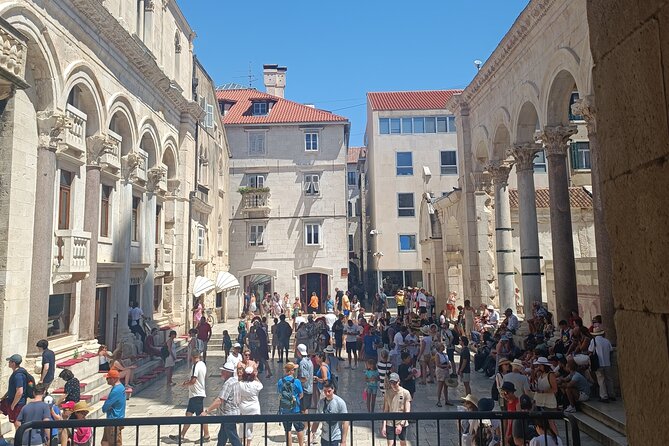
At the statue of Gregory of Nin, the walk shifts from Roman emperors to Croatian culture. The 8.5-meter statue was created by Ivan Meštrović and has become one of Split’s most popular small rituals.
Touching the statue’s toe is said to bring good luck. The toe is now smooth and shiny from years of contact. This takes only about 10 minutes, but it gives the tour a lighter moment after the palace’s heavier political and religious themes.
The stop also introduces an important Croatian figure. Gregory of Nin was a medieval bishop associated with the use of the Croatian language in church services, and the statue’s presence reflects local pride in national culture. The supplied tour details specifically promise information about the monument, so you can expect more than a quick photo opportunity.
This is also the sort of place where the guide’s group management matters. The statue is a busy stop, and a maximum of 17 people is large enough to require care but still manageable.
Marmontova Street and Prokurative
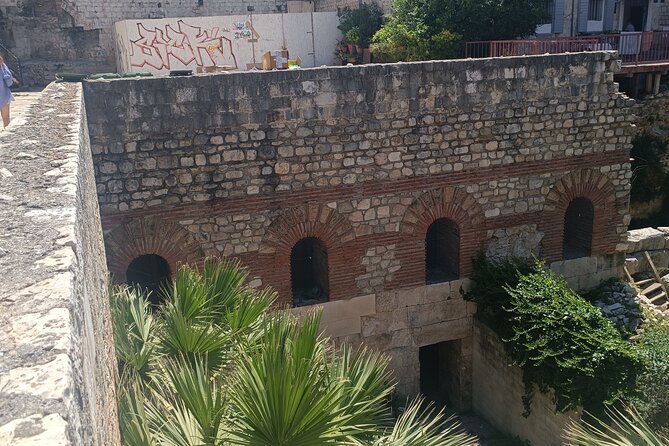
Marmontova Ulica offers a look at a later chapter in Split’s urban story. The street is named for Napoleon’s marshal Marmont, who helped shape the urban planning of Dalmatian cities despite being a conqueror.
The walk spends about 10 minutes here. This stop keeps the tour from becoming only a Roman history lesson. You see how outside powers affected the city’s streets and public spaces long after Diocletian’s rule.
The next stop is Prokurative, formally Republic Square. It is a large open space surrounded on three sides by elaborate neo-Renaissance buildings. The architecture creates a sharp contrast with the stone lanes and ancient walls earlier in the route.
Another 10 minutes here gives the guide space to explain the square’s appearance and its place in modern Split. It is also a practical place to pause because the open layout makes the contrast between old and newer parts of the city easy to see.
Finishing at Fruit’s Square
The final stop is Fruit’s Square, or Trg Braće Radić. Its name recalls the women who once sold fruit there. It is a small, attractive square with monuments including a statue of Marko Marulić, often called the father of Croatian literature.
This is a fitting finish because the subject broadens from buildings to local life. The guide can connect the square to Croatian history, literature, food, and gastronomy. The tour details also identify it as a useful place for those stories, so expect practical suggestions about what to eat or where to continue exploring.
The activity ends back at the meeting point, even though the route itself finishes at Fruit’s Square. The walk is therefore easy to fit into a day when you want a guided introduction before exploring independently.
What the $24.19 price delivers
At $24.19 per person, this is good value if you want a strong orientation to Split rather than a short photo walk. You get roughly 2 hours 20 minutes, an English-speaking professor of history, a route through the main historic center, and all listed fees and taxes.
The value improves if your guide is Mario or Anita, both of whom receive especially warm praise for clear explanations, humor, local pride, and personal attention. Mario is also noted for giving advice on restaurants, food, banks, ATMs, shops, and onward travel. That sort of guidance can save you time after the walk.
The price does not cover alcoholic drinks or entry to the cathedral and Temple of Jupiter. Those are not serious problems, but you should budget separately if you want to go inside. Also allow extra time if your guide gives a longer explanation. One account describes the experience lasting close to three hours.
The group limit is 17. That is not an intimate private walk, but it is smaller than a large coach-style group. If you want the guide to focus closely on your questions, the private upgrade may be worth considering.
Timing, comfort, and booking details
You receive confirmation when booking, and the experience is offered in English with a mobile ticket. It runs in the historic center, near public transport, and service animals are allowed. Most people can participate, but this remains a walking tour through old streets and uneven historic spaces.
Good weather is required. If poor weather cancels the activity, you are offered another date or a full refund. You can cancel for a full refund up to 24 hours before the start time. Changes or cancellations inside that window are not accepted.
The tour is often booked about 33 days ahead. That does not mean you must plan a month in advance, but it is a useful warning for a popular summer date. I would reserve early if your Split schedule is tight or if you want a particular guide.
Who should book this Split walking tour?
I would choose this tour for a first visit to Split, especially if you want the city’s ancient, medieval, and modern layers explained in one outing. It also suits people who enjoy history but prefer stories, questions, and humor to a dry recital of dates.
It is a good fit for families and mixed-age groups because the route includes visual highlights, local customs, and short stops. The guide’s practical tips also help if you plan to stay in Split for several days.
I would look elsewhere if you need full access to every interior, want a very short walk, or dislike tours that may run longer than scheduled. The outside-only treatment of Saint Domnius and Jupiter’s Temple is clear, but it may disappoint anyone expecting an all-inclusive palace admission.
Should you book it?
Yes, if you want a well-priced introduction led by a trained historian rather than a quick circuit of photo stops. The best reasons are the complete central route, the clear historical framing, and the guides’ mix of scholarship, humor, and useful local advice.
Book the private option if personal questions and flexible pacing matter most. Choose the standard group tour if you want solid value and a lively first look at Split. Just plan for sun, walking, and the possibility that a good story will keep you out longer than expected.
FAQ
How long does the Split walking tour last?
The stated duration is approximately 2 hours 20 minutes. It may run closer to three hours if the guide adds extra stories and explanations.
What language is the tour offered in?
The tour is offered in English.
Where does the tour start?
It starts at the Brass Gate, also called Porta Aenea, at Obala Hrvatskog narodnog preporoda 22 in Split.
Where does the tour end?
The activity ends back at the meeting point.
Are cathedral and Temple of Jupiter admission fees included?
No. Both are outside visits, and admission is not included. The guide provides information for anyone who wants to visit afterward.
How many people can join the group?
The tour has a maximum of 17 participants. A private-tour upgrade is also available.
Just added around Croatia
- Split: Local History and Culture 90-Minute Walking Tour★ 5.0 · 194 reviews
- Split: Walking tour of Split with a ‘Magister’ of History★ 5.0 · 110 reviews
- Split: Historical & Gastro Treasures Tour with Green Market★ 4.9 · 144 reviews
- Split: Historical Tour of Salona, Klis Fortress and Trogir★ 4.1 · 108 reviews
- Split: Private Walking Tour in the Historical Town Center★ 5.0 · 25 reviews
- Šibenik: Croatia in a Day, Vistas, History, Olive Oil, Wine★ 5.0 · 30 reviews
- Šibenik: Medieval Night Walking Tour★ 5.0 · 27 reviews
- Dubrovnik: Red History Museum Regular Ticket★ 4.6 · 134 reviews
Split History Tours, compared.
Walking Tour of Split with a ‘Magister’ of History
Read our review →
SPLIT-PRIVATE Walking Tour of Diocletian’s Palace & Old Town
Read our review →
Split: Local History and Culture 90-Minute Walking Tour
Read our review →
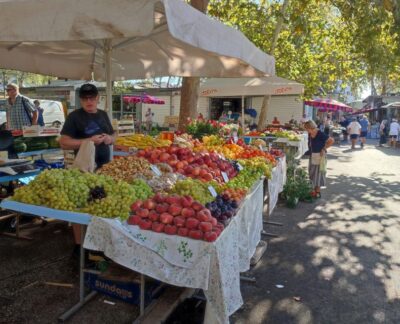
Split: Historical & Gastro Treasures Tour with Green Market
Read our review →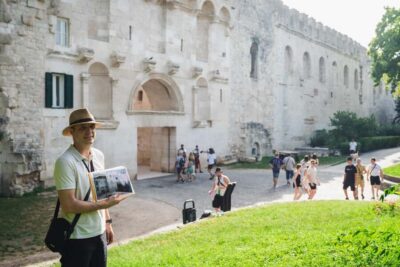
Split: Walking tour of Split with a ‘Magister’ of History
Read our review →
Split: Historical Tour of Salona, Klis Fortress and Trogir
Read our review →Browse the lists this tour appears in