
Review · SPLIT
Walking Tour of Split with a ‘Magister’ of History
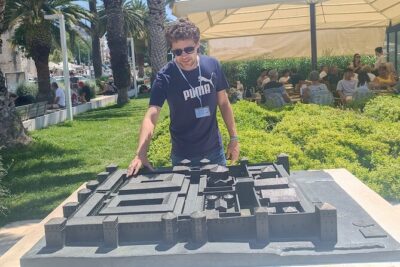
Split’s old center makes far more sense when you can see the Roman palace beneath the medieval streets. On this walk, Toni Šare uses his own 3D reconstructions to show how Diocletian’s enormous retirement residence looked before later generations built homes, churches, and palaces into it.
I like two things in particular: Toni connects Roman remains with Croatia’s medieval, Venetian, and modern eras, and the route gives you useful bearings before you explore on your own. The main consideration is that you do not enter the cathedral, museums, or other paid sites, so this is a history walk rather than an inside visit.
The tour costs $34.83 per person, lasts about 1 hour 40 minutes to 1 hour 50 minutes, and accepts up to 18 people. It has a perfect 5 rating from 1,122 reviews, with 100 percent recommending it. Book it early, since it is typically reserved about a month ahead.
Key points to know before booking
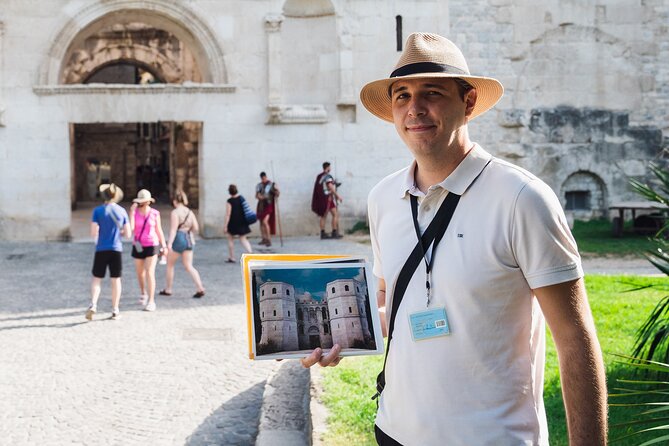
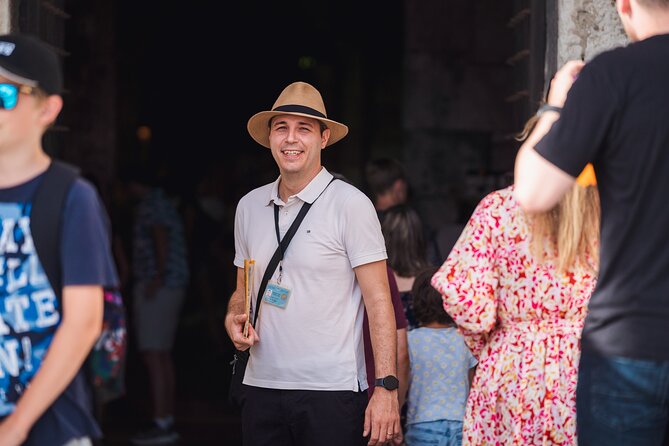
- Toni Šare leads the walk: He is the owner of DiocleSpot Tours, a local historian born and raised in Split who studied and taught history.
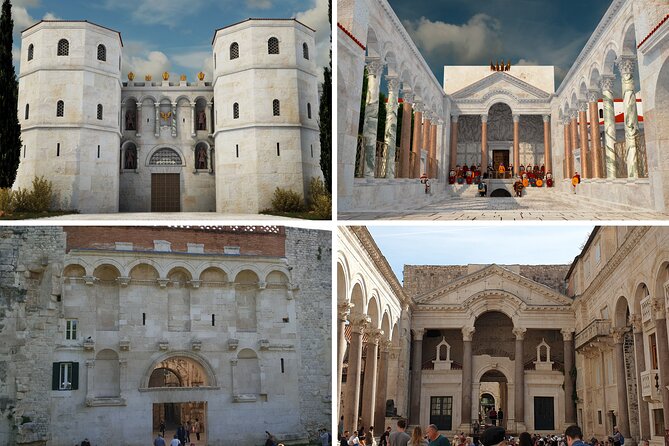
- The 3D images add real value: Toni uses his own renderings to help you picture the palace in its Roman period, not just the worn stones you see today.
- The route covers the Roman core: You visit the Riva, Peristyle, cathedral, Temple of Jupiter, Silver Gate, Vestibule, Golden Gate, and Old Town Hall.
- No paid interiors are included: The cathedral, Temple of Jupiter, museums, and other ticketed sites are explained from outside.
- It works well as a first-day walk: The end point, Pjaca, is central and easy to use as a base for later exploring.
- You can choose a group or private format: The regular group has a maximum of 18 people, and a private upgrade is available.
Why Toni’s 3D reconstructions matter in Diocletian’s Palace
Diocletian’s Palace can be confusing at first. It is not an empty Roman compound preserved behind a fence. Modern Split grew inside it, around it, and through it. Apartments, shops, cafés, churches, noble residences, and narrow lanes now occupy spaces that once belonged to an emperor.
That is why Toni’s visual material is more than a clever extra. At several points, he shows you how the palace may have appeared in its Roman glory, helping you connect a broken column or plain wall with the larger structure it once belonged to. The images also make later changes easier to follow.
I especially like this approach for first-time visitors. A standard walk through the old center can leave you admiring beautiful stonework without knowing what came first. Toni’s explanations place the Roman palace, the Christian cathedral, medieval defenses, Venetian palaces, and later city life in the same frame.
His background also shapes the walk. He grew up in Split, studied and taught history, and brings local experience to subjects such as politics, religion, language, architecture, and culture. The strongest praise for the tour centers on his ability to explain difficult subjects in a clear and entertaining way, while still making time for questions.
More History Walking Tours in Croatia
- Dubrovnik Old Town History Walking Tour
★ 5.0 · 1,684 reviews - Dubrovnik: Ancient City Walls & Wars Walking Tour
★ 5.0 · 1,270 reviews - Zagreb: City and WWII Tunnels Walking Tour
★ 4.9 · 1,230 reviews
Starting at the Riva and the southern wall
The meeting point is at the Brass Gate, also called Porta Aenea, on the Riva at Obala Hrvatskog narodnog preporoda 22. This waterfront promenade is not just a convenient place to meet. It is a useful opening chapter in Split’s story and a good spot for seeing the palace’s southern wall.
Toni spends about 15 minutes here. He uses models and graphic material to introduce what you will see inside the palace, then points out how the southern facade meets the harbor. The Riva is a natural place to begin because it helps you understand the palace from the outside before you enter its lanes.
This opening also gives you a sense of Split as a living city. The waterfront is important to local life, not merely a scenic backdrop for old stone. From here, the tour shifts inland and begins tracing how an imperial residence became the heart of a city.
Peristyle: the palace’s grand central space
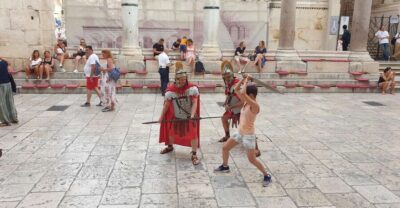
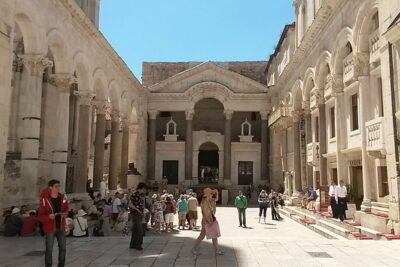
The Peristyle is the central square of Diocletian’s Palace and one of the most striking places on the route. You spend about 10 minutes here, examining some of the best-preserved Roman structures in Split.
The square is impressive even if you know little about ancient architecture. Toni’s added value is in explaining how the space functioned and how much of what you see is original. His 3D images help you picture the columns, decoration, and buildings as part of a larger ceremonial setting rather than as isolated ruins.
This is one of the places where the tour can change how you walk through Split afterward. Once you understand the square’s original purpose and later alterations, you begin noticing the difference between Roman construction and the buildings that were added much later.
The stop is free, but the area can be crowded and acoustics may be tricky. A group of up to 18 is still manageable, though you will want to stay close enough to hear Toni clearly.
Cathedral of Saint Domnius and Diocletian’s mausoleum
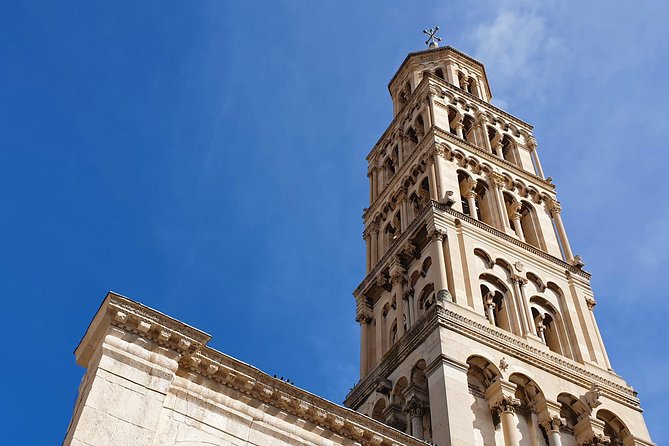
The Cathedral of Saint Domnius began as Diocletian’s mausoleum, making it one of the most unusual buildings in the old center. It remains in use as a cathedral today, and its history reflects the city’s shift from Roman imperial power to Christian life.
Toni explains the original tomb, the Christian conversion, and the bell tower from outside. You do not enter the cathedral or mausoleum, so you will not see the interior on this tour. That is an important limitation if your main goal is to inspect the building inside.
Still, the exterior explanation is useful because the building’s identity changed over time. You are not simply looking at a Roman monument or simply a church. It is both, and the tension between those roles is central to understanding Split.
The stop lasts about 10 minutes. If you want to climb the bell tower or visit the interior, you will need to arrange that separately.
Same city, a different century:
- Zagreb: City & History Walking Tour & WW2 Tunnels
★ 4.9 · 1,202 reviews - Dubrovnik Combo: Old Town & Ancient City Walls
★ 5.0 · 1,019 reviews - Split Walking Tour with Professor of History
★ 5.0 · 926 reviews - Split: History and Heritage Walking Tour
★ 4.9 · 650 reviews
The Temple of Jupiter and Roman construction mistakes
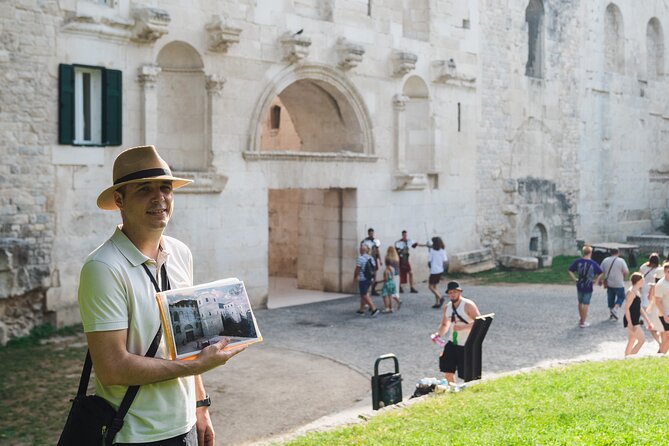
The Temple of Jupiter is another Roman highlight, and Toni spends about 15 minutes explaining it from the outside. It is described as one of the best-preserved late Roman temples in the world, but the appeal here is not only its survival.
Toni points out construction anomalies and mistakes made by the Romans. That small detail makes the stop more human. Ancient buildings are often presented as flawless achievements, yet real construction involves adjustments, errors, and practical compromises. Looking for those imperfections gives you something specific to observe.
The temple is not entered during the walk. As with the cathedral, you receive the explanation outside and would need a separate ticket if you want to go in. For many people, that is enough, especially when the goal is to understand the whole city rather than spend the tour inside one monument.
The Silver Gate and the medieval use of Roman walls
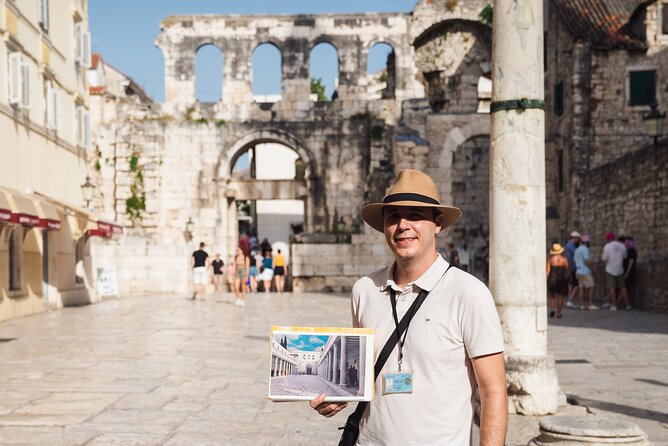
The Eastern, or Silver, Gate offers one of the best views of the palace’s surviving structure. This short five-minute stop looks across the cathedral on one side, the gate on the other, and the only preserved section of the original road beneath you.
It is a compact lesson in how old cities adapt. Split did not discard the Roman palace when the empire changed. Medieval residents reused its walls and entrances for defense and daily life. That practical reuse is one of the most interesting themes of the walk.
The Silver Gate is also a helpful place to pause and orient yourself. After moving through the interior lanes, you can see how the palace was laid out and how its main points connect.
Grgur Ninski and the meaning of the Croatian language
The statue of Grgur Ninski is a five-minute stop with a focus beyond architecture. This large and recognizable figure represents an important part of early medieval Croatian culture and the development of language.
Toni explains what the statue means and why this historical figure matters to Croatian identity. The stop broadens the tour beyond the Roman period, which is important because Split’s story did not end when Diocletian’s palace lost its original purpose.
The statue is also a useful landmark. You will likely pass it again while exploring, and after the explanation it becomes more than a large bronze figure in a busy part of town.
The Vestibule and Diocletian’s private residence
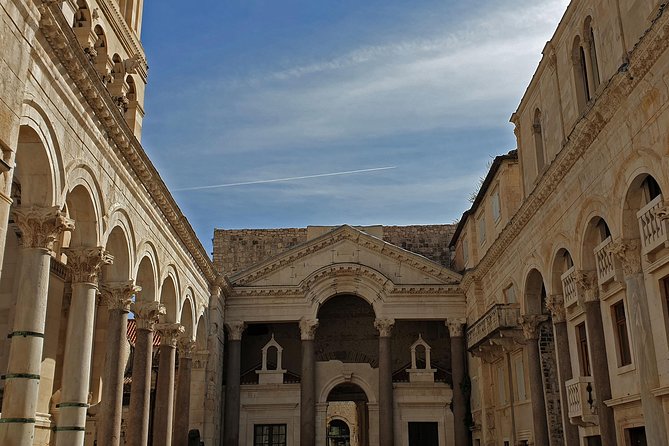
The Vestibule was the ancient entrance to Diocletian’s private residence. Toni spends about 10 minutes here before leading you around the remains of the emperor’s living area.
This section gives the palace a more personal scale. The Peristyle presents imperial ceremony, while the Vestibule and adjoining remains suggest how the private and public parts of the complex worked together. Toni’s reconstructions help bridge the gap between the open stone space you see now and the complete residence that once occupied it.
The route also passes several palaces built by noble families. These buildings show how later elites took advantage of the Roman framework rather than replacing it entirely. You get a useful sequence: imperial residence, medieval occupation, noble houses, and a modern city all sharing the same compact center.
Noble palaces, Venetian influence, and Game of Thrones locations
The walk includes several noble palaces along the way, including the courtyard of the City Museum of Split. You do not enter the museum itself, but the courtyard lets you see a Renaissance noble palace from within.
Here Toni explains Split’s Venetian period and why this style of residence appeared in the city. The courtyard stop is especially useful if you want to understand the later architectural layers, since the old center is often described only through its Roman remains.
If the group is interested, Toni also points out Game of Thrones filming locations along the route and passes the fan shop. This is an optional thread, not the central purpose of the walk. I would treat it as a pleasant extra for fans, while history and architecture remain the main focus.
The Golden Gate and the northern defenses
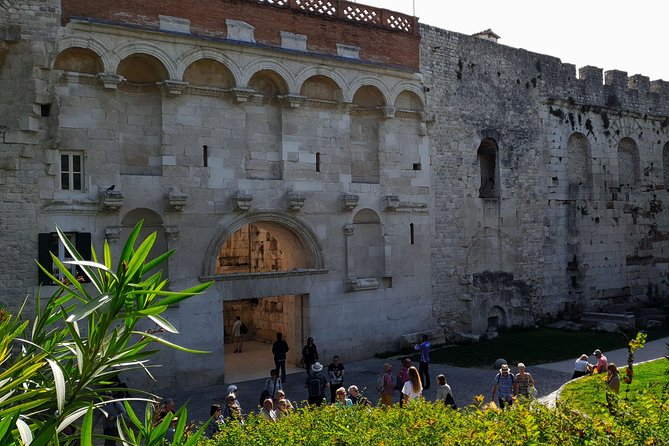
The Golden Gate is the most decorated and best-preserved of the palace’s four entrances. Toni spends about 15 minutes here, explaining its design, the northern wall, and the way medieval Split continued to use Roman structures for defense.
This is one of the strongest stops for understanding the palace as a fortified complex. From the outside, you can see how later residents kept what was useful and removed what no longer served a purpose. The result is not a perfectly preserved Roman monument, but a layered city shaped by repeated practical decisions.
The gate also gives the Roman palace a clearer sense of scale. After seeing interior courtyards and narrow lanes, the northern wall shows you how substantial the original complex was.
Ending at Pjaca and the Old Town Hall
The tour ends at Narodni trg, commonly called Pjaca or Piazza Square. Toni spends about five minutes here, pointing out the 14th-century Old Town Hall and other buildings around the square.
This is a smart ending point. Pjaca is central, easy to recognize, and close to many other parts of Split. You can continue exploring from here without needing transport or a complicated route back.
I would take this tour early in your stay if possible. The walk gives you a mental map of the palace and old town, then leaves you near places you may want to revisit. Several people also found an evening start useful during hot summer weather. Since the duration is under two hours, it can fit either a morning plan or a cooler late-day schedule.
Price, group size, and what you actually receive
At $34.83 per person, the tour is priced above a basic orientation walk but offers more than a simple list of dates and building names. You are paying for Toni’s teaching, local perspective, visual reconstructions, and the connections he makes between Roman, medieval, Renaissance, Venetian, and modern Split.
The regular group has a maximum of 18 people. That is not a private experience, but it is small enough for questions and for moving into quieter spaces when needed. A private upgrade is available if you want more control over the pace or a more personal format.
The price does not include entry to museums or paid sites. This keeps the walk focused and avoids using the limited time for ticket lines, but you should budget separately if you want to enter Saint Domnius, the Temple of Jupiter, or other attractions.
The tour is offered in English and includes a mobile ticket. Confirmation arrives when you book. Service animals are allowed, public transportation is nearby, and most people can participate. The route is outdoors and requires walking through the old center, so sensible shoes and protection from the sun are practical choices.
Free cancellation is available up to 24 hours before the start time. Changes or cancellations inside that window are not accepted for a refund, and poor weather may lead to a different date or a full refund.
Who will get the most from this walk
I would choose this tour if you like knowing why a building matters, not just taking a photo of it. It suits first-time visitors who want a clear introduction to Split, history students, architecture fans, and anyone who prefers a guide who can answer questions across several periods.
It also works well for families and mixed-interest groups because the subjects vary. Roman engineering, Christian reuse, medieval language, noble palaces, Venetian influence, and even television filming locations can all appear during the walk.
You may want a different option if your main goal is to visit interiors. This tour does not include museum admission or entry into the cathedral and temple. It is best understood as a guided interpretation of Split’s old center, not a ticketed monument tour.
The route is also less useful if you already know the palace very well and want a specialized archaeological study. For most people, though, the combination of clear storytelling, local insight, and visual material makes the price sensible.
Should you book the Walking Tour of Split with a Magister of History?
I would book it, especially for your first full day in Split. Toni Šare’s strongest asset is not simply that he knows many facts. He knows how to connect those facts, explain what changed, and show you where Roman, Christian, medieval, Venetian, and modern Split overlap.
The 3D reconstructions are the feature that sets this walk apart from a basic old-town stroll. Add the small maximum group, central start and finish, flexible morning or evening timing, and a price below many private guided tours, and you have a useful introduction to the city.
Just remember what you are buying: an outdoor history lesson with exterior explanations, not admission to the main sites. If that matches your plans, reserve ahead and use the tour to get your bearings before exploring Split on your own.
FAQ
How long does the walking tour last?
The tour lasts approximately 1 hour 40 minutes to 1 hour 50 minutes.
Where does the tour start?
It starts at the Brass Gate, also called Porta Aenea, at Obala Hrvatskog narodnog preporoda 22 in Split.
Where does the tour end?
The tour ends at Narodni trg, known as Pjaca or Piazza Square, beside the Old Town Hall.
Does the tour include entry to the cathedral or museums?
No. The tour does not include entry to museums, the cathedral, the Temple of Jupiter, or other paid sites. Toni explains the relevant buildings from outside.
How many people can join the group?
The group can include a maximum of 18 people. A private upgrade is also available.
What happens if bad weather cancels the tour?
If poor weather causes cancellation, you will be offered another date or a full refund. You can also cancel up to 24 hours before the start time for a full refund.
Just added around Croatia
- Split: Local History and Culture 90-Minute Walking Tour★ 5.0 · 194 reviews
- Split: Walking tour of Split with a ‘Magister’ of History★ 5.0 · 110 reviews
- Split: Historical & Gastro Treasures Tour with Green Market★ 4.9 · 144 reviews
- Split: Historical Tour of Salona, Klis Fortress and Trogir★ 4.1 · 108 reviews
- Split: Private Walking Tour in the Historical Town Center★ 5.0 · 25 reviews
- Šibenik: Medieval Night Walking Tour★ 5.0 · 27 reviews
- Šibenik: Croatia in a Day, Vistas, History, Olive Oil, Wine★ 5.0 · 30 reviews
- Dubrovnik: Red History Museum Regular Ticket★ 4.6 · 134 reviews
Split History Tours, compared.
SPLIT-PRIVATE Walking Tour of Diocletian’s Palace & Old Town
Read our review →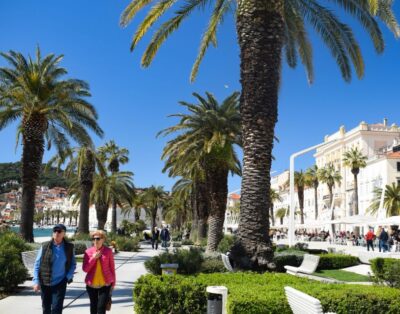
Split: Local History and Culture 90-Minute Walking Tour
Read our review →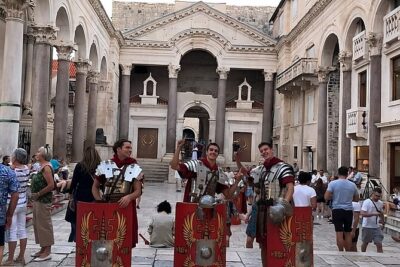
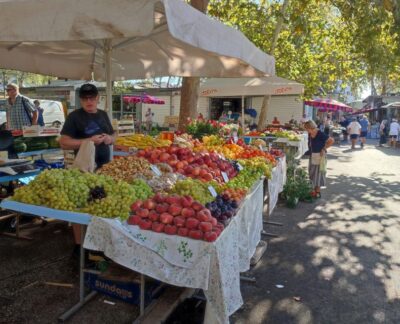
Split: Historical & Gastro Treasures Tour with Green Market
Read our review →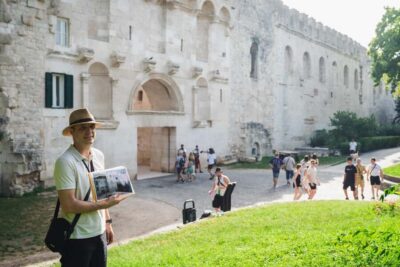
Split: Walking tour of Split with a ‘Magister’ of History
Read our review →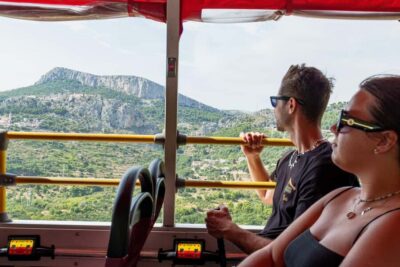
Split: Historical Tour of Salona, Klis Fortress and Trogir
Read our review →Browse the lists this tour appears in