
Review · KYOTO
Kyoto Early Bird English Tour: Fushimi-Inari and Arashiyama
Kyoto’s most photographed sights are far more pleasant before the day gets going. This early-morning tour takes you from Kyoto Station to Fushimi Inari and Arashiyama while the paths are still relatively calm, then fits in Tenryu-ji Temple and Togetsu-kyo Bridge before midday.
I like two things right away: the small group, advertised at up to eight people, and the practical help with Kyoto’s trains. Guides such as Hiro, Vincent, Caleb, Eri, and Haruka are praised for clear explanations, good humor, navigation help, and taking photos. The early start also helps with summer heat.
The trade-off is cost. At $96.83 per person, plus ¥390 for transportation, you pay for guidance and convenience rather than admission to two famous free sites. Tenryu-ji admission details should be confirmed before booking, since the supplied information lists its fee both as included and as not included.
Key points at a glance
- Start at Kyoto Station: Meet at the 7-Eleven Heart-In beside the JR Kyoto Station Central Entrance.
- Beat the busiest hours: Fushimi Inari and Arashiyama are tackled early, before crowds build.
- Four major stops: Allow roughly 4 to 5 hours for Fushimi Inari, the bamboo forest, Tenryu-ji, and Togetsu-kyo Bridge.
- Small-group format: The stated maximum is eight people, though another description says nine.
- Public transport is part of the tour: You ride trains as a group, with ¥390 listed as an extra transportation fee.
- Best for first-time visitors: You get a brisk introduction to two major Kyoto districts without having to work out the route alone.
Why the early start matters at Kyoto’s most crowded sights
The main reason to book this tour is timing. Fushimi Inari and Arashiyama Bamboo Forest are not obscure corners of Kyoto. They are major stops on nearly every first visit, and the paths can fill quickly as the morning advances.
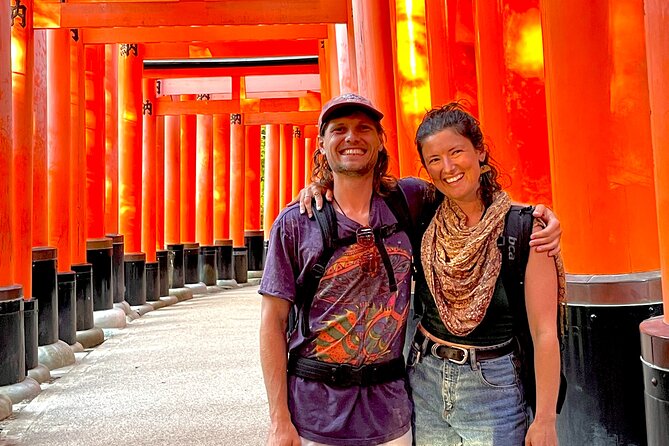
At Fushimi Inari, the early hour gives you a better chance to see the torii gates without a wall of people in every photograph. At Arashiyama, it makes the narrow bamboo path feel calmer and gives you more room to stop without blocking everyone behind you.
I also like that the tour begins at Kyoto Station instead of asking you to find a remote meeting place. The 7-Eleven Heart-In is at the JR Kyoto Station Central Entrance, on the north side of the station area. Since the tour starts early, clear instructions matter. One participant even missed the group despite receiving joining directions, so give yourself extra time to find the exact store.
This is not a slow, contemplative day out. It is a tightly planned morning that covers a lot of ground. That suits you if you have limited time in Kyoto, or if you want a useful first look before returning to your favorite spots on your own.
Other history tours people book around Japan:
- Kyoto: Fushimi Inari, Kinkakuji, Bamboo Grove 1 Day Bus Tour
★ 4.8 · 4,316 reviews - World Heritage Shirakawa-go and Experience Tours from Kanazawa
★ 5.0 · 4,049 reviews - Tokyo: Imperial Palace and Shogun Historical Walking Tour
★ 5.0 · 2,251 reviews
Fushimi Inari, where the torii gates lead uphill
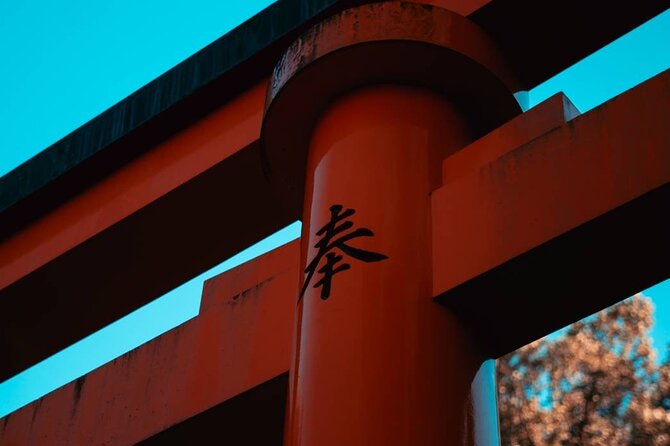
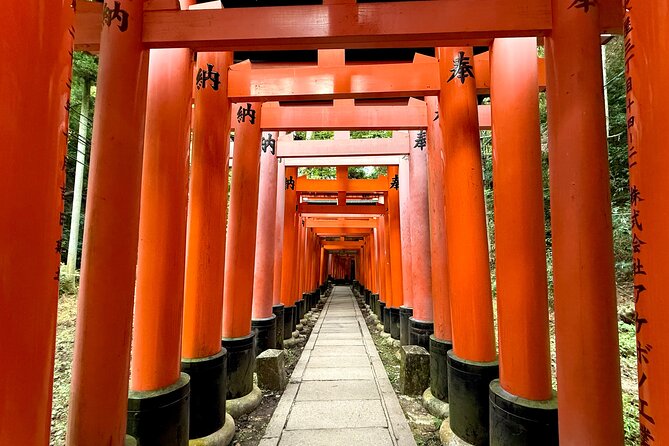
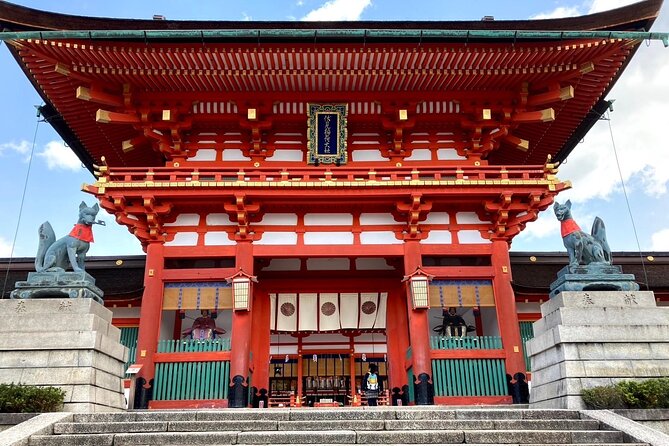
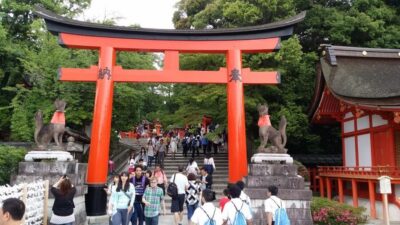
The first major stop is Fushimi Inari-taisha, Kyoto’s famous shrine dedicated to Inari, associated with rice, business, and prosperity. Its signature sight is the long run of orange-red torii gates that climbs the lower slopes of Mount Inari.
You have about 90 minutes here. That is enough to walk through the best-known gate-lined sections, hear about the shrine’s religious meaning, and take photographs. It is not enough for a full, unhurried climb around the entire mountain, so keep your expectations in check.
The lower gates are usually the most photographed. As you move upward, the crowds often thin, and the atmosphere changes from grand entrance route to wooded mountain path. Your guide can help you understand why the gates are there and point out details that are easy to miss when you are focused only on getting the perfect picture.
This is also the more physically demanding section of the morning. The path includes stairs and an uphill walk, so comfortable shoes are sensible. The tour information says most people can participate, but it does not promise a flat route or a pace suited to every mobility level.
There is one practical catch for stamp collectors. The shrine grounds can be visited early, but some counters and temple services may not yet be open. If collecting goshuin or other shrine stamps matters to you, plan to return later in the day. The early start gives you quieter paths, but it can mean missing services that open later.
Arashiyama Bamboo Forest and the value of a good photo stop
After Fushimi Inari, the tour continues by train toward Arashiyama. Public transport is not just a way to get from point A to point B here. It is part of the experience, and the guide helps keep the group moving through Kyoto’s rail system.
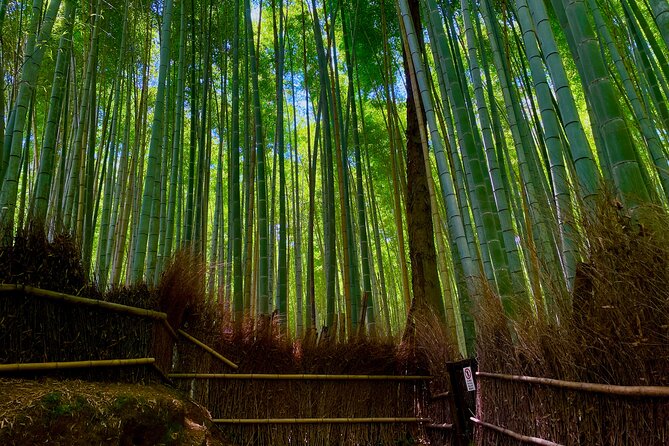
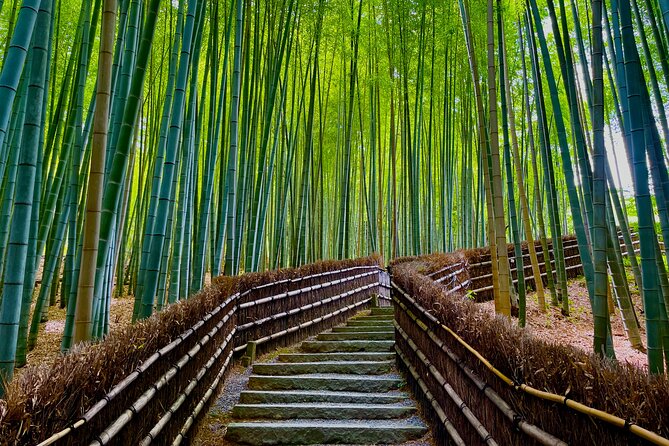
You get about an hour at Bamboo Forest Street. The tall bamboo creates a narrow corridor of filtered light, and the scale is impressive even when the path is busy. Early morning is the right choice if you want photographs with fewer people, though do not expect complete solitude at a famous Kyoto landmark.
The allotted hour is useful for a walk and pictures, but it is not a broad visit to all of Arashiyama. You are not getting a long independent wander through every lane, shop, or riverside path. The tour focuses on the classic sights.
Several guides receive special praise for finding better photo positions and taking pictures for solo visitors or couples. Haruka is specifically noted for taking photos, while Hiro and Vincent are praised for knowing where to pause away from the worst crowds. That kind of help can be worth a great deal if you are traveling alone and do not want to rely on strangers for every picture.
The morning timing also helps in hot weather. Kyoto summers can be humid, and walking through Fushimi Inari and Arashiyama later in the day can feel much harder. Starting early does not remove the heat, but it gives you a better chance of finishing the main sightseeing before the hottest part of the day.
Tenryu-ji Temple, gardens, and an admission detail to check
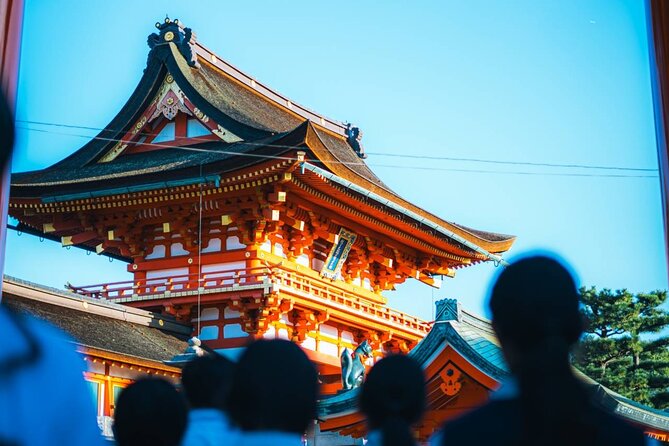
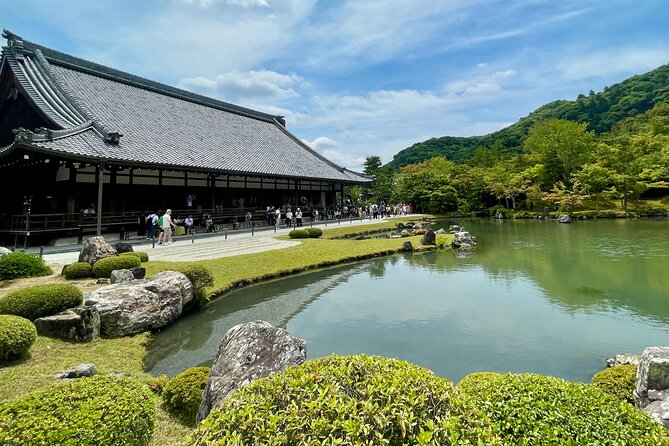
Tenryu-ji is the most formal temple stop on the route. It sits in Arashiyama and is known for its Zen garden and views toward the surrounding mountains. You have about an hour here, which gives the temple more breathing room than the shorter bridge stop.
The garden is the main reason to include Tenryu-ji. Its design works with ponds, rocks, trees, and borrowed mountain views rather than relying on a single dramatic building. A guide can give you useful context about Zen temple design and the role of the garden, then leave you time to look around at your own speed.
There is an important inconsistency in the supplied booking details. One section says the Tenryu-ji admission fee is included, while the itinerary states that admission is not included. Because the listed price is already $96.83 and ¥390 in transport is extra, confirm the temple admission policy before paying. Do not assume that every entrance cost is covered.
Another practical point is opening time. An early tour may reach a site before every interior area, stamp counter, or service is operating. The tour can still be worthwhile for the garden and grounds, but ask the operator what you will see inside at the scheduled hour if temple interiors are a priority.
Same city, a different century:
- World Heritage Kyoto & Nara Uji Authentic Matcha Experience
★ 5.0 · 1,573 reviews - Kyoto Gion: 2-Hour Geisha Culture & History Walking Tour
★ 5.0 · 1,186 reviews - Tokyo Castle & Imperial PalaceーShogun Walking Tour
★ 4.7 · 1,068 reviews - Kanazawa: World Heritage Shirakawa-go Morning Guided Tour
★ 4.9 · 988 reviews
Togetsu-kyo Bridge, a short finish by the river
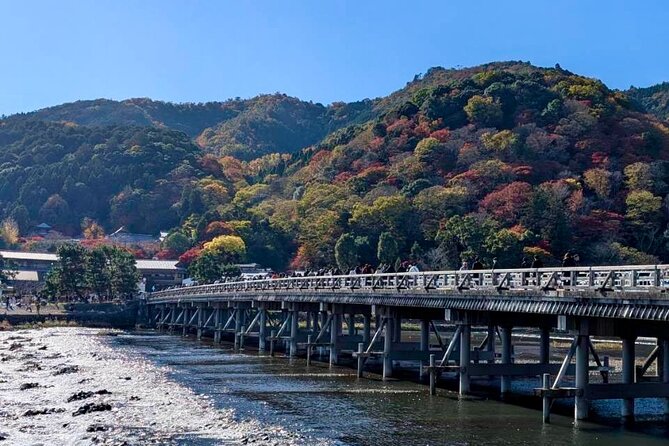
The final stop is Togetsu-kyo Bridge, meaning Moon Crossing Bridge. It spans the Katsura River and is one of Arashiyama’s defining views, with hills rising behind the water.
The stop lasts about 15 minutes. That is enough for a few photographs and a quick look at the riverfront, but not enough for a long riverside walk or a relaxed café break. Think of it as a scenic closing point rather than a full activity.
The bridge itself is historic, though the current structure dates from 1934. Its appeal comes from the combination of river, wooded hills, and the old Arashiyama setting. In autumn or spring, the surrounding scenery can be especially attractive, but the tour remains a short visit in any season.
After this stop, the activity ends back at the original meeting point near Kyoto Station. That makes the tour easy to combine with an afternoon at Nijo Castle, Gion, the Kyoto Railway Museum, or another part of the city. One guide, Vincent, has also helped people with suggestions for later sightseeing and food, but that kind of extra assistance should be viewed as a bonus rather than a promised part of the itinerary.
What the guides add to a self-guided route
You can visit all four locations without a guide. Fushimi Inari and the Bamboo Forest do not require an entrance ticket, and Kyoto’s trains are manageable once you understand the system.
The guide earns the fee by making the morning more efficient and more informative. The strongest guide names associated with this experience are Hiro, Vincent, Caleb, Eri, Haruka, Jem, and Cade. Their styles may differ, but the most useful qualities are consistent: clear directions, cultural explanations, good pacing, and help with photos.
Caleb is praised for explaining historical, cultural, and political context in clear English, while also keeping the mood light. Vincent is repeatedly singled out for friendly guidance, prompt communication, navigation help, and thoughtful photos. Hiro is noted for enthusiasm, humor, and knowing good photo points. Jem is described as engaging with a family that included a six-year-old child.
That makes this a good choice if you want more than a guidebook label beside each site. It is also useful for families, solo visitors, and anyone uneasy about handling transfers before breakfast.
The small group matters. With three or five people, the guide can answer questions and adjust the pace more easily than on a large coach tour. The published limit is eight, although another description gives nine, so confirm the exact maximum when booking.
Price, transport, and what you are really paying for
The advertised price is $96.83 per person. You also pay ¥390 per person for transportation, while food and drinks are not included. Hotel pickup and drop-off are not provided.
On paper, this is expensive for a half-day route built around two free attractions. You could visit Fushimi Inari and Arashiyama independently for less, especially if you are comfortable using trains and researching the sites in advance.
The value improves if you place a high price on time and ease. You avoid spending part of your first Kyoto morning comparing routes, finding the right platform, and deciding how long to stay at each stop. You also get an English-speaking guide, historical context, group navigation, and occasional photo help.
I would book it if you have only one day in Kyoto, if this is your first visit to Japan, or if you want a compact introduction before exploring alone. I would skip it if you already know Kyoto’s train system, prefer long visits at each site, or are watching every yen.
The transportation fee should be part of your calculation from the start. Also confirm the Tenryu-ji admission charge, because the supplied details conflict. Those two costs affect the true value more than the headline price suggests.
The pace, the physical effort, and the best time to go
The tour lasts about four to five hours. In that window, you visit two districts and four major sights, with train travel between them. That is efficient, but it leaves little room for lingering.
Fushimi Inari includes an uphill route and stairs. Arashiyama involves walking between the bamboo forest, Tenryu-ji, and the bridge. Wear shoes you can walk in for several hours, and dress for the weather.
Rain does not necessarily ruin the morning. Wet paths can bring lighter crowds, but you should bring suitable rainwear. The same applies to summer heat. Starting early helps, yet Kyoto can still feel hot and humid.
Families can fit well into this format if children manage an early start and walking. The experience has worked for a family with a six-year-old and for a group with a baby, but the exact guide and pace vary. If you need frequent breaks, ask before booking.
Free cancellation is available if you cancel at least 24 hours before the local start time. Changes or cancellations inside that window are not accepted for a refund.
Should you book the Fushimi Inari and Arashiyama morning tour?
I recommend this tour for first-time Kyoto visitors who want the classic sights handled in one organized morning. The early departure, small group, train guidance, and strong guide lineup make the route easier than doing it alone, especially when your Kyoto schedule is short.
I would not book it solely for low cost. The free shrine and bamboo forest visits mean the $96.83 fee is mainly paying for timing, explanation, navigation, and personal attention. Add the ¥390 transport charge and verify Tenryu-ji admission before deciding.
Book it if avoiding crowds matters, if you want help with photographs, or if you like a guide who can explain what you are seeing without burying you in lectures. Skip it if you want to hike all of Mount Inari, spend half a day in Arashiyama, collect shrine stamps during opening hours, or explore at your own pace.
FAQ
Where does the tour begin?
The meeting point is the 7-Eleven Heart-In at the JR Kyoto Station Central Entrance, at Higashishiokojicho, Shimogyo Ward, Kyoto.
Where does the tour end?
The activity ends back at the original meeting point near Kyoto Station.
How long does the tour last?
The tour lasts approximately four to five hours.
What attractions are included?
The route includes Fushimi Inari-taisha Shrine, Arashiyama Bamboo Forest, Tenryu-ji Temple, and Togetsu-kyo Bridge.
Is transportation included?
No. Transportation is listed as an additional ¥390 per person. The group travels by public transportation.
Is Tenryu-ji admission included?
The supplied details conflict. One section lists the admission fee as included, while another says it is not included. Confirm this point with Tomodachi Tours before booking.
How many people are in the group?
The additional information gives a maximum of eight people. Another description says the maximum is nine, so confirm the exact limit when reserving.
Is the tour conducted in English?
Yes. An English-speaking guide leads the experience.
Can I cancel for a full refund?
Yes, if you cancel at least 24 hours before the experience start time. Cancellations or changes made less than 24 hours in advance are not refunded or accepted.
Just added around Japan
- Private sake pairing@ancient underground★ 5.0 · 27 reviews
- Tokyo: Asakusa & Sensoji ー Oldest Temple Walking Tour (2hrs)★ 5.0 · 213 reviews
- [30 minutes] Rickshaw tour around Asakusa [History, sightseeing, Tokyo Skytree]★ 5.0 · 38 reviews
- Tokyo: Edo Castle & East Garden of the Imperial Palace Tour★ 4.7 · 112 reviews
- Tokyo: Imperial Palace, the history of Japan (ENGLISH GUIDE)★ 5.0 · 77 reviews
- Tokyo: Customized Private Historical Guided Photoshoot Tour★ 5.0 · 25 reviews
- Osaka: Dark Side of Osaka Night Walking Tour★ 4.9 · 89 reviews
- Osaka: Osaka Castle & Historical Museum Guided Tour★ 4.8 · 28 reviews
Kyoto History Tours, compared.
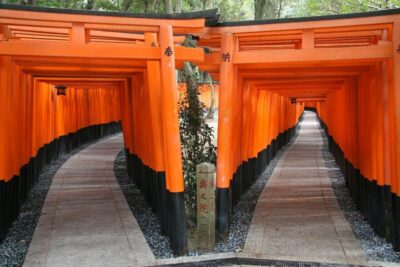
Kyoto: Fushimi Inari, Kinkakuji, Bamboo Grove 1 Day Bus Tour
Read our review →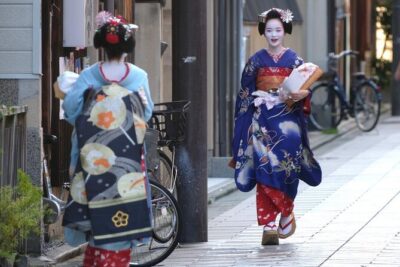
Kyoto Gion: 2-Hour Geisha Culture & History Walking Tour
Read our review →
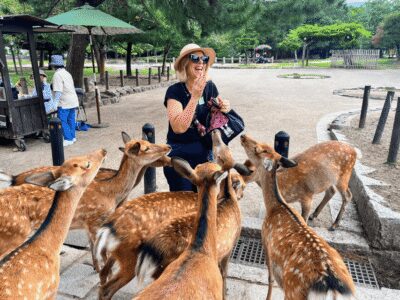
Kyoto: Nara & Traditional Matcha Experience Bus Tour
Read our review →
Browse the lists this tour appears in